




There’s about 67,000 feet (over 20,000m) of ascent
Which you cover over the course of two and a half days– if you can keep going that long, of course. And for better or worse, the course isn’t an A-to-B – it’s a loop that you do 5 times. Thus, the ‘Barkley Marathons’.

Gary at the yellow gate that marks the start and the finish of the Barkley Marathons course.
The race is one hundred and thirty something miles
No one knows for sure – the route evolves every year at the whim of the race organizer. If there are no finishers the course stays the same, if there is a finisher the course is made more difficult by adding another checkpoint that involves an additional climb and descent. Most think the loop, done 5 times, is a bit longer than an actual marathon , and there’s no question the terrain is absolutely brutal. Only 14 people have finished the race in nearly thirty years And what’s worse – every time there’s a finisher, they make the course harder but not necessarily and longer.
Oh, there’s no trail markers
A huge part of the challenge is to navigate the race course. To prove you’ve completed the whole course, you tear a page out of books you find hidden at various points along the race route. After every lap, the organizer will count your pages.
You have no idea when the race will start
Anytime between midnight Friday and noon on Saturday! So it’s tough to plan your rest before the race.

The race takes two and a half days.
How do you train? You go up
I live in Vancouver, BC, and we’ve got three peaks right in town, each of them claiming about 3,000 feet of prominence. I do a couple laps at a time for 20k vert training session about once every seven days – that takes about twelve hours. The other days of the week I go out for a few thousand a day. In the final three weeks of training I'll likely do a 15,000ft workout, and maybe 2x 20,000ft. The 20k workout can take up to 12hrs. Other than that I do at least one near daily lap and attempt to get my overall weekly vertical up to at least 30k ft.
What’s in the pack for a 20k climb?
The way the race is set up, racers can return to a campground (where their cars are parked) at the start line at the finish of every loop. So that’s how I do my training – I can access my vehicle twice during a long training session a day. I’ll bring a water for three hours, food for 12 hours, and gear like a waterproof breathable kit, shirt, gloves, micro spikes for snow.
I need 250 calories an hour
Running is a calorie deficient sport and you can only digest so many calories while moving. 250 per hour is the formula for success. With that, you should be able to move forward, so that’s what I’ll do during the race. After each lap (about 8 - 10 hours, I’ll quickly down about 500 calories go for a full meal, then reset, then get going again. Liquid intake is totally dependent on weather – if it’s hot, more water. Cold, less.
You need two pairs of shoes
I do most hundred-milers in one pair of shoes, but the brush and briars on the Barkley is so brutal that it just can tear shoes apart.
 Navigation skills are crucial to success in The Barkley.
And you absolutely need a compass
Having a map, compass, and the skills to use them is an absolute necessity. It also helps if you have a course veteran to glean knowledge from. Getting lost can mean the difference between finishing and not finishing. You have 60 hours, and clock doesn’t stop if you get lost.
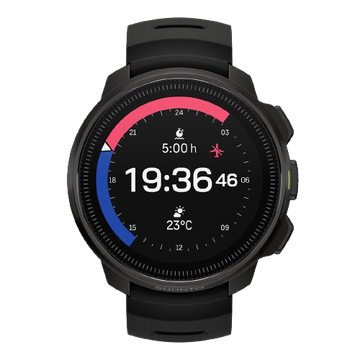
I love the weekly vertical totals on my Suunto
My goal is to get as much vertical as possible. It’s the only way to prepare for this event. The watch shows you your daily and weekly vertical totals. My workout ENDS when I get as much vertical as I need – so my watch makes it easy. The weekly graph that is a great reference point I can’t get away from. It’s a daily reminder that if I don’t get out of my door, I’m not getting my vertical in, and I’m not training hard enough!
Stay tuned during Suunto Vertical Week 2017, as Gary plans to put up over 60k vertical in just a two week stretch – and make sure to check out the Barkley Marathons documentary, now showing on Netflix.
All images: © Matt Trappe / Trappephoto.com


