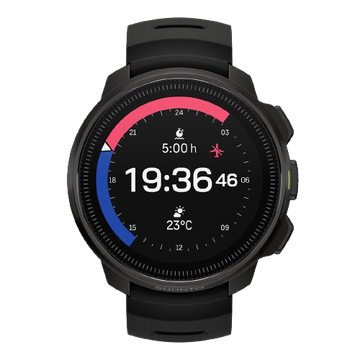


Mountain guide Fabien Meyer offers some tips on how you can use the altimeter function to better understand the weather and how to use the compass to navigate.
Don't become fixated by knowing your exact altitude and re-calibrating every ten minutes. “Don't be obsessed about it,” says Meyer. “It's more important to understand what's going on with the pressure.”
“If you get an altimetric increase of altitude while you're at the same height, the atmospheric pressure is going down,” he says.
“A big advantage is the new Fused Alti technology: it calibrates your altimeter with GPS, so you can follow the evolution of the pressure even as you move vertically, so long as the sky is clear,” he adds.
Click here to find out how the Track back feature can help you navigate safely
Understand how pressure works: “When you're at sea level a difference of 1hPa is equal to approximately 7m. At the summit of Everest it's about 10m. For example, say you calibrate at 2,000m and climb to a 4,000m peak but your Ambit says 4,200 m, you know there's been a drop of approx 20hPa. That's a big drop and you should turn around. Especially if you notice humidity in the air.”
Use the compass
“It's very important to have a compass especially when you still do not need it ;-).” says Meyer. “The Ambit compass is very accurate and you won't leave it at home because it is on your wrist. It's very quick to orientate yourself and gain the right direction.
Check often
“There are lots of different configurations, in all of them, I try to minimize my dependence on electronic gear. For me the safest when it is serious (no visibility and dangerous terrain) is to check my position every 1 to 30 minutes (depending how dangerous the terrain is) and to fix a bearing that I follow during each stage.
“Even if your watch bearing is accurate and safe you don't need 100% accuracy with bearings. In bad weather, if you're glued to a screen you may end up in a crevasse! It's better to check your position often and do lots of little bearings rather than follow a straight line – you're not a sailor.”
Use the bearing lock
Using this, you can take a bearing to the next waypoint and off you follow. The track back is also a very useful feature and when it is turning bad it gives you a solution in any circumstances, serious or not, but don’t forget it doesn't work on steep terrain.
Want to go ice-climbing with Fabien Meyer? He will be one of several guides at the Cogne Ice Opening in December. Click here for more details.