




SUUNTOブログ

Meet the young-gun tri-athlete from the highest big city in the world
I started with triathlon at age 10
Now I'm 21. Here in Mexico we have a lot of races for young kids - that’s really good! However, not many are very competitive – but I was serious on it from the start! For me, there’s nothing funny going on in the races. The very first race, I was in it to win it. But we have a very big community – and the past five years, it has been growing in the whole country.
I love the bike
It’s my favorite discipline to train. But my best competitively is the run.
I have two big races this year
The 70.3 Worlds in September, and of course, XTERRA Worlds in October. There’s a few people mixing it up between normal tri and XTERRA, but as far as I know, no one really has dedicated themselves to doing both like I have. I would say I have had more success XTERRA racing, because in long distance triathlon I need more time for muscle maturity. It's all a process. I believe with really hard work I can succeed in both as I have done in XTERRA – and that means to be the world champion.
I’m a go-by-feel kind of guy
But I definitely use all the technology – I pay tons of attention to heart rate and wattage on the bike. I use the Spartan and I loved my Ambit – I have always loved the Suunto brand, and the way the brand keeps you motivated to do different things and explore, and I’m really happy about that. It’s a good tool to go out and find some adventures.
I do a 30-hour week of training
I’ll go the mountains in Mexico City – about five sessions of swimming. The bike is pretty difficult – so I do a lot of indoor and mountain bike, about 15 hours, and about nine or ten hours of running, approximately five hours of swimming, and then of course some functional gym stuff.
Living in Mexico City is a plus and minus
It’s at 2000m, so I think sometimes that the altitude gives me a training advantage. But I have to do some mixed training, because that way I can do much more volume. Often I’ll go to sea level at San Diego or to Cozumel for more training.
I always talk with my dad before the race
We talk about the strategy and make the plan. I’m nervous, but it’s a good feeling. I’m mostly a relaxed guy – except on the race course.
And so is my age
At the moment my age is an advantage sometimes – I’m one of the youngest pros, always – and I’ve got a lot of energy. But that also means a lack of muscular maturity. When you’re totally mature with your muscles, you’ll be stronger - simple as that. I still have another six or seven years until muscular maturity, so i’m hoping to be performing at my best then. I think the bike takes the longest to get better at. But everything is going well.
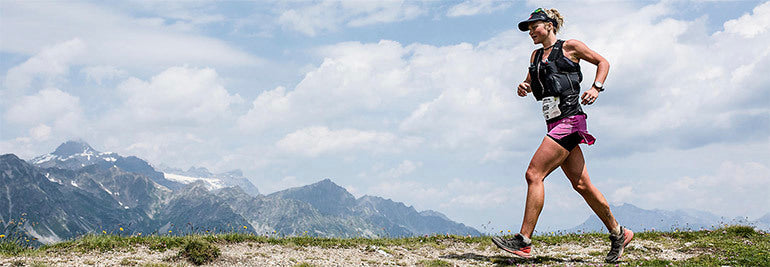

Meet the 21-year-old woman on a six-year running high
I ran my first 100km when I was 16 just one year after I started running
Yep, I went from 0 to 100 in one year at age 16. It’s my dad’s fault. His name is Ashley. It was his second 100k. He’d been running marathons, and once realized he wouldn’t get faster, he decided to go longer. The race was the Surf Coast century.
I’ve run six 100ks since.
And more 50ks than I can even remember. I do them in training – I'll just head out for an afternoon 50. I did three weekends in a row of just 50k runs.
I didn’t love running at the start.
I thought it was hard! Then there I was running a 50k, back to back to back every weekend. It’s amazing what you can do.
But now I’ve been running for six years non-stop.
I started running, and I just did so many easy kilometers with my dad. I built this base very naturally, not forced. Now that I have the base I can do the harder training sessions. I have six years of non-stop running. That’s a big base no matter how old you are.
What I love most is the places I go and the people I meet.
If you didn’t have the people in this sport that were so raw and so organic, it would be a completely different sport. The places you go is really exciting but the people you meet keep you competing.
I want to do the Hard Rock 100
Just because it’s so hard to get into. Transvulcania. And some of that are totally off the grid – ones I don’t even know about, in really cool locations.
I always have a plan, and I never follow it.
I’m pretty reactive and pretty in tune with my body. I’m totally OK with missing a training session or going day by day. I always have a plan but I very rarely follow it. My racing style is not aggressive – I would say I’m someone who eases into it. I start slow and finish strong.
My toughest race? World Sky Running Champs 2016
It was a marathon in Catalonia. I had never seen terrain quite like it. A lot of scree and skiing down scree slopes. I really struggled with it. But I finished the race.
I’m so glad I’m 21...
So I was able to run my last big event: The Marathon du Mont Blanc, 80km of trail in Chamonix. It was the first time I could run the race – because I’m finally 21 years old. But the big goal of the year is the TDS as part of the UTMB weekend.
…but I was a little terrified to start my last race!
I’m a big fish in a small pond in Australia. Now it feels like I’m stepping up to the big leagues. It’s very leveling and I’m a small fish in a big pond – the talent and level is amazing. And more importantly, we just don’t have terrain like this in Australia. I was a bit terrified for my last race! I didn’t have enough time to run every section – only the first climb and last climb, and a few sections in between.
It was 80km.. then 85km… then 92km
The race is called the Marathon du Mont Blanc 80km. They told us the actual course was 85km. Then they modified it to get us more water – but that came with an extra 500m climb and seven more kilometers.
I had a great start, a tough middle section, and strong finish
I felt pretty tired coming into Chamonix, and almost didn’t start the race. The first three hours were great, the next four were terrible, then I hit the halfway point and started counting down the K’s and picking off ladies as I moved up field. I finished in 13h23m, twenty minutes behind 1st place, in a tight battle for 2nd place – I was only a minute ahead of 3rd!
It’s an honor to be a young gun
I know a lot of people are watching me and saying 'maybe it’s safe to start that early.' It’s really exciting to inspire other young runners.
Images by Damien Rosso / Droz Photo
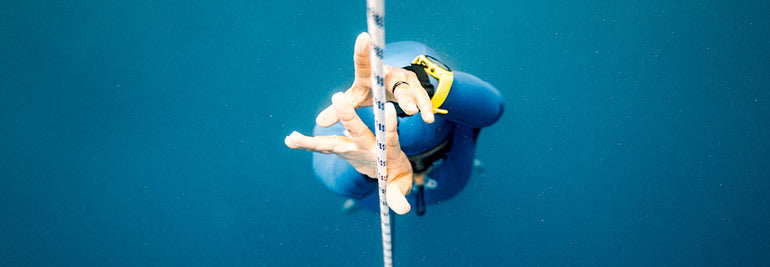

Want to take a great photo? Hold your breath
Diving was something I’d always done.
As a kid, while swimming, I spent more time beneath the surface than above it. But my free dive obsession really started with a SCUBA diving trip in Egypt. During that trip I actually was snorkeling with a friend, and trying to get our depth gauge as deep as we could. Which is a stupid thing to do, by the way. But I was having so much fun, I took a course in freediving… and haven’t been dry since.
My best was good enough for a Dutch National Record.
With fins to 60m, without to 55m, and free immersion to 65m. But I was a very average free diver during the time I was competing. At the time, 2011, the 55m was top 20. It’s nowhere near that anymore.
I’ve had seals kiss my camera
Last year, here in Cornwall, we were swimming with seals. Really shy in the beginning, but after a while, one was interested in my fins. Then he got close enough to my camera dome that his whiskers touched it. That was an interaction where you feel someone looking back at you.
I get in the water with a different mindset than the diver.
We both dive, but they have to go within themselves – all I do is look outside of myself. I look at them, the environment, the light. The same actions with completely opposite goals.
Safety dives helped me train.
At every comp, I did safety dives. There is a diver at depth and 30m. And because I did a lot of that, I knew I had a lot of stamina to do repeated dives. The deep guys go to 100m but do it once. The safety guys – and me – go to 30m, but we do it all day long.
I’m definitely, absolutely doing more work than the guys diving
I’m just not going as deep. I have to swim to 15m, see the diver, swim around him, get in front, crane your neck – and it’s a bad position. They’re going for maximum depth efficiency, I’m going for bursts of speed to get my shot. Totally inefficient as far as diving goes. I don’t become a better free diver by being a free dive photographer.
I love Will Trubridge
I met him first in 2007, but it took me till 2012 to work with him. Now we’re actually friends. He can be a bit shy. It took until I found out he had a wicked sense of humor for us to become friends. It’s nice to work with him – he’s a good delegator who tells you what he wants or expects, and he’s really clear about what he can do.
At Vertical Blue, I do fifty dives a day
Mostly hanging out between 10 – 20m. That’s my office, ten to twenty meters deep. That’s a depth where the light is still good, the background is good, and it’s easily achievable –I can do it on repeat all day long.
My dream dive is The Arch in the Blue Hole in Dahab
It’s an opening in a natural reef. The arch is at 58m, and then there’s a 30m overhang, then you have to go back up. To do the arch, with a camera, that would be spectacular.
All images © Daan Verhoeven / Vertical Blue
Read also 7 tips to help you make amazing diving videos and 10 tips to help you take amazing underwater photos
Learn more about Vertical Blue
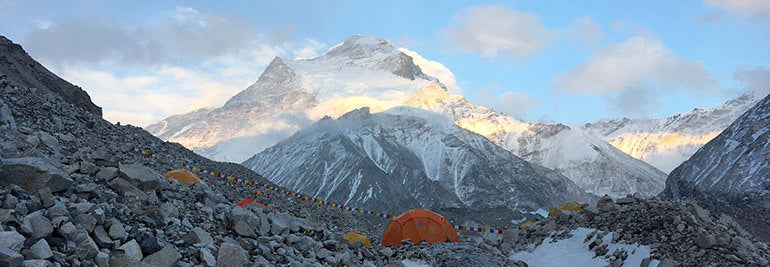

It’s not easy being Emelie! Get in the mind of one half of a mountain-sport power couple
I’ve been to the Himalayas before, but not like this
I’ve been running in the Himalayas plenty, but I’ve never done anything quite this: an attempt on Cho Oyu, an 8000m peak and the sixth tallest mountains in the world.
We did all the acclimatization at home
I was there for less than two weeks – most people take two months to acclimatize. This is very much new-school, fast-and-light alpinism. We did all the acclimatization at home hooked up to a machine that simulated being up at 7500m.
People hear we did an expedition, and they think ‘sherpas’
But that’s not how we did it. That’s not how I want to go the mountains, and not how Kilian wants to go to the mountains.
There was no pressure
This was a trip I did for myself, out of my own pocket – so there was very little pressure to ‘do it for the sponsors’. I wanted to explore for myself and see what was possible for myself.
At sea level Kilian is much faster
But at altitude we start to even out a little bit more – although he will always be stronger and more technical. We were surprised at how fast we were moving at altitude – about 250m an hour at 7500m. That’s pretty fast.
I reach 7500m and 7800m on two different days
The first time was a planned acclimatization. The second attempt was a summit bid – it was our last day, and there was a small weather window. But it got late, bad weather started rolling in, and I simply decided to turn around. Kilian and I discussed that he would go on. I had to wait a few hours for him to come down – during that time I regretted a bit the decision to split up.
Ueli’s death gave us a big scare
We were in Cho Oyu we got the news about Ueli Steck. I didn’t know him personally well, but he was friends with Kilian. He was extreme but he was a hero. His life was an affirmation of everything that is possible. When he died it was hard.
Kilian never considered not following through
There is a big difference between Ueli’s very technical route and Kilian’s Everest Route. I knew Kilian was in a really good shape and responding well to the altitude. I knew he would be fine on Everest in the right conditions. When he was taking longer than expected I began to worry a bit, as Kilian is usually extremely good at predicting his times – but I was getting updates from Seb Montaz.
I don’t want to do Everest
I want to go to some high altitude mountains. I really liked it. Mountains are the foundation, racing is just the topping. I love running and skiing, and I’m fascinated with alpinism, but I’m more concerned about the exposure. I don’t like that. I’m a big fan of life. I don’t see myself moving in the kind of terrain that Ueli did, in the way that he did. Even if I attained the technical skills, I don’t think I want to be here.
I would like to go back to Mt Blanc
Ii have been running up and down many times, but I want to put a record on that one – there’s not so many women doing it. I would like to go back to Cho Oyu to ski, as the winter route looks amazing. Some other bigger peaks as well. But Cho Oyu on skis might be my next dream trip.
I am happy Kilian is done
I want to keep his passport so that he can’t go anywhere for some time!


The Grouse Grind(グラウスグラインド)とは?バンクーバー名物の急登トレイルに挑むSuuntoアンバサダー
カナダ・バンクーバーを訪れたら、一度は歩いてみたいと名前が挙がる「The Grouse Grind(グラウス・グラインド)」。距離はわずか2.5kmですが、標高差800m、2,830段もの階段を一気に登る急登トレイルです。
なぜこの短いコースが「Mother Nature’s Stairmaster(自然のステアマスター)」と呼ばれるのでしょうか。本記事では、グラウス・グラインドの特徴と現在挑戦する際の注意点を解説。さらに、2017年にSuuntoアンバサダーのサイモン・ドナートが挑んだ、1日に何度も登る「Multi-Grouse Grind Challenge」から、急登を長く続けるためのペース配分、補給、メンタル管理を紹介します。
目次
The Grouse Grindとは?
短距離でも過酷な理由
挑戦前に知っておきたいこと
2017年のMulti-Grouse Grind Challenge
Suuntoアンバサダーが考えた急登戦略
急登トレーニングに活かせる4つのヒント
まとめ
The Grouse Grindとは?
The Grouse Grindは、カナダ・ブリティッシュコロンビア州ノースバンクーバーのグラウス・マウンテンを登る、上り専用のハイキングトレイルです。バンクーバー中心部から車で約15分というアクセスのよさと、短い距離に凝縮された急登から、地元ではトレーニングコースとして親しまれています。
項目
現在の公式案内
距離
2.5km
標高差
800m(標高290mから1,090mへ)
階段
2,830段
平均所要時間
約2〜2.5時間
下山
トレイルの徒歩下山は禁止。ゴンドラまたはスカイライドを利用
公式サイトによると、現在のルートが形づくられたのは1980年代。登山家たちが、長い山行に向けたトレーニングのため、より急なルートを求めたことが始まりでした。現在では年間10万人以上が挑戦する、バンクーバーを象徴するアウトドアスポットのひとつです。
短距離でも過酷な理由
2.5kmと聞けば、平地では短い散歩のように感じるかもしれません。しかしグラウス・グラインドでは、約30度とされる急斜面を、岩、木の根、自然の段差、木製階段が続く不整地で登ります。水平距離よりも「どれだけ登るか」が負荷を決めるコースです。
コースは4つの区間に分けて表示されています。公式FAQによると、最初の4分の1は距離が長く感じられる一方で傾斜は比較的緩く、第2・第3区間が特に急です。序盤に勢いで進みすぎると、核心部を迎える前に余力を失いかねません。
また、樹林に囲まれた狭いトレイルのため、途中の眺望や広い休憩場所は限られます。「短いから簡単」と考えず、標高差、路面、混雑、当日の気象を含めて判断する必要があります。
挑戦前に知っておきたいこと
グラウス・グラインドは常時開放ではありません。雪や氷、急斜面の状態により閉鎖されることがあり、開放時間も日照時間などに応じて変わります。出発前に、Grouse MountainとMetro Vancouverの公式サイトで開閉状況、天候、下山便を必ず確認してください。
徒歩で下らない:急で狭いトレイルのため、下り方向の通行は禁止されています。山頂からは有料のゴンドラまたはスカイライドを利用します。
水と補給食を携行する:公式FAQでは少なくとも1Lの水またはスポーツドリンクと、必要に応じた軽食を勧めています。ゴミ箱は途中にありません。
適切な靴と重ね着を用意する:トレイルシューズや軽登山靴を選び、山頂で身体が冷えたときに着られる防寒着や雨具を携行します。
自分の体力を見極める:日頃から有酸素運動やスクワット、ランジなどで準備し、不安があれば先に易しいコースを試しましょう。
狭い道では右側を歩く:追い越す人のために右側を空け、休む際も安全な場所へ寄ります。
注意:本記事の数値と利用ルールは公開時点の公式案内に基づきます。開放期間、時間、下山方法、料金は変更されることがあります。現地の最新情報と係員の指示を優先してください。
2017年のMulti-Grouse Grind Challenge
2017年6月、グラウス・グラインドでは、夜明けから日没までの1日で登頂回数を競う「Suunto Multi-Grouse Grind Challenge」が行われました。参加者は山頂に着くたびにスカイライドで下山し、再び2,830段の急登へ向かいます。
19時間にわたるイベントで、45人の参加者は合計434回を登りました。最多はイアン・ロバートソンの17回。単純計算で獲得標高は約13,600mに達します。女性最多のアンドレア・ジョブも14回を記録しました。
Suuntoアンバサダーのサイモン・ドナートは大会前、14回を達成できれば満足、15回なら最高だと話していました。結果は9回。目標には届かなかったものの、それでも現在の公式標高差で換算すれば約7,200mを1日で登ったことになります。
Suuntoアンバサダーが考えた急登戦略
ドナートが大会前に重視していたのは、最初から速く登ることではありません。長いチャレンジでは、脚力だけでなく判断と計画が結果を左右すると考えていました。
序盤を抑え、ラップをそろえる
目標は、1周目から最後まで、できるだけ同じテンポで登ること。序盤には遅すぎると感じるペースでも、長時間にわたって反復するなら、その余裕が後半を支えます。強く追い込んで山頂に着いても、下山便を待つだけなら、その加速は全体の時間短縮につながりません。
移動時間を補給と装備交換に使う
大会では、下山中のスカイライドが限られた休息時間でした。ドナートはその間に食事と装備交換を済ませ、次の登りに備える計画を立てていました。登る時間だけでなく、休む、食べる、移動する時間まで含めて設計する発想です。
食べられなくなる前に補給する
疲労が進むと食欲が落ち、食べないことでさらに疲れる。この悪循環は、ドナート自身が過去に経験した課題でした。大会では身体が受け入れられる範囲で、実際の食事を中心にカロリーを補う方針を立てていました。補給の種類や量には個人差があるため、長時間の挑戦で初めて試すのではなく、普段の練習で確認することが大切です。
回数より、いま守るべき計画に集中する
苦しいときにドナートが意識したのは、絶対的な登頂回数ではなく、決めたペースと補給計画を守れているかということでした。好調な時間を楽しみ、低調な時間も永遠には続かないと理解する。その考え方が、長い挑戦を小さな判断の積み重ねへ変えていきます。
急登トレーニングに活かせる4つのヒント
Multi-Grouse Grind Challengeは極端な事例ですが、その戦略は、普段の登山やトレイルランニングの登りにも応用できます。
距離だけでなく累積標高を見る:同じ距離でも、獲得標高によって負荷は大きく変わります。練習記録では距離、時間、心拍数とあわせて累積標高を確認しましょう。
序盤の心拍を上げすぎない:急登では平地のペースを維持しようとせず、呼吸や心拍数、主観的なきつさを基準に速度を調整します。
区間ごとの変化を比較する:同じ坂を反復する場合は、ラップタイム、心拍数、垂直速度の推移から、どこでペースが崩れたかを振り返ります。
補給と休憩も練習する:何を、いつ、どれくらい摂るかは、行動時間や体格、気象条件で変わります。本番前に試し、自分に合う方法をつくりましょう。
登りのデータを実践に活かしたい方は、勾配・垂直速度・獲得標高を使った登りの攻略法も参考にしてください。
まとめ
The Grouse Grindは、全長2.5kmで標高差800mを登る、バンクーバー名物の急登トレイルです。短い距離の中に2,830段が続き、徒歩での下山は禁止。挑戦するなら、最新の開閉状況と天候を確認し、水、補給食、適切な靴、防寒着を準備しましょう。
2017年のMulti-Grouse Grind Challengeでドナートが重視したのは、派手なスタートではなく、一定ペース、計画的な補給、休息時間の活用でした。急登では、距離だけでなく累積標高、心拍数、ラップごとの変化を記録すると、自分に合う登り方を見つけやすくなります。
当時ドナートが使用していたSuunto Spartanは旧モデルです。現在は、Suunto Vertical 2をはじめとするスポーツウォッチで、登りの記録、心拍数、累積標高、ルートを確認できます。ただし、ウォッチは体調判断や現地の安全情報の代わりにはなりません。公式情報、地図、天候を確認したうえで活用してください。
登りを記録できるSuuntoウォッチをチェック
累積標高、心拍数、トレーニング負荷、ルート機能を比較し、自分のフィールドに合うモデルを見つけましょう。
Suuntoスポーツウォッチを見る
画像:Simon Donato © Luis Moreira / Adventure Science、Grouse Mountain images © Grouse Mountain


