




SUUNTOブログ


How a UTMB winner lives, trains and runs
Francois D’Haene is simply put, one of the best distance runners around. He’s competed in almost every major ultra on the planet, and took home first place in plenty of them – including three wins and a course record on the UTMB, a FKT on the GR20, and lately, a FKT on the ultra-gnarly John Muir Trail in the western United States. His latest run was an incredible achievement – and the story is very well told in the mini-doc below. Have a look – then read on to get Francois D’Haene’s tips for really, really long runs.
Do it for the adventure
For me ultra trail is an adventure and an experience. I want to discover myself, some new mountains, a new place and a new landscape. The competition between the runners is important for me and I play a lot with that during the race but it 's not my priority when choosing a race. When I choose an ultra trail I choose it because of the challenge that it is for me. It must be something really challenging to excite me and motivate me during many months and many training days.
For me this is the main difference between ultra trail and a classic trail race around 50-60k. On the ultra trail if you focus on the competition, and not on yourself and the adventure, it will be difficult to finish the race. On a 60k race I think that the motivation can be more based on the competitive aspect and less on the challenge of the race.
Listen to your body
Try to learn how your body works. Learn what it’s telling you. What are the signs that you are tired, hungry? Know them.
Keep your feet healthy and happy
I have my preferred shoes and I'm really confident in them – I feel really comfortable and protected inside. Then I have some socks. I always use them many times before the race day so I know exactly how they work. And of course, anti-chafing crème!
Eat the same thing, all the time
In training I try to use exactly the same food as in the race. You have to experience it and to prepare your body to use it. For me, that’s Nutrisens energy drink – about 800 ml an hour. And then each hour I eat a small energy bar. It's not a lot of variety, but it works for me and I have to be confident in that before a long race so I'm happy with that. During the race in the aid station, I’ll sometimes drink a hot bouillon or soup.
Always have a goal… or three or four
For me it's important. It cuts down pressure at the start line. You can always say to yourself: “I will try to do my best, but no matter what happens, I have some amazing projects later. So anything is possible today, and I'm happy with all the possibilities.” If you have only one goal... you put a lot of pressure on achieving that one goal.
Go slowly
If you’re new to trail or new to ultra distances, take your time. It's two different worlds. Your body needs to adapt itself. It must take some time. You have to understand how it could possible for your body.
Make it a team sport
When you, as a racer, are lucky enough to have an entertaining assistance crew around you, you really feel like you're running for a team.
And preparing for an ultra takes a long time – a really long time. You have to program it in your social life and you have to find your personal balance with training, your job, your family, your friends. If you plan it well, people around you can – and will – help a lot. So when you run your adventure, you will think about all those moments, all those people behind and around you, and you will have the sensation that you've run it all together.
Know your numbers
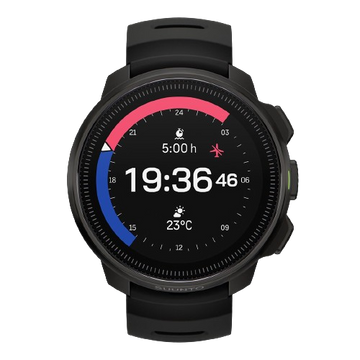
I have my personal screen that always has five pieces of data: time/altitude/ascent/distance/duration. During a race, I put the GPX in the map to make sure I can find the way when I’m not feeling confident.
Save your battery
On the John Muir Trail, I put the watch settings on ultra mode: less GPS precision, no automatic lap, no heart rate. I look at the watch every 15 minutes or so to just check the time and see how I’m feeling.
Recover later, enjoy the moment first
Recovery depends on your personal habits. After a race for me it's more important to have a moment with family, friends, and enjoy a party. So I don't take time for massage, relaxing and different things like that...
If you have small children you understand that it's important to take care of them and give some free time to your partner. Because it was hard time for them too during your race!!
Again, go slow
Take the time to plan your race, and be happy with that. With the right balance, everything will be easier. You will train and race with pleasure, good motivation and good health.
All images © Damien Rosso / DROZ Photo
Want to get a little better insight into Francois’s life of running, making wine, and more running? Follow him on Instagram.

Ocean plastics are a problem and no one knows better than divers
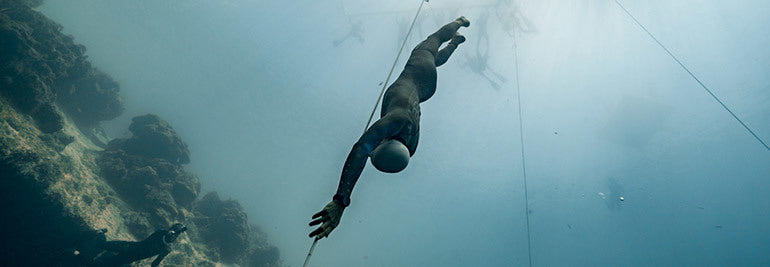
For anyone who spends a serious amount of time either working or playing in the ocean, it’s a near-impossible problem to ignore: plastics are filling our oceans. Even if your particular stretch of sand and water still appears pristine, it likely isn’t – as these materials (slowly) break down, they become microplastics – an ever more difficult problem to understand and deal with. In Long Island, the Bahamas, home to world-champion freediver William Trubridge and world-class freedive location Dean’s Blue Hole, it’s an everyday problem. We talked to the man who lives quite literally in the ocean what he is doing about it.
This is an issue you care about.
I have to – it’s in my backyard. Worldwide, plastic pollution – we reached the tipping point a long time ago. The Queen of England has banned single-use plastics from the castle! I’m an ambassador for the Ocean Conservation Alliance, run by Doug Woodring, who was one of the original people to discover and explore the Pacific Garbage Patch. His organization has done a lot for our oceans with things like their Plastic Disclosure Project – where they help businesses track their plastic use and offset it, much like companies do with the carbon footprint.
What does the ocean plastic problem mean for you?
Locally here – especially on my island – Long Island – the swell and tradewinds push garbage all to the north end of the island and it all collects in the bays and coves. And Dean’s Blue Hole is one of them. So we organize cleanups during events and competition, and we keep a bucket and just chuck in a little bit each day.
Where is the garbage coming from?
There’s a lot of theories about how plastic is getting in the water, and I think a lot of them are misguided. A lot of people blame cruise ships, but that’s not the case – you can see it in the trash itself.
More than half of the plastics that wash up in the beaches in the Bahamas are these little plastic bags of drinking water – in poorer countries, they get most of their drinking water from little 250 ml bags. They just tear off a corner and chuck it in the rubbish – but the rubbish ends up in the sea. And we’re downstream from them.
A huge amount of the plastic waste is those plastic bags. There’s also Petrol cans, cheap fishing nets. We’ll grab 20 or 30 toothbrushes in a day – the kind sold in Haiti or the Dominican Republic. They don’t have the infrastructure for waste management. Words are in French or Spanish. For us, there’s no question where it’s coming from!
And not only does the trash pollute, it doesn’t degrade, it just turns into smaller pieces – microplastics. For every plastic bag we see, there are thousands of millions of smaller particles you can’t see. Those all enter the food chain. So sea life is basically eating plastic all the time. And we’re at the top of that food chain. That can’t be good. Huge quantities of toxins are in the fish that we eat, and it’s killing sea life as well.
How can divers help?
The most effective way for divers is to help is to reduce their own use – less single-use plastic. Straws. Bring your own bags to the supermarket. Awareness of that is becoming more common – A lot of regions - cities, countries, are banning plastic bags. There is a ground shift movement to less plastic.
That’s in the developed world. But we also need to see that in the less developed world, and it’s a lot more difficult there. When you’re visiting those kinds of countries, put pressure on the local businesses, to take a more thoughtful approach to recycling and use.
And talk about it. Because most people simply don’t know. If you go into a supermarket in Honduras, talk about it. The more people that bring that message, the better. It will have an effect.
Doing cleanups and tackling that end of the problem helps, but not as much going to the source. Changing your own behavior and leading by example.
You also have some pretty crazy ideas about how to help.
One of the things I wanted to do, and so far it’s been a failure: I’d love to get the Bahamas to convert plastic to diesel. We have to ship in every once of diesel in the islands. There are machines – they’re not cheap – but you chuck in plastic and outcomes diesel. But in the end it’s quite effective if you have a good central hub. That’s a profitable way of cleaning up, but the initial investment is quite high.
You’ve also gone out on a limb about the plastic water bags.
Yeah – you know, some beaches are just carpeted with these bags. There are machines that obviously create this bag. The business that makes these machines in American, and basically aware of the fact that they’re creating a huge amount of waste that can’t be managed. So I got the CEO on the phone. Initially he was evasive, but he admitted that particular product that they are supplying is doing a huge amount of damage. His argument was that it’s better than bodies on the streets – people dying from clean water.
It’s hard to argue this defense – because it’s not completely wrong. So I’ve got in touch with a bunch of companies that work with biodegradable materials. Of course, any material that is biodegradable will biodegrade with water. So what’s left? The only other way is to change the whole system. In the Bahamas we use 5-gallon plastic jugs for drinking. But in a lot of those countries they can’t even afford to buy one or two jugs because they’re living so hand to mouth that they won’t even buy a jug. We need a few million jugs, and we get the government to ban plastic bags. Not as simple as it sounds, but we’ve got to get there somehow.
Learn more about the problems facing our ocean at Will’s efforts at the Ocean Recovery Alliance – and please, do what you can to help battle the problem!
Main image © Daan Verhoeven / Vertical Blue


Just getting started and already full beast mode
It only takes a few minutes of talking with Mau Méndez to notice the confidence he exudes. Some might even say cockiness. Thing is, like it or not, it helps him win races.
“Usually I’m a super mellow guy, smiling and laughing all the time,” says the 2016 XTERRA World Champion. “But when I’m racing I don’t have any doubts or fear. I go into beast mode. I take on an alter ego at every race.”
Full beast mode will almost be his default for the rest of this year as he travels the world hunting trophies like the Predator hunted skulls.
While his 2018 race calendar is full with XTERRA and Ironman events, his main focus is regaining his title at the XTERRA World Championship in Maui this October. He won second last year, losing the crown to South African, Brad Weiss. Winning it back is a step towards a bigger goal.
“I have always liked to dream big,” he says. “My goal is to be the XTERRA world champion as many times as possible. I would like to beat Conrad Stoltz’srecord of five times. I think I can do it – I have time on my side.”
Méndez says he has learned and matured a lot since becoming a professional triathlete four years ago. With so much time ahead of him, and already freakishly fast, his potential is massive. And he knows it.
“Another big goal is winning the Kona Ironman,” he says. “If you win Kona you will be in the history books forever. This means you can have a positive influence on people. I am learning motivational speaking, something I would love to develop more. I want to give back too.”
It hasn’t been easy for Méndez to essentially forfeit the usual things 18 to 20 somethings revel in. He admits that after winning the XTERRA World Championship in 2016 he went through a low, when he really questioned being a full-time athlete.
“I was a 20-year-old guy and all my friends were having a great time at parties,” he says. “I wondered what I was doing with my life.
“Plus, when you win the world champs, everything changes; you feel more pressure, feel the need to win, rather than the joy of competing and racing. It was a big learning curve.”
Since that time Méndez says he has learned to live in the moment, to find the good in the bad, and regained his passion for the sport.
Getting used to longer distance races, improving his endurance and gaining experience are his main focus as an athlete. Learning to balance sport, family and downtime is important, too.
“It’s not just about winning,” he says. “If you do that and end up alone, it doesn’t mean anything. I try to remember I’m fighting for something bigger.”
The toughest race of 2018, he says, will be the Ironman 70.3 World Championship in South Africa in September. The distance, the high level of competition, and his relative lack of experience, all put him at a disadvantage. “I will train as hard as possible,” he says.
Méndez is also excited about competing in the Patagonman Patagonia Xtreme Triathlon in December. Traveling the world and seeing beautiful places is one of the things he loves about the sport.
“Every time I sign into a race, and I know I’m going to travel somewhere new, it’s a huge motivating factor for training,” he says. “I have pictures of the place on my phone or close by to keep me pumped along the way.”


