




SUUNTOブログ

The stage race across the Alps in 8 pictures
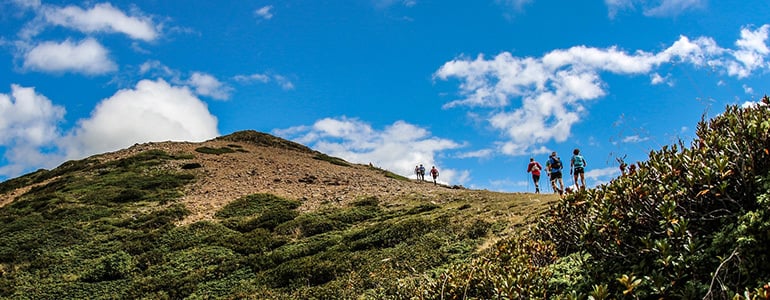
The GORE-TEX® TRANSALPINE-RUN is not for the faint hearted. Reaching the finish line of the eight-stage race across the Alps will take every scrap of your being. Get a taste of this epic adventure with the eight images below!
The 11th edition of the GORE-TEX® TRANSALPINE-RUN finished last week and Suunto was the official time sponsor. The eight-stage, 268 km race across the Alps from Germany to Italy is a gruelling test of endurance. Because it crosses exposed and sometimes isolated alpine terrain, competitors must race in two man teams for their own safety. Trail runner and ski mountaineer Philipp Reiter, along with teammate Iker Karrera, won the race in 2012. This year, due to an injury, the 24-year-old German could not compete so instead he photographed each stage of the race.“Crossing the Alps from north to south is a kind of a dream,” he says. “For eight days you’re in your own world.”
Click here to see this year's results.
Stage one: Oberstdorf, Germany to Lech, Austria
Distance: 34.60 kmVertical ascent: 2083 mVertical descent: 1469 m
All good times and smiles on day one. © Philipp Reiter
“This year the first stages were really hot, 36° C, so a lot of people became dehydrated and some collapsed,” Philipp says. “The race medical team had a lot of things to do.”
Stage two: Lech, Austria to St. Anton am Arlberg
Distance: 24.70 kmVertical ascent: 1899 mVertical descent: 2040 m
© Philipp Reiter
“People are used to running, but not everyday for that long,” Philipp says. “You have to make sure your body is able to deal with the distance and vertical gain for eight days.”
Stage three: St. Anton am Arlberg, Austria to Landeck, Austria
Distance: 39.60 kmVertical ascent: 2658 mVertical descent: 3133 m
© Philipp Reiter
“In my experience, stage three is really tough because you are feeling exhausted from the first two days, but know there’s another five days ahead of you,” Philipp says.
Stage four: Landeck, Austria to Samnaun, Switzerland
Distance: 45.70 kmVertical ascent: 2861 mVertical descent: 1829 m
© Philipp Reiter
“It’s funny, because each day when I get up in the morning I don’t know how I can complete the stage because I’m so tired and sore, but once you start, you just keep going and it works,” Philipp says. “It’s interesting to see how much the body can achieve.”
Stage five: Samnaun, Switzerland – vertical sprint
Distance: 06.23 kmVertical ascent: 731 mVertical descent: 60 m
Landie Greyling (above) and husband Christiaan Greyling won second in the mixed category this year. © Philipp Reiter
Stage five is the so-called “rest day” of the Transalpine Run. However, to keep the muscles warm, it includes a 6 km uphill sprint!
“Sometimes you run in the snow and it’s freezing cold,” Philipp says. “Then the next day it might be 36° C. The weather can change quickly. Everyone has to carry mandatory safety gear.”
Stage six: Samnaun, Switzerland to Scuol, Switzerland
Distance: 37.10 kmVertical ascent: 2064 mVertical descent: 2698 m
© Philipp Reiter
“It’s crazy – competitors spend their holidays crossing the Alps,” Philipp says. “These guys pay to run over the mountains and are out for about 10 hours a day and have no real recovery time.”
Stage 7: Scuol, Switzerland to St. Valentin, Austria
Distance: 37.80 kmVertical ascent: 1633 mVertical descent: 1369 m
© Philipp Reiter
“To train for this race you have to keep training everyday for a longer period,” Philipp says. “It’s not just physical fitness but also mental preparation.”
Stage eight: St. Valentin, Austria to Sulden, Italy
Distance: 42.60 kmVertical ascent: 2381 mVertical descent: 1934 m
© Philipp Reiter
“There is a party at the end, but people are so tired and after two beers they’re drunk,” Philipp says. “What’s unique, is only finishers get a finisher’s t-shirt – the rest get destroyed.”
Main image: © Philipp Reiter
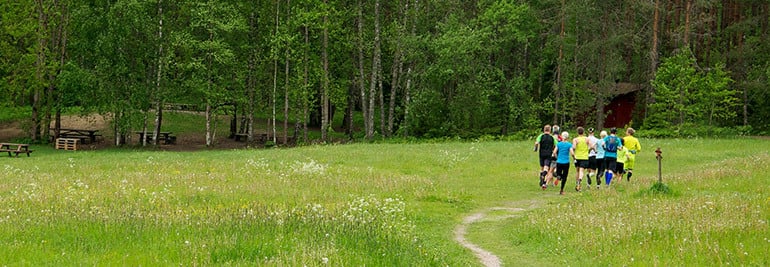

Running with a common goal
Many times adventure or endurance sports can be solitary pursuits. When we share our experiences and challenges with others, we are strengthened. As a new edition to our efforts to help build connections, we will be sharing stories from inspiring groups around the world whose love for sport and adventure not only build camaraderie amongst themselves, but also serve to invigorate and motivate all of us together.
In Suunto’s home country of Finland, trail running has moved from niche to mainstream with incredible speed. Races that had only a handful of runners two years ago, now sell-out to their capacity in hours. Located all over the country, trail races are a natural extension to the almost inherent connection Finns have with nature, from orienteering to cross-country skiing. Vast expanses of forested wilderness and rolling fjells provide countless opportunities to explore.
The Nuuksio Classic trail marathon is one of the most popular races on the calendar, happening the first weekend in September. It is held on the beautiful and varied trails and grey rock of the Nuuksio National Park just outside the capital, Helsinki.
We joined a training run in Nuuksio as runners from all walks of life and levels of experience were preparing for the marathon and getting to know the trail. For many of these runners, race day is the opportunity to challenge oneself and celebrate accomplishments, but the real transformative value of running and community come through the daily training, the scars, the group runs, the early morning miles and getting lost in the forest on a new (or old) trail.
As Ali Leivo, an avid trail runner and community stalwart, says, “while the Finnish trail running community is small, it is like a family. I could shoot off to anywhere in the country and someone would welcome me, not only on their home trails, but into their homes as well.” This community often congregates, and reunites in some of the most iconic national landscapes, prepared for the challenges ahead and sharing their collective energy with one another.
Community encourages us to explore, both our wondrous natural world and within ourselves. As we embrace new connections, our energy combines and propels us forward, and when you are running in the wild it’s always nice to know someone’s got your back.
We’ll return soon with our next instalment of community events. Stay tuned!
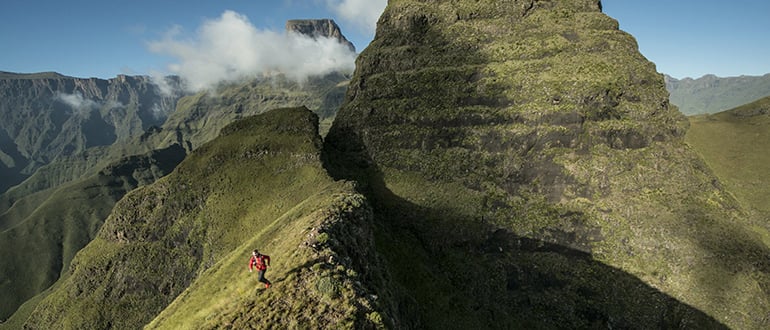

How to handle setbacks like a champion
Being an athlete isn’t all glory and endorphin highs. Just ask champion ultra runner Ryan Sandes. He’s had to pull out of three races recently due to catching glandular fever and struggling to recover. Now he’s taking a break from running to allow his body time to fully heal. We caught up with Ryan and asked him a few questions about how he deals with setbacks.
How are you doing after your recent setbacks?I feel pretty low and disappointed now, but I am focusing on switching off from my setback and not overthinking it too much as that just makes it worse. I am putting a plan in place to fix my health and that is all I can do. I have had a crap year racing, but I have had some epic experiences this year, traveled to some awesome places and it is important to be grateful for that!
Check out Ryan's recovery tips for before and after the race!
Ryan enjoys a soak after announcing he's taking a short break from ultra running to recover. © Ryan SandesHow do athletes often react to a setback, whether injury or illness? It is really frustrating and demoralizing at the time. You think back to all the hard training and effort you have put into a specific goal and then all of a sudden that all disappears. I always try to focus on the positives in the situation and remember that a setback is not the end of the world – it’s just a hurdle on the way to reaching my dreams.
Find out how to use the Suunto Ambit3 to help you recover
Are setbacks always a bad thing or can they be helpful in unexpected ways?
I think it’s actually through our setbacks that we learn the most about ourselves and develop as people. It’s easy when everything is going right, but when you have a major setback it really tests you and when you come out the other side, it makes your achievement that much more rewarding. I find after a big setback I am more focused and determined than ever.
Having unstructured fun is important for recovery. © Ryan SandesWhat do athletes often fear most about setbacks and is this fear necessarily true? It’s a common worry that if you can't train you will lose your fitness and not be ready for an upcoming race, but I believe often the body knows best, and the time off from training helps it to fully recover and get strong after all the training. You will often see an athlete come back really strong after an injury because they have taken enough time off.
Read more recovery tips from Suunto's ambassadors!
Setbacks can make you stronger, Ryan says. © Ryan Sandes
If someone gets an injury, they can sometimes get training withdrawal– how do you recommend working with this? Sitting around with an injury is really frustrating and you get 'cabin fever' as you know all your fellow athletes are outside training. It’s important to focus on fully recovering and doing your rehab so you can come back stronger. If you can’t run and are feeling really frustrated then go outside for an easy hike to be outdoors, but don't push yourself otherwise you will just get injured again.
What recovery really means – from a physiology specialist
What to do if you lose your motivation because of a setback?
If you are feeling a real lack of motivation take a complete break and focus on the fun element of your training or just having fun in general. This could be running for fun with no specific time or training goals or even just hanging out with friends and having a laugh. Take your mind off training and the setback to reboot your system and feel inspired again. Don’t take life too seriously and accept that you will have setbacks along the way.
It's important to keep the big picture in mind, Ryan says. © Ryan SandesDo you have a favorite quote about never giving up?
"If one dream dies, dream another dream. If you get knocked down, get back up and go again." - Joel Osteen
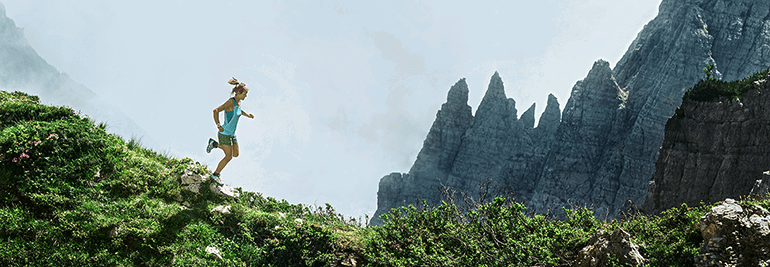

Emelie Forsberg's power pancake recipe
Training a lot and want to power up? Then try cooking up this recipe for high-energy almond and banana pancakes from skyrunning champion Emelie Forsberg.Eating healthy, nutritious food is essential for recovery after intense training. But it need not be boring! Suunto ambassador Emelie Forsberg spends her days running in the mountains and then making and baking delicious, energy rich food to help her recover.
The morning after a big race, for example, the world and European skyrunning champion likes to enjoy a big plate of healthy pancakes.
"After an ultra, when your body is drained and you've eaten a lot of chocolate or gels, I like to eat fresh and healthy, at least on the first and second day," Emelie says. "But pancakes are my standard breakfast the morning after a race, and yes, I think pancakes can be healthy. Especially my banana pancakes!"
Who could say no to these? © Emelie Forsberg
Emelie Forsberg's power pancake recipe!
Ingredients:
3 organic bananas3 tbsp coconut oil3 eggs1 tbsp honey or 1 tbsp bee pollen ( If you don't have pollen, it doesn't matter, I just like the taste of it)200 ml oat flour100 ml almond flour100 - 200 ml almond/rice/soy milk1 tbsp honey + 1 tbsp pollen1/2 tsp salt1/2 tbsp cinnamon and cardamom if you like that1 tsp baking soda
Method:
Grind the oat and almonds to flour. Or, if you prefer, use bought oat and almond flour. Add all the dry ingredients. Mash the bananas and blend with the eggs, oil and the honey. Add the milk (or if you want the pancakes more solid you skip the milk).
Emelie's favorite toppings:
1. Fresh strawberries, rasberries, blueberries or cloudberries2. Bananas and honey3. Good cheeses4. Whipped cream with jam or fruit
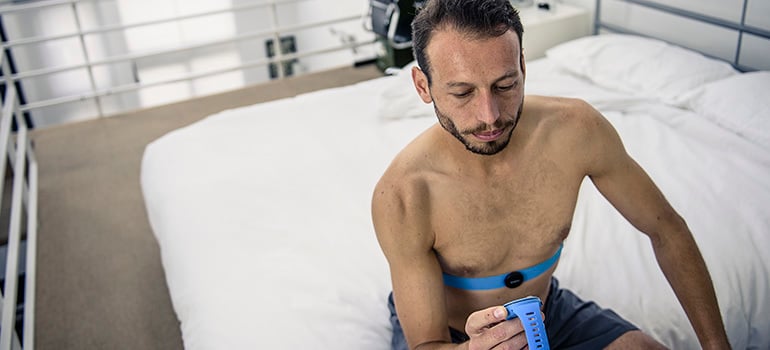

トレーニングで強くなるのは休んでいるとき|回復と適応の仕組み
トレーニングで強くなるには、走る、登る、泳ぐといった運動そのものが欠かせません。しかし、身体がトレーニングの刺激を受け止め、次の負荷に対応できるよう変化していくのは、運動を終えたあとの時間です。
つまり、休息はトレーニングの反対ではなく、その一部です。負荷と回復が適切に組み合わさって初めて、持久力や筋力、動作の効率といった能力の向上につながります。
この記事では、スポーツウォッチで回復をどう測るかではなく、回復中の身体で何が起きているのかを中心に解説します。
目次
身体は一定の状態を保とうとする
「疲労が抜けること」と「適応」は同じではない
睡眠は適応を支える土台
自律神経の変化は回復を知る手がかりになる
データが良くても休むべき日はある
回復を「判定」ではなく「判断材料」として使う
日々の変化を、現在のSuuntoで振り返る
まとめ|休息まで含めてトレーニングを設計する
身体は一定の状態を保とうとする
人の身体には、体温や血糖値など、体内の環境を一定の範囲に保とうとする働きがあります。これはホメオスタシス(恒常性)と呼ばれます。
トレーニングは、この安定した状態へ意図的に刺激を与える行為です。運動中はエネルギーを消費し、筋肉や心肺機能、自律神経系に負荷がかかります。身体はその刺激から回復する過程で、同じような負荷へ以前より対応しやすくなるよう適応を進めます。
ただし、刺激が強ければ強いほど効果が高まるわけではありません。回復できる範囲を超えて負荷が続けば、質の高い練習を積み重ねにくくなります。
「疲労が抜けること」と「適応」は同じではない
回復という言葉からは、筋肉痛がなくなる、疲労感が軽くなるといった変化を想像しがちです。しかし、身体が元の状態へ戻ることと、トレーニング刺激に適応することは、厳密には同じではありません。
エネルギーの補充、損傷した組織の修復、神経系の落ち着き、運動動作の学習などは、それぞれ異なる時間軸で進みます。朝の数値が良好でも脚に強い張りが残ることがあり、反対に身体は軽く感じても、睡眠不足によって集中力が落ちている場合があります。
回復を一つの数字で表し切れないのは、このように複数の仕組みが同時に関わっているためです。
睡眠は適応を支える土台
睡眠は、身体と脳が日中の刺激から回復するための重要な時間です。トレーニングだけでなく、仕事、移動、暑さ、精神的な緊張なども身体にとってはストレスになります。運動量だけを見ていても、実際の回復状態を捉えられないことがあります。
睡眠を振り返るときは、一晩の長さだけでなく、就寝・起床時刻の規則性、夜間の目覚め、起床時の感覚、日中の眠気にも目を向けましょう。完璧な睡眠を一晩だけ目指すより、無理なく続けられる生活リズムを整えることが大切です。
自律神経の変化は回復を知る手がかりになる
心拍数やHRV(心拍変動)は、自律神経の状態を間接的に捉える手がかりです。睡眠中の変化を継続して見ると、普段の自分と比べて身体が落ち着いているか、ストレスの影響が残っているかを考える材料になります。
大切なのは、他人の値や一般的な基準と競うのではなく、自分自身の通常範囲からの変化を見ることです。また、単日の上下だけで結論を出さず、睡眠や主観的な疲労と合わせて傾向を確認します。
▶︎関連記事:「HRVとは?心拍変動を理解してトレーニングの回復を最適化する方法」
データが良くても休むべき日はある
自律神経に基づく指標は便利ですが、筋肉や腱、関節の局所的な負担、感染症、栄養不足など、すべての状態を検出できるわけではありません。ウォッチの数値が通常どおりでも、強い筋肉痛や痛み、発熱、息苦しさがあれば、数値を優先して運動を続けるべきではありません。
回復を判断するときは、データに加えて次のような感覚も確認します。
起床時に疲労が残っていないか
筋肉や関節に普段とは異なる痛みがないか
食欲や気分が普段どおりか
ウォームアップで身体がいつものように動くか
練習に集中できる状態か
回復を「判定」ではなく「判断材料」として使う
回復データの目的は、その日のトレーニングを自動的に決めてもらうことではありません。予定していた練習と現在の状態を照らし合わせ、負荷を調整するための判断材料として使うことに価値があります。
状態が安定していれば予定どおり取り組み、疲労の兆候が重なっていれば、強度を下げる、時間を短くする、軽い運動へ切り替える、休養日にするといった選択ができます。こうした小さな調整は、長期的にトレーニングを継続する助けになります。
▶︎関連記事:「Suuntoでリカバリーを確認する4つの方法」
▶︎関連記事:「ランニングのトレーニング負荷を管理する方法」
日々の変化を、現在のSuuntoで振り返る
元記事で紹介されていた旧世代ウォッチの単発テストに代わり、現在は睡眠、HRV、心拍数、トレーニング負荷などを継続して振り返る考え方が中心です。Suunto Race 2、Suunto Race S、Suunto Run、Suunto Vertical 2などの現行モデルとSuuntoアプリを活用すれば、トレーニングと日常生活の変化を長期的な傾向として確認できます。
大切なのは、その日の数値だけで良し悪しを決めるのではなく、自分の通常状態を知り、負荷や生活習慣との関係を振り返ることです。具体的な確認方法は、上記の関連記事で詳しく紹介しています。
まとめ|休息まで含めてトレーニングを設計する
身体は、トレーニングの刺激を受けたあと、休息中に修復と適応を進めます。だからこそ、負荷をかける日だけでなく、回復する時間まで含めてトレーニングを考える必要があります。
一つの数値だけで「回復した」と判断するのではなく、睡眠、自律神経の傾向、筋肉や関節の状態、気分、実際に動いたときの感覚を組み合わせましょう。自分の通常状態を知り、その変化に合わせて負荷を調整することが、継続的な成長につながります。
トレーニングと回復を、一つの流れとして振り返る
SuuntoのスポーツウォッチとSuuntoアプリで、睡眠、HRV、心拍数、トレーニング負荷の傾向を確認し、自分に合ったトレーニングリズムを見つけましょう。
Suuntoウォッチを見る


