




SUUNTOブログ

Living peak adventure: find your starting point
The Living Peak Adventure article series gives you everything you need to know to find, create and navigate smoking routes. The series covers:
How to find hot routes with Suunto app heatmaps
How to find popular starting points
How to create your own routes
How to share your routes with friends
How to navigate a route outdoors
How to pinpoint the best starting spots
Say you’ve identified an intriguing mountain range or forest on the map that looks like prime trail running territory. Or maybe you’ve discovered a nice cross-country skiing loop on Suunto app heatmaps, but don’t know the area so well. Now, you just need to know where to park your car and start your adventure; let the Suunto community show you.
Popular starting points are shown in heatmaps as little circles the same color as the activity type you have selected. These circles indicate a parking lot, a trail head or other starting points, such as outside a hotel or apartment complex. They show you where the local Suunto community begins its adventures.
Tap and go
Next, simply tap on a circle you’d like to use as a starting point and an information box with options will appear at the bottom half of your screen. The box confirms it’s a popular starting point, and provides other useful info, such as the sunrise and sunset times, the temperature and coordinates.
Below that you can choose to save the starting point as a POI (point of interest), or to start or end your activity there. Remember you can zoom in on your screen to more clearly see the location and what’s around it so when you arrive there you know what to look for.
Suunto app has heatmaps for 16 different activity types from running, trail running, cycling and mountain biking to activities like ski touring and open water swimming. With the Suunto community behind you, you’ll always find awesome routes and know exactly where to start!
Popular routes
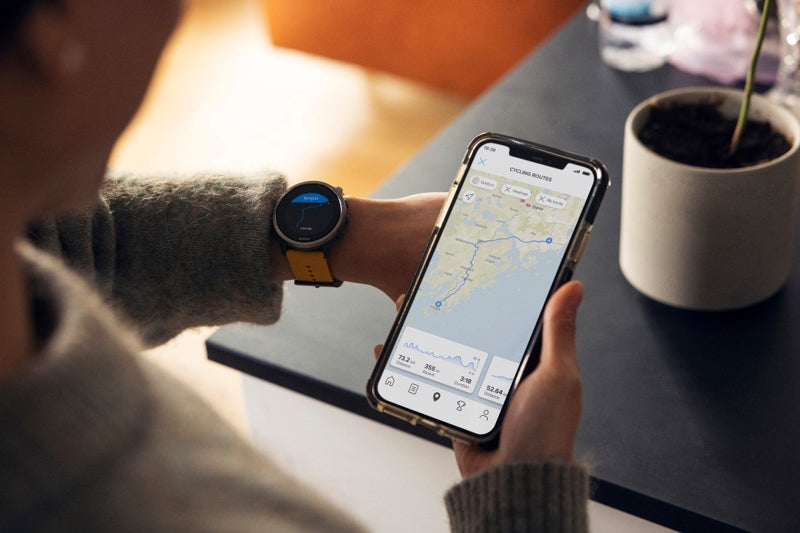
To find popular routes, open the Suunto app map and swipe up from the bottom of the screen. A menu window will open that shows nearby popular routes. Once you’ve found a popular route based on your activity type, tap the route and a box will appear on your screen allowing you to save it and sync it with your watch. You’re good to go.
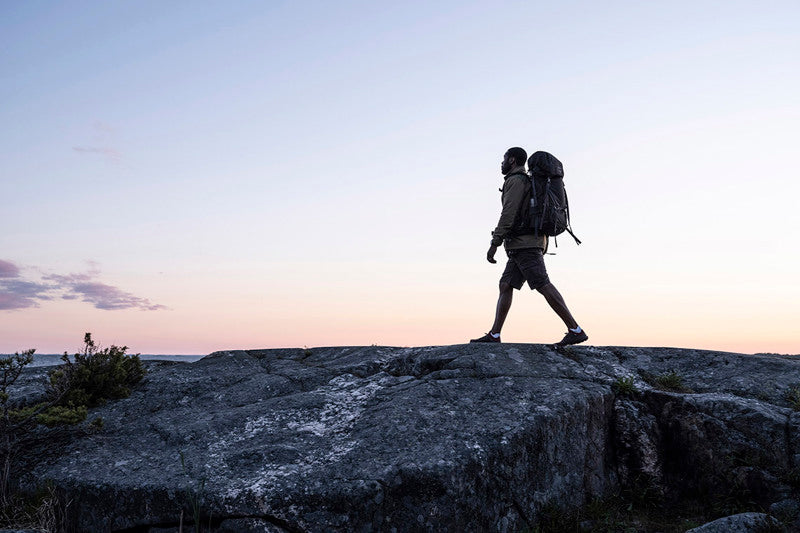

Living peak adventure: find routes that rock
At Suunto, our purpose is to help you have unforgettable outdoor experiences. We want to make it as easy as possible for you to find, create and navigate trails that simply rock.
So we’ve put together the Living Peak Adventure series so everything you need to know is all in one place. We’ll cover:
How to find hot routes with Suunto app heatmaps
How to find popular starting points
How to create your own routes
How to share your routes with friends
How to navigate a route outdoors
Master this, and your best adventures are still waiting!
Find hot routes with Suunto app heatmaps
Imagine you’ve moved across town or to a new city altogether and you’re looking for some sweet local spots to go mountain biking or trail running, Suunto app heatmaps will show you what’s hot with the locals.
You can view Suunto heatmaps also in 3D!
Based on millions of workouts, Heatmaps highlight the most frequented training spots for more than 16 sports in locations around the world. Just select the activity type for your heatmap, whether trail running, cycling, swimming and so on, and the more our community works out somewhere, the brighter the lines in our maps become (each sport has its own color), making it easy for you to see where to head next. There are five map styles for you to toggle between, depending on your sport, season and what you are looking for.
You can also use heatmaps to identify locations not so popular with our community if you are searching for somewhere quieter or less frequented to go. Look for duller colored lines.
How to use Suunto app heatmaps
First, open Suunto app on your device, then open the map by tapping the location pointer icon on the bottom right corner. Now select the heatmap layer for your sport or activity type and choose your preferred map style. Zoom in to look more closely at particular trails or areas of interest. The brighter the lines, the more popular those routes are.
Switch from 2D to 3D
You can also switch between a standard 2D map and a 3D map. The former gives you an overview of the location and the popular routes, while the latter, when you zoom in, gives a better sense of the topography - hills, valley and mountains and so on.
Switch between 3D and 2D maps and different map layers to get the most out of heatmaps.
Whether you select the 2D or 3D map, you can zoom in and create your own route. Simply tap the plus symbol on the lower right side and tap where on the map you’d like your route to start. Then keep tapping on the map where you’d like your route to extend to. Suunto app will calculate the distance, vertical meters and estimated duration and present it at the bottom of the screen as you create your route. As you build it, you can switch between different map styles, 2D and 3D, and with heatmaps on and off.
Once you are ready, save your route, sync it to your Suunto watch and get out there!
Learn more about the navigation features, map styles and routes with the Suunto app 🔺
Stay tuned for the rest of the five part series to learn how to live peak adventure with your watch from Suunto!
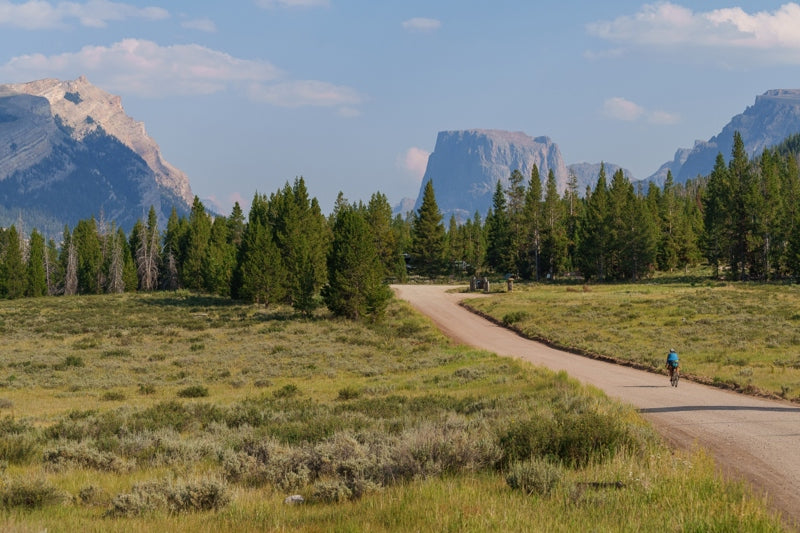

How to mix it up when you love too many outdoor sports
With winter deepening in Boulder, Colorado Suunto athlete Anton Krupicka is dusting off his ski gear and getting ready for some big skimo days in the mountains.
This builds on a huge summer of adventure that saw him complete an epic tour that involved cycling to five different 4000 m mountains, running up as far as possible and then climbing to each summit.
We wondered how in the world Anton finds time to train in all these disciplines and how he strikes a balance. Read on for our Q&A with him.
Read more about Anton here!
What adventures have you been on recently?
I had a pretty busy summer. In June, I rode the Unbound XL gravel race - a 360 mile (579 km) bike race in the Flint Hills of Kansas. It was the farthest I’ve ever ridden in one stretch.
In July, I completed a 2300 mile (4000 km) bike/run/climb tour through Utah, Idaho, Wyoming, Montana, and Colorado where I linked together six different remote technical mountains, starting and finishing at my doorstep in Boulder, Colorado: Kings Peak (13,528 ft / 4123 m), the high point of Utah; the Grand Teton (13,775 ft / 4198 m); Granite Peak (12,807 ft / 3903 m), the high point of Montana; Cloud Peak (13,164 ft / 4012 m), the high point of Wyoming's Bighorn Range; Gannett Peak (13,804 ft / 4207 m), the high point of Wyoming; and Longs Peak (14,255 ft / 4345 m), my backyard mountain here in Boulder, Colorado. I dubbed this trip “Sagebrush & Summits”; those three weeks of riding, running, and climbing were the highlight of my summer.
Finally, in August I ran the Leadville 100, my first ultramarathon in more than six years. This fall, I took a trip back east to North Carolina where we enjoyed some climbing and also a four-day bikepacking trip along the Blue Ridge between Boone and Asheville. That was more for relaxation and recovery, though.
That’s huge! Anything coming up?
Right now, I’m looking forward to skimo racing this winter and hopefully a bikepacking trip to southern Arizona over the winter. I’m already scheming a bikepacking tour for next summer that can top Sagebrush & Summits, though!
You love to mix disciplines; how do you approach this from a training perspective? How do you build in enough recovery time?
It’s all intuitive. I tend to specialize a little bit more as a key objective approaches, but in general I’m trying to balance running, climbing and cycling, and skiing in the winter.
A typical week will probably see me biking 3-4 days, running 2-4 days, and climbing 2-3 days. I do some kind of cardio every day. I typically go on a bike ride after climbing (after having already ridden to the crag), and I use the bike/climb days as recovery from the running days. On days that I run, I usually only run. That’s the general thought process.
What I do is further influenced by the weather forecast - I’m constantly paying attention to weather patterns! - as I prefer to run on cooler or wetter days, and ride/climb on sunnier/drier days, and, of course, run/climb in the alpine when the weather is favorable.
What signals do you look for in your body to determine where you’re at and when you need more recovery time?
Everything is ultimately determined by what my body is telling me. Specifically, how my Achilles is feeling and how it’s responding to the stresses I’m placing on it. As for taking an easier day, I decide that in the moment. Unless I have some key session that I want to be sure to hit before a goal (say, a long run before an ultra or a long bike ride before a bike race), all of my easy/recovery days are determined by how my energy levels are feeling on the day. If I’m feeling good and my body is feeling sound, I’ll push the pace or the distance, or both, in a session. But there are plenty of times where I’ve wanted to hit a harder session and I just don’t have the energy, so I go easy or shorter, sometimes a lot shorter.
What have been some of the key lessons you’ve learned about mixing it up that might be helpful to others who are doing the same thing?
I think you have to realize that you can really only be progressing meaningfully in one activity at a time. That doesn’t mean that I’m not pursuing other activities simultaneously, it’s just that they’re temporarily in maintenance mode. Also, as my previous answer made clear, it’s extremely important to listen to your body and your energy levels and know how they will react to various activities.
For me, running is always the most intense and abusive pursuit. Recovery from that requires only cycling, and probably at a low intensity if I’m really tired. Climbing shouldn’t be classified as active recovery, as the climbing I do usually involves a fair amount of vertical gain/loss in hiking and descending and several multi-pitch routes where more vert is being gained and lost. And if I’m trying to climb hard - at my technical limit - then that’s only going to be possible if I’m not overly tired from running or riding. I love climbing as much as running and cycling - maybe even more - but I rarely prioritize it in any meaningful way. It necessarily takes a back seat because it doesn’t really do anything to further my development in endurance pursuits, where I actually have talent.
Are there any classic pitfalls to avoid?
Like I said above, I think it’s important to not try to progress in more than one activity at a time. I think that usually just ends up being counterproductive.
How has mixing it up made you a better athlete? I guess fun is an important benefit?
Embracing a variety of mountain sports has made me a more well-rounded athlete. It’s also extended my running career - there’s no way that I could only run now and stay healthy enough to race and have it be sustainable. That’s the main benefit.
I don’t like the word “fun”. I think the way it’s typically used is too broad and not incisive enough. What do people really mean when they say “fun”? Often, I think what they really mean is “rewarding”, “satisfying”, or “with joy”. To me, those words imply hard work, challenge, discomfort, and/or intentionality. None of those things, I think, really apply to the textbook definition of “fun”.
The most important benefit to me of mixing up activities is that it has allowed me to grow and learn so much more about each activity and, concurrently, about myself. Having spent several years now pursuing all of these things, I can’t imagine ever going back to being only a runner.
Do you think mixing it up in the way you are is becoming more popular today?
Hmmm, I don’t know. I think to truly reach your potential in a given pursuit you have to be singular in your focus. I did that for a decade-plus with running. But it eventually became physically unsustainable. I think it’s fine to go through phases or seasons in one’s life. I doubt that pursuing multiple sports at the same time is anything new. But, with social media and the internet, we’re probably all just more aware of people who are doing that.
All images by Fred Marmsater
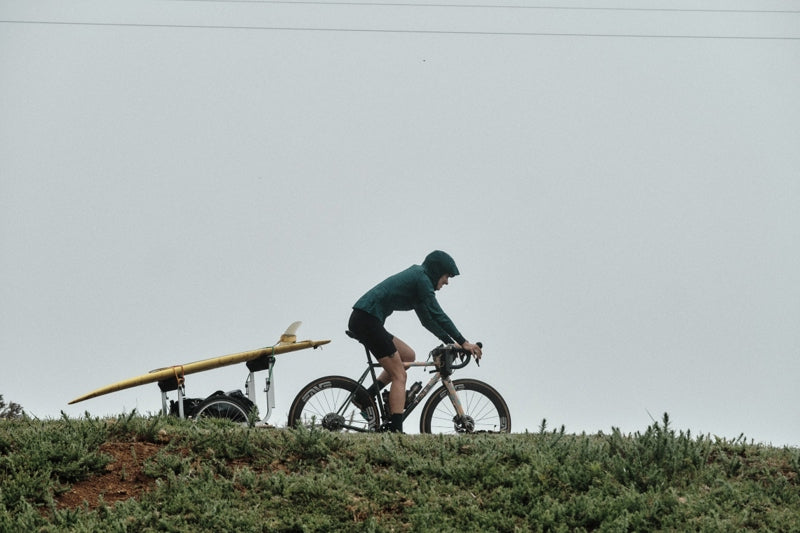

Into the Atlantic Islands
It started with a little bike and surf trip to Madeira in May 2021 and has now expanded into an island hopping adventure across the Atlantic. Sami Sauri’s Into the Atlantic Islands project will see her and her friends Sergio Villalba and Christian Rosillo explore the Madeira, Canary, Azores and Faroe archipelagos by bike and board.
More than just adventure, the goal of the project is to produce art in the form of analog photography, printed fanzines and videos showcasing each trip. Money raised from selling the fanzines will go towards Frodeno Fund, a cycling association that supports children with bikes and equipment.
Read about Sami’s journey from wild child to adventurer here.
Watch episodes on each trip here!
On the first trip to Madeira, the trio began their journey at Sant Antonio Da Serra, on the northern side of Funchal, the capital of Madeira. Over five days, Sami cycled 152 km, with 4260 m elevation gain, pulling her surfboard on a trailer that together weighed 30 kg. She wild camped along the way and surfed at two beaches.
“My inspiration for this project came from following my dream of wanting to combine two sports,” Sami says. “I’ve been sort of doing it with cycling and running, but I wanted to discover and try more. I started surfing in my teens and I always love it and miss it so I thought traveling to a new place would motivate me more than ever to try new spots and also a new pretty board. Madeira came to my mind and we literally booked and went there within three weeks.
“I think the special thing about the Atlantic islands is that all of them are so completely different. The charm of these islands and the story of how they were discovered and how they are now I find really interesting.”
Watch all three Madeira episodes here and follow Sami’s next trip to Denmark’s Faroe Islands here.
All images: Sergio Villalba

7 adventure films to watch over the holidays
Over the course of 2021 we’ve had the pleasure of being involved with some excellent adventure films. Now the holiday season is upon us, we decided to curate our favorite short films for you so when you have some downtime soon you can kick back and watch them. Scroll down for our seven favorites!
From Rails to Trails
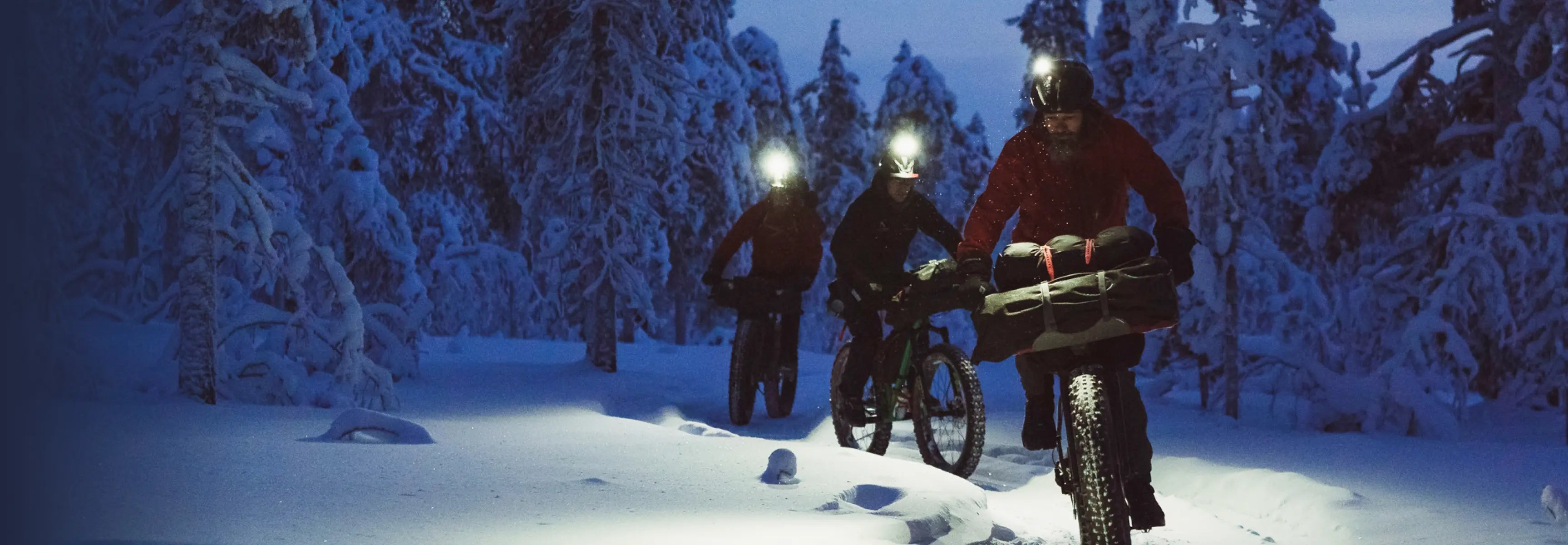
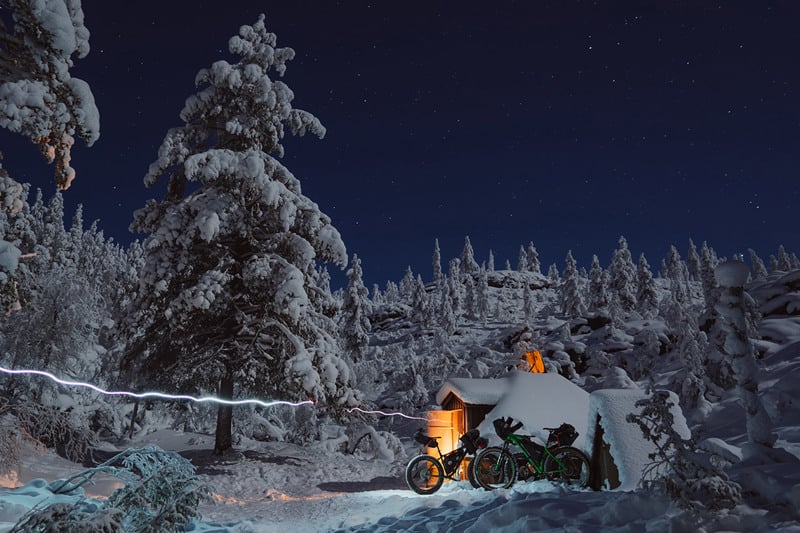
Just watching this will make you shiver. Our very own bike lover Antti Laiho and his buddies Timo Veijalainen and Erkki Punttila went on an overnight bikepacking tour in the Finnish Lapland in the middle of winter. The landscapes look like something from a fairytale. Truly magical.
Rails to Trails from Kona Bikes on Vimeo.
Peak creators
Since forever there’s been a connection between creativity and the great outdoors. In this series of films we talk to an artist, a photographer, an architect and a trail builder about their creative process and how the outdoors inspires them.
Canary in the coalmine
Decorated technical diver, explorer and filmmaker Jill Heinerth explores the veins of the Earth. She sees close up how the impacts of humanity are affecting our planet so considers herself a canary in the coalmine.
How fast can Kilian run a vertical k?
This film shows just how much the Kilian pushes himself during his lightning fast ascents. He might be the GOAT mountain athlete, but that doesn’t mean it’s a walk in the park for him. Watch him attempt to break the fastest vertical k record and push his lungs to their limit.
Immersed
Swedish slopestyle mountain biker Emil Johansson won the 2021 world championship and is now the most successive slopestyle rider in history. But it very nearly wasn’t to be. A mysterious autoimmune disease came close to derailing his dreams. This film is about his journey.
Finding myself
Suunto ambassador Sami Sauri fell in love with cycling as a teen and says it gave her a new purpose in life. Since then she has done epic bikepacking tours across the US, and elsewhere. When she’s not riding, she might be out surfing or trail running.
Arctic Lines season two
Finnish freerider Antti Autti has embarked on the second season of his Arctic Lines project, the goal of which is to ride 30 lines above the Arctic Circle. He and his team document each trip and release a film about the experience. Watch as they face brutal cold, the polar night and their physical limits in the pursuit of sweet, sweet rides.
Lead images by Jaakko Posti Photography

自然を楽しむために、自然を変えすぎない。山岳リゾートをつくる建築家の哲学|Suunto
山に道をつくる。建物を建てる。人が自然を楽しむための場所をつくる。
そのとき、私たちは自然にどこまで手を加えるべきなのでしょうか。
世界各地で山岳リゾートを手がけるランドスケープアーキテクト、ライリー・ティーセン(Ryley Thiessen)が大切にしているのは、「新しいものをつくる」ことだけではありません。
自然と向き合い、その土地にすでにあるものを生かしながら、人と自然の距離を近づけること。
アウトドアからインスピレーションを受けるクリエイターたちを紹介するSuuntoの「Peak Creator Series」。今回は、自然と人との関係をデザインする建築家の仕事を紹介します。
目次
自然から生まれるクリエイティビティ
自然と人をつなぐランドスケープアーキテクト
大切なのは「自然とのバランス」
自然をデザインするのではなく、体験をデザインする
自然を知るには、自分の足で歩いてみる
Suuntoとともに、まだ知らない場所へ
まとめ|自然の中にあるものを見つける
自然から生まれるクリエイティビティ
霧に包まれた森。遠くに連なる山々。岩肌がむき出しになったピーク。
自然は昔から、画家や写真家、音楽家、建築家など、多くのクリエイターにインスピレーションを与えてきました。
Suuntoの「Peak Creator Series」は、そんなアウトドアから刺激を受けながら活動するクリエイターたちを紹介するシリーズです。
トレイルビルダー、フォトグラファー、建築家、アーティスト。
仕事は違っても、彼らに共通しているのは、自然を単なる「背景」として見るのではなく、自然そのものからアイデアを受け取り、自分の仕事へとつなげていることです。
自然と人をつなぐランドスケープアーキテクト
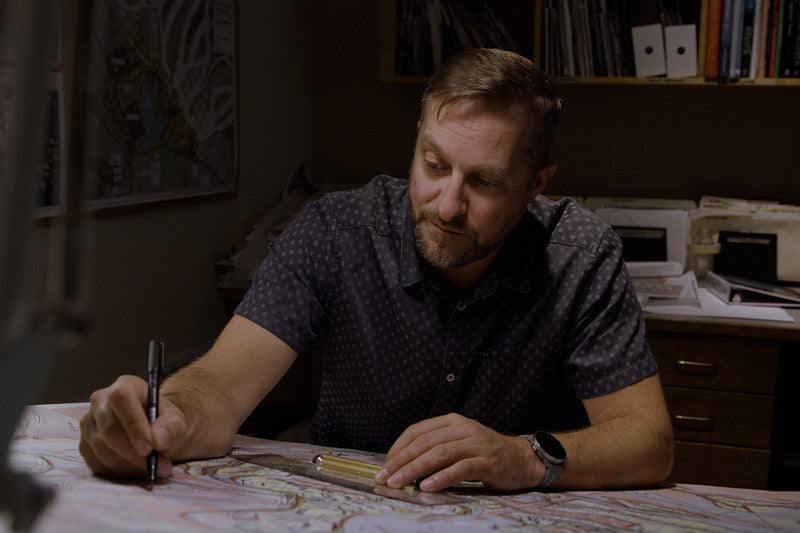
シリーズ第3弾に登場するのは、ランドスケープアーキテクトのライリー・ティーセン。
彼は世界各地で、四季を通じて楽しめる山岳リゾートのデザインを手がけています。
ライリーは自然豊かな田園地域で育ち、幼い頃から「土や自然に関わる仕事がしたい」と考えていたといいます。
山岳リゾートの設計というと、大きな建物や施設を山の中につくる仕事を想像するかもしれません。
しかし、ライリーが目指しているのは、自然を人間の都合に合わせて大きく変えることではありません。
その土地の地形や景観を読み取り、そこにある自然をできるだけ生かしながら、人が自然とつながるための場所をつくることです。
大切なのは「自然とのバランス」
ライリーが仕事をするうえで、もっとも重要だと考えているものがあります。
それが「バランス」です。
自然とともに仕事をし、取りすぎないポイントを探すこと。
自然の中に何かをつくる以上、まったく手を加えずに済むわけではありません。
だからこそ、「何をつくるか」だけではなく、どこまで手を加えるのか、そして何をそのまま残すのかを考える必要があります。
新しいものを加えることと、そこにあるものを尊重すること。
ライリーの仕事は、その境界線を探す作業でもあります。
自然をデザインするのではなく、体験をデザインする
優れたアウトドア空間は、それ自体が主張しすぎる必要はありません。
歩いているうちに視界が開け、山が見える。
森の中を進んだ先に、その土地ならではの景色が現れる。
人が自然を「見る」のではなく、自分自身がその風景の中に入り込んでいく。
ライリーが手がける山岳リゾートのデザインは、そんな体験を生み出すためのものです。
建築やランドスケープは目的ではなく、人を自然へと導くためのきっかけ。
これは、アウトドアを楽しむ私たちにも通じる考え方かもしれません。
自然を知るには、自分の足で歩いてみる
地図で眺めているだけでは分からない景色があります。
実際に山を歩いてみると、地形の変化、森の匂い、風の向き、足元の路面、登った先に突然現れる景色など、その土地を身体で感じることができます。
初めての山やトレイルを探索するときは、事前にルートを準備しておくことも大切です。
Suuntoアプリでは、地図上でルートを作成したり、人気のルートやヒートマップを参考にしたりしながら、次のアドベンチャーを計画できます。
作成したルートを対応するSuuntoウォッチへ同期すれば、アウトドアでも手元でルートや現在地を確認できます。
▶︎ Suuntoアプリで地図やルートを使う方法
ウォッチに表示される地図やルート、ターン案内、ウェイポイントなどの見方はこちらの記事で詳しく紹介しています。
▶︎ SUUNTOの地図・ナビゲーション画面の見方|登山・トレイルのルート案内を解説
Suuntoとともに、まだ知らない場所へ
アウトドアで大切なのは、目的地にできるだけ早く到着することだけではありません。
どのルートを選ぶのか。
どこで立ち止まるのか。
そして、その途中で何を見つけるのか。
ライリーがその土地の地形を読みながら空間を設計するように、私たちも地図を眺め、ルートを考えるところから次の冒険を始めることができます。
山やトレイルを探索するためのSuunto Vertical 2
Suunto Vertical 2は、登山、トレイルランニング、ロングハイクなど、アウトドアアドベンチャーのために設計されたGPSスポーツウォッチです。
事前に地図をダウンロードしておけば、スマートフォンの電波が届きにくい場所でもオフラインマップを表示可能。登録したルートと現在地を手元で確認しながら進むことができます。
さらに、長時間のGPS記録に対応するバッテリー、デュアルバンドGNSS、内蔵LEDフラッシュライトなど、長時間フィールドで行動するときに役立つ機能を搭載しています。
自然をただ眺めるだけではなく、自分の足でその中へ入っていく。
そんな時間をサポートするためのアドベンチャーウォッチです。
Suunto Vertical 2を見る
Suunto Vertical / Vertical 2の登山での使い方や、オフラインマップ、GPS、バッテリーについて詳しく知りたい方はこちらもご覧ください。
▶︎ Suunto Vertical / Vertical 2が登山用GPSスマートウォッチに向いている理由
まとめ|自然の中にあるものを見つける
ランドスケープアーキテクト、ライリー・ティーセンが大切にしているのは、自然を自分たちの都合に合わせてつくり変えることではありません。
その土地にすでにあるものを理解し、人と自然が出会える場所をつくること。
それは建築だけでなく、アウトドアを楽しむときにも通じる考え方です。
地図を開いて、まだ歩いたことのないルートを探してみる。
自分の足で森へ入り、地形を感じ、山の景色を見る。
いつもと少し違う道を選ぶだけでも、新しい発見があるかもしれません。
次のルートを計画して、まだ知らない自然の中へ。
Suuntoとともに、自分だけの新しい景色を探しに行きましょう。


