





SUUNTOブログ


4 reasons rock climbers should learn freediving
© Mike Board
When an earthquake struck Indonesia in August, Kate Middleton’s home on the island Gili Trawangan (neighbouring Bali) was shaken, but not destroyed. “We were lucky to have very little damage, just a couple of walls in the yoga hall,” she says.
The 30-year-old Canadian-New Zealander owns a yoga studio, freediving school and organic cafe on the island. It’s in the clear waters, teeming with exotic marine life, around the island that Middleton trains as a competitive freediver.
Click here to donate to the Lombok Earthquake Support effort underway.
She wasn’t on Gili when the earthquake struck; she was thousands of kilometers away on a different island: Greece’s rock climbing mecca Kalymnous, in the southeastern Aegean sea.
“In 2015, I gifted myself a trip here to learn to rock climb,” the gold medalist says. “I did a beginners and intermediate course back to back, and was totally hooked. The following summer I returned and stayed for two months, climbing almost every day. Now I’m back again.”
© Kalyja Rain
Beginner’s mind
Currently working on climbing a grade 6c route, Middleton is focused on cultivating presence on her climbs, rather than being concerned about numbers and statistics. Competition freediving demands, structured, disciplined training, and what she calls a “monofocus”.
“What I love about both trail running and rock climbing is it’s really easy for me to maintain a ‘beginners mind’ with them,” Middleton says.
Here are her four reasons rock climbers should learn freediving
© Kate Middleton
1. Relaxing into it
The biggest challenge for people new to freediving is learning to relax. “Most of us know how to push and force our way into things, instead of knowing how to relax into our power,” Middleton says. In freediving, relaxation is key for being able to dive deeply on a single breath. Relaxation calms the breath and reduces the heart rate, which conserves oxygen. Tension, stress, force increase the heart rate, wasting energy and oxygen.
“I see where that crosses over into climbing,” she says. “I’ve seen my friends practically float up 50 m overhangs, and I feel they are relaxing into their ability, rather than forcing it. I also see a lot of climbers who climb in a different way, that is more aggressive, and that doesn’t seem to be as efficient or enjoyable.”
Click here to read more about Middelton’s yoga and freediving journey.
2. Breathing well
“Freediving gives you a really great awareness of your breathing and breathing patterns,” Middleton says. “Any time the breath is getting out of balance, maybe due to stress, it’s very easy to pick up on that. This has helped me a lot when I’m climbing. I notice when I’m in the crux of a climb, or when fear starts to edge in, and I start to hold my breath. I then take some deeper breaths, with a steadier rhythm, and then I come back to presence and can continue climbing.”
3. Mastering fear
“Freediving has given me such a sensitivity to what’s happening with me. Because relaxation is so critical for freediving, especial deep diving, I can see so clearly how fear manifests in the body and how tension escalates. If I can catch it early, then it’s a lot easier to regulate and work with.”
4. Finding your power
When most people hear about freediving it seems a little mad, dangerous, even suicidal. But in actual fact, learned properly, it is a safe sport that shows us we can do so much more than we believe. “What I’ve learned from freediving is this body is so capable,” Middleton says. “I know without me having to understand it, that my body knows how to adapt and wants to adapt. I thrive in these environments that aren’t our everyday comfortable spaces. That gives me a lot of trust.”
True grit
Middleton says it’s not only freediving helping her to climb, but vice versa, too. “I’m getting more grit from the climbing,” she says. “When I fall, it hurts a bit more. I have to want it more to get over the crux of a climb. I fail a lot more. It would be easy for me to give up and say it’s beyond me, and stick to easy climbs. I’m learning to tap into the inner determination and fire that really wants to overcome the hurdle.”
Lead image: © Mike Board
More stories about freediving:
Learning the joy of freediving.
Is the ultimate cross-training ... breathing?
The one thing every freediver needs.
How deep can we go?

Make everything count: 7 tips for office workers to get moving
At Suunto headquarters in Finland we try to practice what we preach. Which is why we have an in-house personal trainer to motivate us all to stay fit and healthy.
Matias Anthoni, 26, roams the offices, dropping by rooms, calling on us to get up and to join him for short exercise breaks on the spot. Resistance is futile!
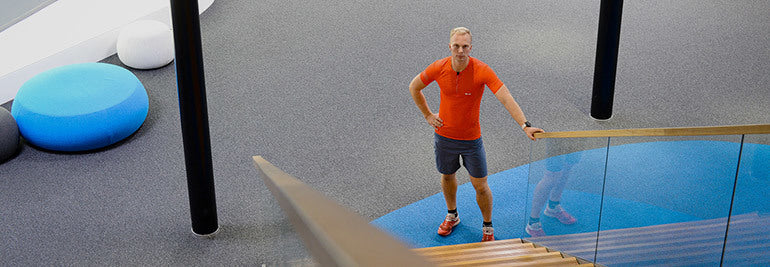
Matias sees stairs as an opportunity to stay active.
“My job is to maintain the health and wellbeing of everyone at Suunto,” the former footballer turned trail runner says. “Everyone who works for the company can use me free of charge. I offer group exercise classes, personal sessions, nutritional advice, and random exercise breaks. Everyone understands it’s a great opportunity.”
Matias has a Bachelor in Sports and Health Promotion, and believes there are many opportunities throughout the day for office workers to take care of their bodies and minds. Here are his tips:
1. Everything counts
Remember this phrase and make it your mantra. It cuts through all the excuses about not having time. Sometimes we get stuck in an “all or nothing” mindset; if we can’t, for example, go for an hour long run or a full gym workout, we don’t do anything at all, failing to see the possibilities that are often right in front of our faces, and don’t take much time. Matias says it’s about thinking laterally, and making everything count.
2. Three x three minutes
Take three, three-minute exercise breaks a day. Set a timer on your phone, and do it. Invite your colleagues to join you. To get you started, here’s a short video of Matias demonstrating a few simple movements – try them! “Getting the blood flowing is good for the brain,” Matias says.
3. Go out of your way
When you need to go to the bathroom or get water or coffee, rather than going to the closest option, get in some extra movement and take an extra flight of stairs to do what you need on a floor above or below. Go out of your way for the sake of a little extra movement. It all counts.
4. Have walking meetings
When you have a simple catch up meeting that doesn’t require technology, why not make it a walk and talk? Aside from the movement, people are generally less distracted and more engaged at a walking meeting. You’ll breathe better, and will feel more energized.
5. Use your lunch breaks wisely
Have a 25 or 30-minute workout before you have lunch and you’ll have more energy for the rest of your day. It could even be 15 minutes. Remember, everything counts. Do what you can, rather than getting stuck in what you can’t. “Studies show a small amount of exercise goes a long way,” Matias says.
6. Create team challenges
Try to create a culture where you encourage one another to stay active. Create a challenge to see which department or team can do the most pull-ups in a month, or can walk the most steps in a month.
7. Plan your day
When you plan your day in advance you will know when you have windows for exercise or movement breaks. Planning means you are more likely to take advantage of these. Lock them in, and make them count.


