


SUUNTOブログ

The Lowdown: CMAS 4th Outdoor Freediving World Championships 2019
On the white sun drenched shores of Roatan Island the gentle sound of the Caribbean Sea’s crystal clear water tentatively exploring the sand is lost behind the dissonance of diving activity coming from a dive platform located not far from the beach.
Divers are descending, safety protocols are being fine tuned, Alex St-Jean the official event photographer is testing his underwater camera equipment while the final training rehearsals are being observed in preparation for the CMAS World Championships that fin-kick off with an almighty duck dive on 6thAugust 2019 lasting five days. The event has been organized by Esteban Darhanpé at the Roatan Freediving School and Training Centre.
Chilling in the warm waters of the Caribbean Sea, Roatan Island is situated alongside a part of the 1000km of Mesoamerica Barrier Reef, the second largest reef system in the world.
The best of the best from around the globe are gathered to compete at the event. They compete not only to win but to be to a part of the freediving community.
A common misapprehension of freediving is that it is all about gaining the depth and in competitions this may be the case. Competition diving and its many disciplines are only one aspect of the sport. For most freedivers, the sport is just about hanging out with friends and exploring the underwater world.
“To the observer, freediving is all about serenity and calmness – a peaceful interaction with the underwater world. It is exactly all these things, which is why competition freediving presents such a unique challenge.” says Will Trubridge, Suunto Ambassador and World Champion.
“The conditions of a competition are slightly different to a world record attempt. In a competition you have an official pre-set time and there's a lot more people around – spectators and media. It's not as controllable as with a world record attempt,” says Will.
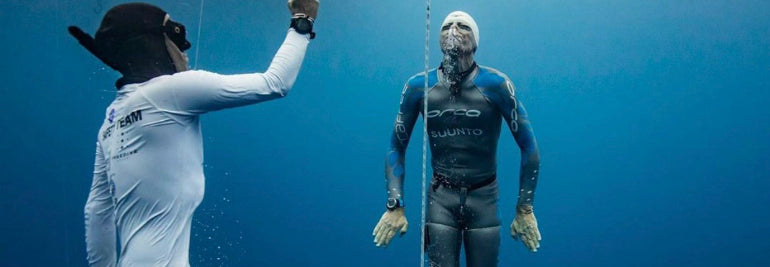
William Trubridge captured by photographer and freediver Alex St-Jean ©
Organizations
CMAS- The World Underwater Federation/Confédération Mondiale des Activités Subaquatiques founded in 1959 and is an international federation that organises underwater activities and events and is amongst the leaders in the scientific and technical research and development. It also acts as a training standards agency in snorkel and scuba training.
AIDA- International Association for the development of Apnea was created in 1992 after the film release for Big Blue. The rise in training freedivers and record breakers was developing at a vast rate and the AIDA was founded to keep track on the growing interests. The largest organization world wide of freediving event organizers, it also actively participates in scientific and technical research and development to help the world see freediving not as a thrill seekers sport, AIDA wants the recognition that “freediving is safe, fun, challenging and a fantastic blend of inner peace, concentration, technique, training, friends and team work”.
Disciplines
CNF- constant weight no fins is often talked about as being the purest form of freediving unassisted
CWT- Constant Weight with Fins discipline means the diver can wear fins, however they are only allowed to touch the rope to stop their descent and start their ascent. This discipline tends to give the deepest performances.
CWB- Constant Weight with Bi Fins. More monofins than you can shake a pair of bi fins at.
FIM- Free Immersion is a more relaxed dive where the diver can use the rope to pull themselves along using the rope, the diver is not allowed to wear fins on the dive.
Competition Terms
Safety Teams/Safety Diver- the Dive Safety Team is headed up by Italian Freediver Marco Cosentino and is currently holding the position of Chief of AIDA Safety Committee. He has a team of twelve safety divers there for support including Suunto Ambassador Sofia Gomez’s coach, freediver Johnathan Sunnex aka Johnny Deep.
Announced Dive Time- the official target time the diver will take to complete the dive, must be announced pre-dive. “You announce your dive on that day. If something goes wrong, then you don't have a second chance. It creates more of an element of chance. There is also a lot of sleuthing and spying to find out what other freedivers have done in their training to gauge how they're performing, and using that information to make pronouncements.” Says William Trubridge.
Official TOP- Time of Performance, as during the competition the organisers will be sticking to strict scheduling and the divers are assigned a time the dive must commence so all pre-dive preparation must be completed by the official TOP.
Duck Dive- the way a free diver ‘enters’ the water is by this type of dive as it gets the diver in a good position for descending and helps them along to few meters deep very quickly.
Freefall- once the diver reaches the point of negative buoyancy on their descent and begins to sink in a state of complete relaxation without finning down. This year we have spotted the athletes with strings tied around their thighs, Will Trubridge uses his to slide his thumbs in place so his arms stay positioned during freefall in order to conserve every bit of energy. It is this part of the dive that can induce the most pleasant feelings. Many freedivers feel euphoric as they enter an almost trance-like state.
Tag- a marker the diver must grab and bring back up to the surface when competing in depth competitions.
PB- personal best is the athletes, longest or deepest dive they have achieved. Can also be measured by distance.
Surface Protocol- the sequence a freediver must completion upon reaching the surface after a dive in a competition to convince the judges that the diver is lucid and not unconscious. The diver must face the judge’s direction remove googles and nose clip, give the OK signal and say in English “I am OK”/I’m OK” with a 15 second time limit.
Hypoxic- where the body is in a state of inadequate oxygen at tissue level. If the diver doesn’t get to the surface with enough oxygen to be lucid enough to complete the surface protocol they will be disqualified.
Cards- white, yellow or red. The judges will show a card at the end of each competition dive to signal whether the diver has had a fine performance with no penalties, yellow means the dive was completed with penalties and red signals disqualification from the dive.
World Championships Schedule
AUGUST 6th OPENING CEREMONY
Much like the opening ceremony of the Olympics we hope to see the atheletes parading around Roatan wielding flags, looking strong and generally building the hype, however it may be more of a technical meeting!
AUGUST 7th CNF COMPETITION DAY
Suunto Ambassador William Trubridge holds the world record in this natural discipline. Will set a new world record in freediving by diving to 101m with no fins in Dean's Blue Hole in the Bahamas. The new world record was set mere three days after he established an astounding new world record dive of one hectometre. Will's record-setting and mind-boggling constant no fins dive to 101 meters took 4 minutes and :08 seconds to complete.
Watch it here:
AUGUST 8th CWT COMPETITION DAY
Constant weight APNEA. This discipline means the diver can wear fins, however they are only allowed to touch the rope to stop their descent and start their ascent.
AUGUST 9th REST DAY
Rest day for re-ups on oxygen and rest.
AUGUST 10th CWB COMPETITION DAY
More monofins than you can shake a pair of bi fins at.
AUGUST 11th FIM COMPETITION DAY / AWARD CEREMONY / CLOSING PARTY
The winners get to take home a magnificent Suunto D5 dive computer and also collect a cash prize.
Sofía Gómez Uribe taken by freediver Johnny Sunnex @johnnydeep110 ©
Follow on Instagram @Suunto Dive to keep up with Sofía Gomez Uribe as she takes over for all latest news from the dvie platform.
Click here to see the offical Facebook page for the comptition.
5 inspiring coral reef restoration projects
Diving rich, rainbow colored coral reefs is every diver’s dream. We travel the planet to experience them, leaving us in awe of how staggeringly beautiful they are. Imagining our oceans without them is simply heartbreaking.
Yet, mass coral bleaching events – due to a rise in global surface temperature – could cause all 29 reef containing World Heritage sites to cease to exist by the end of the century. The stakes have never been higher.
To stop this from happening, divers, scientists and ocean conservationists are teaming up to find solutions. We look at five inspiring initiatives to save the coral, and also what you can do to help.
Reef Rescuers, Cousin Island, Seychelles
In a way, every diver should identify as a reef rescuer, and do what he or she can, even if only make donations, to support one of these initiatives. Starting in 2010, this huge and impressive restoration project has raised 40,000 corals in underwater nurseries, with 24,000 of these being successfully transplanted onto reefs, covering an area of a football field. The project utilised the coral gardening technique of retrieving fragments of healthy coral, growing it in protected nurseries and then transplanting it onto degraded reef to help rejuvenate it. Based on its learning, the project created a Coral Reef Restoration Toolkit for other initiatives to benefit from.
Secore Coral, Yucatan Peninsula, Mexico
Starting in 2015, this pilot project researched and tested new techniques to use coral grown in land-based or ocean nurseries for restoration, waiting until they are old enough to plant out on reefs where they are then monitored. This inspiring documentary below shows what’s possible.
Pur Coral, Indonesia
Coral reefs across the world need all the help they can get, including financial support from the corporate sector for restoration projects. French dermo-cosmetics brand EAU THERMALE AVÈNE partnered with Pur Projet to create Pur Coral, a project to preserve and regenerate marine ecosystems in Pejarakan, Bali. The corals had been destroyed mostly by cyanide and dynamite fishing, which are now banned there. Since its start in 2016, the project immersed 24 artificial reef structures underwater, then planted 1855 corals, from more than 15 species, on them. For several years Avène has engaged in an eco-responsible initiative called "Skin Protect Ocean Respect" to raise awareness about the impact of sun protection on the environment, and particularly on the marine life and corals. Avène has also been a leader in redesigning its sunscreen product range, minimizing the impact on the environment without compromising on optimal UVB-UVA protection for the skin.
RangerBot, Great Barrier Reef, Australia
Like a Swiss army knife, a state-of-the-art robo reef protector developed by researchers at Queensland University of Technology in Australia – RangerBot – has a number of functions, all designed to protect one of the wonders of the world, the Great Barrier Reef. It’s first function is to search and destroy; its incredible cameras identify invasive Crown-of-Thorns Starfish and injects them with a lethal dose of poison. It also monitors the health of the coral and water quality. It can also map vast areas underwater at scales not previously possible.
World’s largest 3D printed reef, MARS, Summer Island, Maldives
The Modular Artificial Reef Structure (MARS) is an ongoing project developed by industrial designer Alex Goad. It utilises 3D printing to provide a rigid skeleton on which corals can be implanted and grown. In August 2018, they submerged the first reef off the coast of Summer Island, in an area where there has never been a coral reef, and where locals have been growing corals. Alex says the ease, affordability, flexibility of 3D printing can play an amazing role in preserving coral around the world.
6 ways you can make a small difference
Conscious travel
Air and vehicle travel are major contributors to the rising greenhouse emissions driving the climate crisis. Consider trying to reduce both. For example, use public transport or ride a bicycle whenever you can. And when you do fly, offset the carbon emissions from your flight by using a carbon calculator, and compensating a green cause of your choice.
Hands off
When you’re out diving, don’t touch coral or any marine animals. Keep a respectful distance. Don’t pursue animals to get that trophy photo. And don’t collect shells and so forth as souvenirs – remember that hundreds of people dive the same site, and if every diver took a souvenir it would create a big problem.
Use eco-friendly sunscreen
Use sunscreens based on eco-designed, biodegradable formulas. Avoid products that have the following ingredients in them: Octocrylène, Benzophenone, Methoxycinnamate. Take a look at Avène’s sunscreen range – they are brand of choice for divers at Suunto head office.
Be a tidy diver
Single use plastics really are an abomination. Divers should lead the way and quit using them. Be sure to clean up any plastic trash after your dive when you’re back on land.
Start “strawkling”
Strawkling is a new recreation that combines snorkeling and collecting litter. Take a net-cloth bag on your next dive, and collect any plastic litter you find. Imagine if we all did this!
Change your business practices
If you own, manage or work for an organisation in the global dive community, join Suunto in getting onboard with Mission 2020 and changing your business practices so they help protect and preserve our oceans for the future.

The Baltic Unveils Treasured Secrets with The Help of Suunto Divers
Bow of Vrouw Maria with divers. In the early stages of the work, investigations of Vrouw Maria were also illustrated by artwork. Drawing by Tiina Miettinen, Finnish Heritage Agency.
Suunto’s Dive Engineer Pasi Lammi and his dive team, the Badewanne, were invited by the National Board of Antiquities in Finland to join the expedition to create a 3D model of the underwater site. This was not the first time the Bedawanne had experienced the wreck, they were amongst a team of divers in 2007 that got to explore her pristinely preserved wooden structure. Diving access on previous archaeological expeditions have been limited on the wreck due to the increased risk of disturbing the sea floor and concealing the wreck further or risking damage to the delicate structure.
The atmosphere after the expedition dive in 2007. Roope Flinkman (left), Pasi Raasakka, Petri Puromies, Jussi Kaasinen, and Minna Koivikko. Photo by Ulla Klemelä, Finnish Heritage Agency.
Down with the ship
The Vrouw Maria is a Dutch two mast merchant ship that set sail from Amsterdam on 5th September 1771 destined for St Petersburg, Russia but it never arrived in port. During late September the Vrouw Maria entered into the Danish Straights and the cargo was last recorded at the Elsevier (Øresund) toll before she sank. It was reported that after some navigational errors through the stormy Archipelago Sea the ship lost its course and ran aground. Obtaining only slight damage to the hull, the vessel fell foul of another grounding shortly afterwards this time losing the rudder when a large wave freed the ship from the sea bed and the crew could not control the water coming.
On October 4th 1771 the crew finally abandoned ship and made it to safely to nearby rocks after saving only a portion of cargo during the short window of opportunity they had as the water flooded in. There was some effort to stabilize the ship but the pumps were clogged with coffee beans leaked from cargo in the hold and finally, on 9th October 1771 the Vrouw Maria sank beneath the waves taking most of the cargo and revered luxuries down with ship.
Onboard the Vrouw Maria when it sank were bags of coffee, sugar and fabric dyes. The most precious items in the hold were artworks purchased by Catherine the Great at auction that year in Amsterdam on their way to her residence. Other luxuries including mirrors, ivory eggs, and flower bulbs headed for Russian nobility that still lay in the sea bed today. Little was saved during the rescue and even less has been salvaged off the wreck since it was discovered.
The positioning of the wreck on the sea bed had remained a mystery and regard was lost in the wreck for over 200 years. However, interests peaked in the 70’s when Dr Christian Ahlström discovered documentation of the incident in the Finnish National Archives that he then published. His findings in 1979 sparked an exciting search mission that was to last twenty more years.
A wreck was discovered in 1999 by the Pro Vrouw Maria society using a side scanner under Rauno Koivusaari’s leadership, and was positively identified as the Vrouw Maria.
Now twenty years later on the anniversary Suunto’s very own Dive Engineer Pasi Lammi has been invited to dive the wreck and take part in the 3D modelling project. Pasi and his dive team, the Badewanne Team are committed to working alongside the Finnish Board of Antiquities, Military Museum of Finland and collaborators from around the world in a bid to preserve the Baltic history.
Pasi’s office location
2012 Virtual Simulation
During 2012, at an exhibition called ‘Lost at sea, rediscovered’ there was a virtual simulation of the wreck that visitors of the Finnish National Maritime Museum could visit. This impressive footage was honoured with an award at the Europa Nostra Awards 2015 competition of the European Union.
“Through a simulation constructed by Aalto University and the Finnish Heritage Agency, the general audience could examine in detail the treasure ship, which in reality is difficult to access. At the time, the Vrouw Maria simulation was a totally novel way of visualising the underwater world and making it accessible.”
The virtual simulation of the Vrouw Maria wreck received a special nomination in the research and digitalisation class of the Europa Nostra Awards 2015 competition of the European Union. Image by the Finnish Heritage Agency.
The Revisit - 3D model of Vrouw Maria
Now with team of volunteer divers who are revisiting the wreck and taking the latest in photo 3D modelling technology underwater to create an ultra-realistic interactive map of the wreck site people will be able to appreciate the ship in all its glory from above the water. The divers use a mix of videos, photos and photogrammetry to create the final product that will illustrate how far technology has come since the 2012 simulation and give a more in depth look at the wreck.
“Today was the first day and our initial mission was set up for the modelling to begin. We experimented moving the camera into different locations to get the best views of the wreck and setting up attachments to secure cameras. After this the team and I then test documented two locations so we could present the findings for the Finnish National Heritage agency. The project has just begun and the results will be released soon, and we certainly are excited to see the results.” Pasi comments.
Pasi shared his dive profile from his Eon Steel paired with his Suunto App we can re live his dive with him.
The completed project will go on display at the new Stockholm Treasures of the Baltic that is scheduled to open its doors in 2020.
Before the final model opens at the museum you will be able to view the first version of the project on the twentieth anniversary of the discovery of Vrouw Maria, 28th June 2019, on the online 3D modelling platform, Sketchfab.com.
About Pasi Lammi
Pasi Lammi lives in the city of Espoo, Finland. He started diving in 2007 and had his first dives on a rebreather in 2009, after which he made the switch to JJ-CCR in 2014. His diving certifications include IANTD, NSS-CDS, PADI, NAUI and CMAS accolades and instructor level for both NAUI & CMAS training agencies where he teaches diving both in Finland and Estonia.
He is an active instructor and teaches both recreational level divers and technical but his heart lies in the technical side of diving. Pasi is also a very active dive club member and joins in activities with a number of local dive clubs.
When he is not training you will find him diving wrecks in Baltic Sea or mines in the Nordic countries. For Pasi diving is not only about seeking experiences of his own but also working as part of a team and sharing the experiences with others by the means of documentation of historical interests. He enjoys taking underwater images, videos and now working on 3D modelling projects has brought a whole joy to his diving. He takes great pleasure in contributing to the discoveries of new historical facts and building up the bigger picture of his cultural heritage.
Filling cylinders on location in preparation to explore the Vrouw Maria on the anniversary dive, 2019.
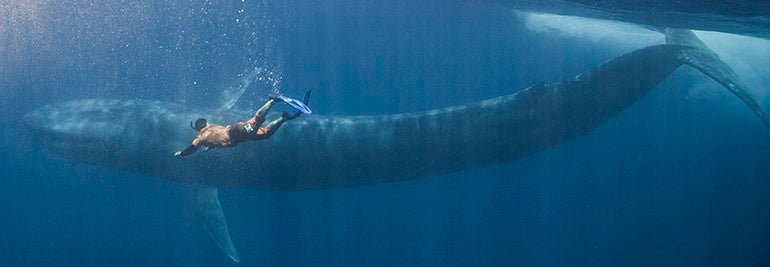

Underwater videographer Patrick Dykstra is taking over @suuntodive Instagram for a week
Underwater videographer Patrick Dykstra is taking over @suuntodive Instagram (Image by Chris Michel).
Who are you and where you from?
My name is Patrick Dykstra and I'm from Denver, Colorado, USA, but have been based in Dubai for the past 10 years.
Where do you dive?
I dive anywhere that has whales and other megafauna. The more remote, the better!
What inspires you in the underwater world?
There is so much that we don't know about the animals that inhabit our ocean. I'm inspired by the pursuit of the unknown and driven to help others learn more about our oceans, and the threats they are facing.
How would you describe your photography style?
I actually am doing a lot more videography these days, but I do still love taking still images now and then. That said, I don't think I have a particular style.
Is there a story you wish to tell with your images?
I hope to bring the mega fauna of our oceans to people's attention. In Dominica, we know most of the sperm whales by name as they are individuals. The whales have calves that they struggle to raise, they need find enough food to eat daily and sustain life while avoiding getting entangled in fishing gear. Introducing them to people as their individual self is important and we hope to inspire people to conserve their habit and respect their home.
What have you been working on recently?
I filmed for the BBC's Blue Planet II ending in 2018 (for which I won a BAFTA), then for National Geographic's Hostile Planet and BBC's Wild Shetland - Scotland's Wild Frontier.
Next year sees a big change as I move in front of the camera to host a multi-part series on Animal Planet coming out in 2020 that explores new discoveries in the world's oceans which is very exciting.
Where can we follow your adventures?
Follow me here:
Website: www.pictureadventure.com
Instagram: @pictureadventure1
FB: Facebook.com/PictureAdventureExpeditions
FOLLOW @SUUNTODIVE INSTAGRAM TO SEE PATRICK'S WORK AND MORE!

How to swim like a dolphin
Watching Suunto ambassador and freediver William Trubridge swim underwater like a dolphin across New Zealand’s wild Cook Strait, it’s easy to believe he possesses some sort of preternatural ability. There are, after all, few people on the planet who can swim 32 km in that manner for nine hours and 15 minutes.
In March this year, Trubridge achieved a world first: he swam under the surface of the strait before surfacing, and diving under again, all the way across, using the dolphin kick to propel him. A channel crossing of this kind had never been done before.
He did it to raise awareness about the plight of New Zealand's endangered Maui and Hector's dolphins. During his swim, his Suunto D6i Novo dive computer recorded 943 dives. Watch the short clip below below to see him in action.
Mastering the dolphin kick didn’t come easily to Trubridge. He’s had to work at it. “When I first started free diving, I struggled with the movement, and it’s probably because I never swam butterfly at high school,” he says. “It’s not a natural movement for me. It requires a lot of flexibility in your whole back and I didn’t have that at first. I still don’t have it to the same degree as some other free divers.”
He has patiently practiced the technique over a number of years. All that training has paid off. Who better to ask about how to develop a powerful dolphin kick?
Trubridge did his epic swim to bring attention to New Zealand's dolphins and to pressure its Government to protect them.
Why master the dolphin kick?
Simple answer: it feels awesome. “You can really fly through the water at a good speed for a human being,” Trubridge says. “It’s fun to play in waves. You can swim towards a wave as it’s about to break and jump out the back of it like dolphins do. Or you can swim down to 10 m, turn around and swim back up as fast as you can and actually breach clear out of the water because of your speed. It’s a lot of fun to play around with a monofin.”
It’s also an important stroke for freediving, especially for the Constant Weight discipline. Using a monofin and a dolphin kick is the most efficient propulsion, and is best the way to dive the deepest and longest.
How is it done?
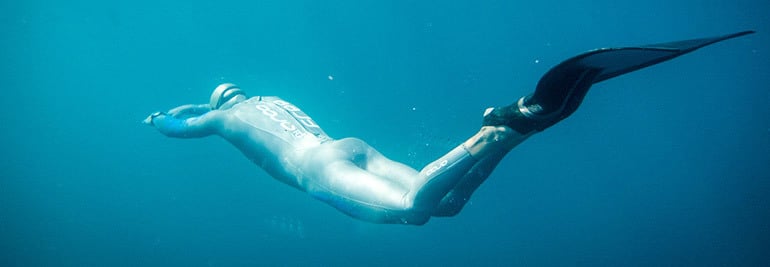
It’s the same stroke as butterfly swimming, however it’s done underwater. A monofin or flippers are used in freediving to gain a bigger surface area for propulsion. “The movement is generated by an oscillation of the pelvis, forwards and backwards, controlled by your lower back, and abdominal muscles,” Trubridge says. “It starts a wave that’s sent down your legs into the fin. In order to transmit that wave efficiently you need to keep your legs straight, using your quadriceps, hamstrings and calves. Your upper body, ideally, stays pretty stationary. You can have your arms out in front of you which is a lot more streamlined, or by your sides which is more relaxed.”
How to develop the underwater dolphin kick?
Technique before power
One common mistake, Trubridge says, is to start out practicing the dolphin kick with a monofin. Because the monofin is so powerful it compensates for bad technique. “You can bend your knees, and move inefficiently, and still get good propulsion with a monofin,” Trubridge says. “My advice is to always start with something that doesn’t have the same surface area, like really small flippers, and practice dolphin kick with those, which will be a lot more difficult.” Alternatively, try without flippers.
The practice: Underwater, extend your arms and try to dolphin kick and get good speed. Don’t be put off if you don’t move forward at all; it takes time to develop the technique.
Vertical dolphin
Position yourself vertically in deep water with just your head and shoulders out of the water. Extend your arms above your head. Now, try the dolphin kick, keeping yourself as high above water as possible while staying in the same spot. “It becomes tiring very quickly,” Trubridge says. “It trains the muscles you need in your core and legs, and after a while you will find yourself slipping down into the water.”
Land-based exercises
Any exercise that improves core and leg strength will help. However, Trubridge says specificity of training is important. “Squats, crunches, those sorts of things, will target those muscles, but I prefer to target them in a way that is more specific to the way they are being used in the stroke,” he says.
Hanging bar exercises
Swinging: Find a hanging bar, and hang from your hands, with your palms pointed away from you. Using your core muscles, swing your legs back and forward, keeping them as straight as possible. Don’t use momentum to swing, but rather the abdominal muscles.
Pike pull up: From the hanging bar, do a pull up with your legs in the pike position, or in front of you at a right angle to your upper body.
Monofin or flippers?
The monofin is the best for deep dives, maximum speed and efficient movement. The downside is they are hard to wear for long periods of time. They have to be strapped to the feet very tightly, which can cause blisters and cramps.
Flippers are better for relaxation, recreation – spearfishing and snorkelling, for example – and for training. They offer more versatility.

William Trubridge swims like a dolphin across wild New Zealand channel
New Zealander William Trubridge has emerged from the Cook Strait jubilant after becoming the first person to complete a channel crossing by swimming underwater.
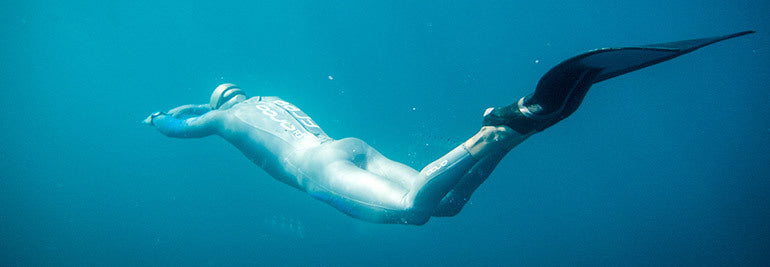
Trubridge used his incredible breath hold diving ability to swim under the surface, like a dolphin, before surfacing, and diving under again, all the way across. He followed conventional channel crossing rules, such as not resting on a boat or float, except for two changes: all propulsion had to take place underwater on a breath hold, and the use of a wetsuit and fins/monofin was permitted.
“We had strong currents and cold water patches, rough seas, it was like being in a washing machine at times,” he says. “I was getting cramps, cold, blisters, the usual stuff. But I still feel like I got off lightly; there were so many things that could have been different, and for each one of those I probably wouldn’t have made it. I’m feeling a lot of relief and jubilation at the end to make it.”
The Cook Strait separates New Zealand’s North and South islands, and is considered one of the world’s most unpredictable and treacherous stretches of water. At it narrowest points, it’s a mere 22 km across. But what it lacks in lengths it makes up for in fierceness: wild unpredictable weather and powerful currents, chilly water that can cause hypothermia, stinging jellyfish and a population of curious sharks.
“Crossing the Cook Strait is like trying to hit a bullseye, with the target on the back of a bucking bull,” Trubridge says. “The currents are so powerful, and reversed direction at least three times during the swim, mean that hitting the closest piece of land (Perano Head) required constant calculations and course corrections. I’d heard many tales of channel swimmers coming within 500 m of land and battling against currents for another four hours before succumbing to cold and fatigue without reaching the shore.”
The decision to attempt the first “human aquatic crossing” was made suddenly when a good weather window coincided with advantageous low tides. Trubridge had previously done only a few six to eight-kilometer training swims to prepare. “I knew I wasn’t really built for this kind of thing,” he says. “My sport (depth diving) is primarily anaerobic fitness, so I don’t have well developed aerobic muscle fibers. My body type is pretty much the exact opposite of what you need to have for this kind of cold water swimming.”
Thoughts about the plight of New Zealand’s Hector’s and Maui’s dolphins, and wanting to save these precious and intelligent animals, kept Trubridge moving forward despite the challenging conditions and 15-18 degree water. “The main reason for doing it has always been to bring more awareness to the situation with the dolphins,” Trubridge says. “These are the two subspecies of New Zealand dolphin that occupy the North (Maui's Dolphins) and South (Hector's Dolphins) islands. Both subspecies are threatened by extinction.”
Trubridge is calling on the New Zealand Government to act quickly to save the dolphins. The fishing industry must be better regulated to protect the dolphins. He invites divers around the world to put pressure on the New Zealand Government to act before it’s too late.
“I made it across about five times slower and with five times as many dives as it would take a Hector’s Dolphin to make the same crossing, but it showed that if we can swim like a dolphin between our two islands then they too should have the freedom to do the same.”
WATCH NOW: Will Trubridge crosses Cook Strait "like a dolphin"