




SUUNTOブログ

EXPLORING WRECKS IN THE GULF OF FINLAND
On a dark, stormy December night in 1944 a fleet of five German warships was cruising the labyrinthine waters of the Gulf of Finland. Due to navigation error two of the ships ran into their own German minefield between Porkkala and Naissaari and were lost.
Badewanne, a Finnish, non-profit organization representing a group of voluntary divers that have been documenting shipwrecks in the Gulf of Finland for more than 15 years, recently dove down to one of the destroyers, the Z36. Juha Flinkman, one of the Badewanne divers, gives us a guided tour:
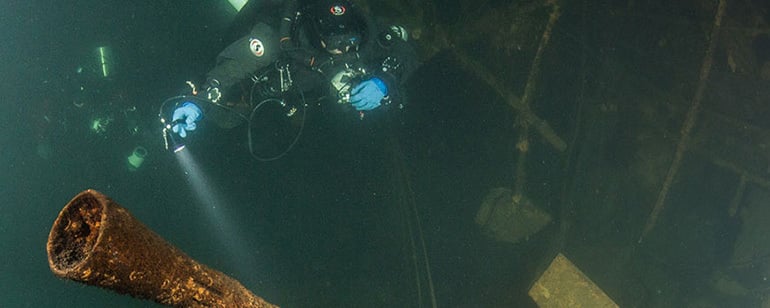
“Diving to the wreck of Zerstörer (Destroyer) Z36 is a unique and eerie experience. As you glide down the shotline into the darkness, the beam of your light first picks up a scary mess of mast, radar aerials and – trawl, lots of it! Carefully avoiding the trawl you descend towards the superstructure past a quadruple 20 mm flak gun wrapped in netting, barrels sticking through the mesh.
Passing over the port side of the bridge wing, you suddenly stare at the muzzles of a twin 20 mm Flak gun mounted on the fo’csle deck. The barrels vainly aim at the unreachable sky far above. This flak gun is situated a little aft of “Bertha Geschütz”, that is B-gun of the main armament of 127 mm guns. These Mob 36b type destroyers weren’t supposed to have any such armament here, but what the heck, maybe the Skipper just wanted some extra anti-aircraft hardware installed!
Later, swimming from the gracefully arching bows towards midships, your lights pick up mighty Rheinmetall-Borsig barrels of Anton and Bertha Geschütze still defiantly pointing forwards, but never to be fired again. Even the riflings inside the barrels are clearly visible.
Even when diving in the clear parts of the wreck, the ever-present trawl netting looms, if not in your vision, then in your mind. You must always be aware of this danger – there is no room for carelessness.
This wreck is very big. It was distinctly once a very powerful warship, but now lays with her back broken on the seafloor, wrapped in trawl, and her payload of death strewn all around. A dark and a lonely place.”
All images: © Badewanne

Swimming the Northwest Passage
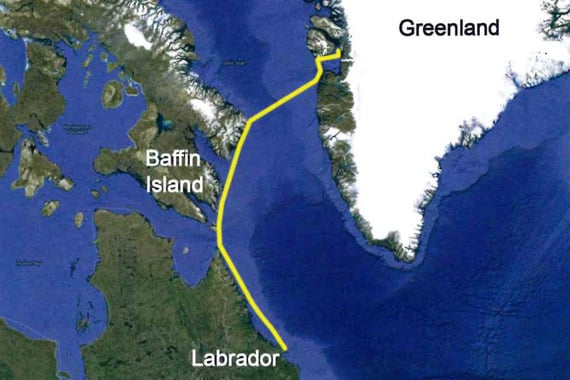
The Northwest Passage, spanning 3,000km from Pond Inlet, Nunavut, to Inuvik in the Northwest Territories, was daunting enough when Roald Amundsen became the first person to unlock its secrets back in 1906.Over a century later, a team of ten women will do it a new way — swimming with snorkels. Named the after the Inuit goddess of the sea, the Sedna Expedition will seek to expand our knowledge of what lies beneath the often sub-zero waters, while reaching out to local Inuit and Inuvialuit women and girls, empowering them to build resilient communities to battle climate change. While the swim won't take place until 2016 (route map, top right) this coming summer will see an exploratory mission as Team Sedna boards a 116 expeditionary trawler for a 15-day trip (route map top left). They'll connect with local communities, build team cohesion, test their gear, and prove they can manage the distance. Suunto ambassador Jill Heinerth gives us the lowdown. Snorkeling across the Arctic? Sounds like a crazy plan! The concept for the expedition was the dream of Susan R. Eaton, a Canadian earth scientist and journalist with a passion for educational awareness of global climate change and a deep connection with the indigenous people of the North. Three years ago, after witnessing another sailboat navigate the Northwest Passage Susan had a 'Eureka!' moment: Wouldn’t it be remarkable to swim the Northwest Passage? Why snorkel? Snorkeling (as opposed to SCUBA diving) gives a swimmer a completely different viewpoint. The loss of sea ice is transforming the Arctic rapidly. We’ll be working in the transition zone between the earth, air, water and ice. Everything is the Arctic is driven by what happens in this snorkel zone. It’s the wheat fields of the North, where feeding, mating, predation and migration all take place. What's the plan? We definitely have to do shifts to make the distance. Assuming success during the proof-of-concept expedition, we'll start our epic three-month journey in the summer of 2016. We’ll follow in the esteemed footsteps of European and Canadian explorers, many of whom perished during their attempts to cross the treacherous Northwest Passage.How many people will take part? We have a team of ten remarkable women, aged 26 to 56, taking part in the project supported by a mother ship equipped with two rigid hull boats. The women hail from Canada, the United States, Mexico and New Zealand. Many are world-class technical divers and underwater scientists.What's your personal motivation? To bring science and conservation messages to people in a fun and exciting way. Last summer, I rode my bicycle across Canada, some 7,000 kilometers, and had a remarkable opportunity to connect with citizens of all backgrounds, while sharing a project called “We Are Water.” When people are inspired, it opens up a dialogue that can be life changing for all.The biggest challenge? The biggest challenge is the environment itself. The brutal cold, transient ice conditions and ferocious animal life (polar bears, walrus, orcas, Greenland sharks) all bring risks. How cold will the water be?The water will be as cold as it can get — minus 2 Celsius. We will need to be in the water many times a day and standing watch, completing science missions, making outreach journeys to Inuit communities and filming the entire mission. It is a lot of work for a small group. I think we’ll crash hard at the end of each day!You'll have some help with propulsion. Diver Propulsion Vehicles (DPVs) are also known as “scooters.” A diver or snorkeler can clip herself behind this torpedo-like device and use the motor to help propel her through the water at a faster speed than swimmers could otherwise achieve. This will help us cover ground, battle currents, and get to safety quickly if we encounter a polar bear or other animal that could harm us in the water.
Stay tuned for more updates on the Sedna Epic Expedition. For more diving adventures, check out our Facebook fanpage.

Under The Pole
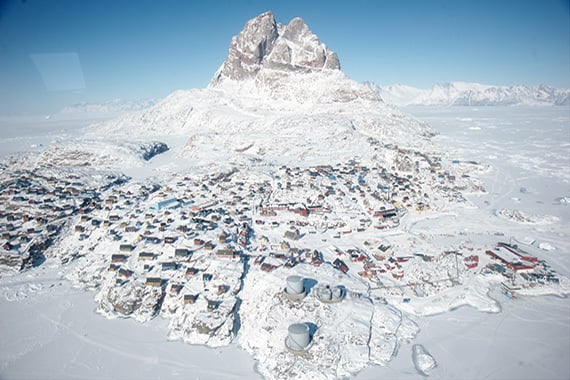
A team of French explorers has set sail on an ambitious scientific expedition to chart the western coastline of Greenland from both above and below the waterline. The group set off from Concarneau, France on January 16th and will spend the next 22 months on the expedition.
The first phase will see them sailing up the west coast of Greenland, carrying out detailed surveys before wintering on the boat in the Nares Strait. A third phase, from March to June next year, will the see them undertake a 600 km adventure as they cross northern Greenland with Inuit and dogs. “It's an amazing dream come true,” says expedition leader Ghislain Bardout.
The expedition website reveals the many goals of the expedition: “Under The Pole is a series of submarine polar expeditions aiming at exploring the hidden face of Arctic polar regions. We will explore the coastal ice sheet, open sea ice sheet, glacier fronts, icy fjords and the continental shelf between the polar circle and the north of Greenland.”
Suunto is pleased to be an expedition partner and is supplying the team with a range of products. The scientific aims of the expedition include listing the polar submarine biodiversity during a complete season to a depth of 130 m and studying the relations between atmosphere, ice and the ocean.
Stay tuned for updates from the team.
All images © Emmanuelle Périé / Under The Pole


Freedivers prepare for Suunto Vertical Blue
Freediving is a sport that attracts some of the most unique athletes on the planet — men and women who can hold their breath for several minutes and plunge to impossible depths of the sea. This weekend sees the start of one of the highlights of the freediving calendar — the Suunto Vertical Blue.
On November 9th, 36 athletes from 16 countries will join the event host and dual world record holder, William Trubridge, to compete in the nine day competition at Dean’s Blue Hole, Bahamas. Along with an unmatched location at the world’s deepest underwater sink hole, Suunto Vertical Blue offers the prospect of battles between the world's top freedivers. Among those attending this year is Alexey Molchanov, the current world record holder in Constant Weight (CWT).
His record breaking dive to an astounding depth of 128 meters (420 ft) is held in awe by the freediving community but there are hints of greater depths to come. Pursuing him is William Trubridge, current world record holder in the disciplines of CNF and FIM. Trubridge has his eye on reclaiming his national record in CWT as well as challenging his own, legendary CNF record of 101 meters (331ft).
Says organizer William Trubridge: “The biggest names in men's freediving will be there and will go to their body's absolute limit in order to secure a title or medal! But Suunto Vertical Blue is more than just a competition — it has a convivial atmosphere that makes it special. We have people who haven't trained for long and are diving to 30-50m, right up to the biggest names in the sport, who are setting national or world records at almost every event.”
Freedive depth disciplines consist of three categories:Constant Weight No Fins (CNF): The freediver descends and ascends without any assistance (only using arms and legs without fins).
Constant Weight with Fins (CWT): The freediver descends and ascends using fins/monofin and the use of arms.
Free Immersion (FIM): The freediver dives without the use of fins/monofin, but pulls a rope during descent and ascent.
Says Trubridge: “CNF and CWT are the two most popular disciplines. CWT gives the deepest performances, while CNF is seen as the purest expression of human aquatic potential. FIM is more of a relaxed discipline, but there are definitely some very serious practitioners there as well!”
He adds that the sport has moved away from 'sled-diving' — where freedivers use artificial means such as a weighted sled and balloons to descend and ascend. It is seen as a more dangerous fringe activity and is not a discipline at regular freediving events.
Comments Mika Holappa, Business Unit Director, Suunto Dive: “Suunto Vertical Blue is a really unique competition. Dean's Blue Hole is an amazing location and the freedivers are some of the most inpiring athletes around. We're very pleased to be supporting this event once again and wish everyone the best of luck.”
Competitors have six official dives to challenge themselves and their rivals to obtain the coveted Suunto Vertical Blue Championship title. There are also significant prizes on offer — including a purse of almost $20,000 in cash, as well as a selection of Suunto D4i and D6i dive computers.
For daily updates, latest news and spectacular images, check out the Facebook fanpages of Suunto Diving and Vertical Blue.


