




SUUNTOブログ


New software 1.5.9 for Suunto D-series dive computers
Suunto, the world’s leading dive computer brand, introduces an optional software update bringing usability and performance improvements to the Suunto DX, Suunto D6i, Suunto D6i Novo, Suunto D4i and Suunto D4i Novo.
Suunto's D-series dive computers are known for their refined design and solid functionality. The new software update 1.5.9 builds on consumer feedback and makes the devices even more user-friendly whether you're an experienced technical diver, freediver or an adventurous spirit new to the diving world.
The new enhancements include:
The dive mode selection is moved to sub menu ”General Settings” to make it easier to change and dive with the desired mode.
Easier and quicker digital compass calibration brought to D6i (similar to the DX) adds the possibility to calibrate the compass also underwater.
Stopwatch usage simplified.
Enhanced battery and pressure sensor checking.
This optional software update is available to existing Suunto DX, D6i and D4i owners via Authorized Suunto Service Centers. Please note, Suunto authorized battery change points are not able to offer this software update. When you send your dive computer for servicing or a battery change, the software will be updated at the same time without an additional cost. Without a battery change or other service procedure the cost is a handling fee that varies from country to country. D4, D6, D9 and D9tx can not be updated – you can identify the model on the backplate of your dive computer.
Please contact your local Suunto Dealer or Suunto Contact Center for more information. For contact details and updated user guides check out support. You can also check out the D-series learning tool or visit the Suunto YouTube channel for how-to-use videos.


Diving between tectonic plates
Underwater explorer and Suunto ambassador Jill Heinerth has dived in breathtaking locations all over the world so when she says one place has the clearest water and is the most inviting it’s worth sitting up and paying attention. It’s time to update your bucketlist. Located in Iceland’s Thingvellir National Park is the most impressive meeting place of the North American and Eurasian tectonic plates – the Silfra fissure. The two plates drift apart about 2 cm every year and snorkelers and divers can swim between them in the fissure and even touch the two continents at the same time – the only place in the world this is possible.
Intrepid underwater explorer, photographer and film maker Jill Heinerth dived there in 2014 with scientist Jónína Herdís Ólafsdóttir who is researching the unique bacterial colonies that live in the Silfra and in other fissure cracks around Iceland. The research may offer insights into early life on Earth and possibly about life on other planets. While exploring there, Jill captured some amazing images of Jónína swimming in the fissure. Prepare to be amazed.
The Silfra fissure from above. © IntoThePlanet.com – Jill Heinerth
100 m visibility
The underwater visibility in the Silfra fissure is over 100 m. This is because it’s cold (2°C – 4°C year round) glacial water that's filtered through lava for 30 to 100 years before seeping from underground wells into Thingvellir Lake. It’s so pure it’s fit to drink. “Diving or snorkeling in Silfra should be on everyone's bucket list,” Jill says. “There’s simply no other water on this planet that is as clear and inviting.” © IntoThePlanet.com – Jill Heinerth
Diving into creation
The Silfra fissure has four sections that can be explored: the Silfra Big Crack, the Silfra Hall, Silfra Cathedral, and Silfra Lagoon. “Drifting through the gap in the tectonic plates in the middle of this gusty, raw and primordial environment makes you feel like you are diving into creation itself,” Jill says.
© IntoThePlanet.com – Jill Heinerth
The home of adventure
“Iceland is a stunning and unique environment,” Jill says. “The people are warm and the geography is absolutely incredible. For those that love the wildness of outdoor adventure, there is nothing like it.”© IntoThePlanet.com – Jill Heinerth


Discovering the earth’s last hidden frontiers with Phil Short
Phil Short has been a dive industry professional for over 20 years. He has explored some of the world’s deepest dry caves and spent thousands of hours diving water filled passages. Research and archeology are also his passion, including such assignments as the Antikhytera survey project in Crete. But what is down there that draws Phil to explore these submerged realms?
Cave diving is the last field where human beings are mandatory for exploration. In Victorian times, when somebody climbed a mountain, that was it. They were the first. Now technology has taken over. You can take a look at a picture of a mountain, a valley, jungle, or a gorge before you go there. It has been all mapped.
“When you get to the end of the line in a cave, tie your line to that line and swim around the corner, you're the first human being there. It's true exploration, much like Shackleton, Scott and all of these early explorers did because there was no choice. In cave diving, there's still no choice, and that's why I’m so passionately driven by it. Anyone with a sensible budget can find new territory.”
THE CAVE DIVING ROCK NERD
Millions of years ago, the seas were filled with very different kinds of life forms than today. Over the millennia, soft seafloor turned into limestone, preserving a snapshot of these creatures from the past. Caves cut right through these ancient layers, displaying a rich collection of fossils and telling a geological story of the Earth’s past.
Phil Short has dived caves all over the world, spending thousands of hours diving exploring many kinds of dry and water filled passages. He knows that seemingly small details hide countless stories. Taking a close look, a bulge in the cave ceiling can turn out to be a tooth of an extinct tiger.
“Think about swimming through 100 metres of cave passage today, and memorise all of it. And then get into a time machine and go 3,000 years into the future. The cave would be different because you're diving in something that is alive. The acidic rainwater is dissolving rock, and the flow of the water is eroding it. So the cave is growing. It's forming. It's changing as you're swimming through it.”
SETTING THE PERSONAL LIMITS IN CAVE DIVING
Cave diving requires rigorous training and the right equipment. But there also needs to be the correct mentality and respect for the forces of nature. Constant practise and safety margins are the cave divers tools for keeping the risks at bay.
Phil Short has been a dive industry professional for over 20 years. He has trained hundreds of divers and participated in demanding cave rescue operations. With the experience of thousands of dives, he knows where to draw his line.
“I don't consider cave diving an adrenaline sport. In fact, it's the opposite. Going to an extremely deep point in the ocean, just to get a number for a depth record, that is not my motivation. I would happily do, and have done a lot of very deep dives, for a reason such as a historic shipwreck that nobody's managed to dive. I have more of a kind of Peter Pan, never grow up, child-like approach to exploration. Being there is just magical. It's my drive.”

What freedivers can learn from the top of the world
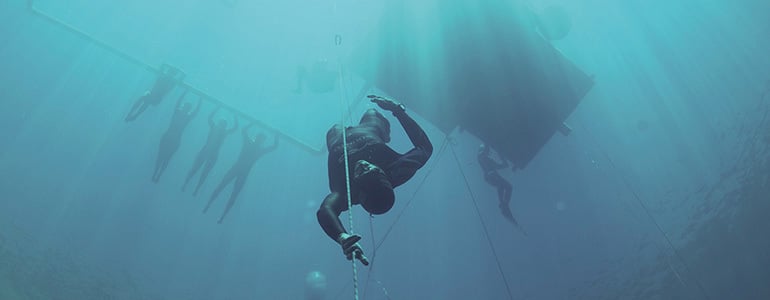
Suunto ambassador and freediver William Trubridge has given his life to the sport of diving as deep into the ocean’s depths as any human can without scuba equipment. But he recently decided to explore the other end of the planet – the heights of the Himayalas. He trekked 300 km, with 10,000 m of vertical ascent. The longest day was 13 hours of hiking. We asked him what he learned at the top of the world.
Why did you go trekking in Nepal? It was mainly to do something together with my father David and brother Sam, as we live in separate parts of the world. We chose the Himalayas, as my father loves the mountains, and neither Sam nor myself have seen those kinds of mountains.
"I think freediving training definitely has a crossover effect to mountain climbing."
Where were you?We trekked to Kanchenjunga base camp in eastern Nepal. Kanchenjunga is the third highest mountain in the world, and one of the holiest. The remoteness of this area means there are few trekkers and even fewer amenities. This is exactly what we wanted.
At 5163 m, the atmosphere is half as dense as at sea level, meaning half the volume of oxygen per breath.Vastly different environment than you’re used to – how was it? It was humbling. I realised just how un-adapted my body is to that kind of world. After 12 years of only freediving training in the water my knees were unacquainted with any kind of impact, and the first day's gruelling descent paid its toll. In fact, all the descents were tough for me. I really enjoyed going uphill because I was able to push myself. You’re used to having a lack of oxygen – how was the higher altitude for you? The altitude wasn't a factor. Our ascent was very gradual, which allowed the body time to adapt. I think freediving training definitely has a crossover effect to mountain climbing by developing haemoglobin oxygen storage in the blood. Freediving training stimulates erythropoiesis, which is the generation of new red blood cells, in order to store and transfer more oxygen. This benefits all hypoxic activities, whether apnea or trekking at altitude. What did you learn? It gave me an appreciation of volumes, and the vastness of the mountains, but also the seas. When looking up at a towering 7,000 m peak and thinking that huge mass could disappear in the huge well that is our planet's oceans it made me marvel at the scale of these environments. What can freedivers learn from trekking or the mountains? Trekking can be a kind of meditation, as the slow pace of changing scenery lulls your mind. It also gives you an appreciation for the 'other end of the spectrum' of our planet's ecosystem, and for the many other various forms that water can take: snow, rain, mist, waterfalls and rivers.


