




SUUNTOブログ


How deep can we go?
As freediver William Trubridge embarks on his attempt to dive to 102m unassisted in a single breath, he speaks to us about the future of the sport and how deep human beings could go.
Image (and feature image) Alex St Jean
Freedivers are continually pushing their boundaries, reaching depths never thought possible. William, as ever is leading the way and will attempt to break his current world record of 101m for the CNF discipline (Constant Weight No Fins) when he dives in Dean’s Blue Hole in the Bahamas on July 21,2016 as part of the Return To The Deep event produced by Steinlager Pure.
But what are the limits, will the point come when freedivers just can’t go any deeper? William suspects the answer is yes, but it’s not so clear-cut. He says: “I think we’re starting to plateau now. I wouldn’t like to speak too soon, but based on how I feel in my training, and what I’ve seen of results and performances over the last 15 years I’ve been involved in the sport, the rate of increase has definitely slowed down dramatically in the last five to eight years.”
"I think we're starting to plateu now."
Image Daan Verhoeven
The records have moved quickly as the sport progressed, from 81m at William’s first record, to 101m at his current standing. The chance of leaps like that being repeated could be slim he says: “I’ve added 20m and I don’t think, I can say pretty much for certain, that I’m not going to add another 20m on to that myself in that discipline and I would be really surprised if even in my lifetime we get to that kind of depth.”
Fellow freedivers are also less inclined to make predictions that they will reach greater depths, suggesting the industry feels a “natural limit” is nearing. That’s not to say more records won’t be reached, just not with the same frequency as previous years. William says: “I don’t think anyone would disagree that we can add a few meters on all of the disciplines. The prospect of much greater depths has dried up to a large extent. It’s hard to imagine an innovation that could change things.”
The motivation for William hasn’t abated, however, he still feels the drive to push himself further. “I definitely motivate myself and I feel like I have the same motivation now as I did 10 years ago,” he says. “I feel like it’s a sport where we peak a lot later in our lives than in other sports. It’s more comparable to marathon running or other endurance sports because it requires a lower metabolism, as well as a maturity and patience that comes with age,” he adds.
"I definitely motivate myself and I feel like I have the same motivation now as I did 10 years ago."
Image Daan Verhoeven
All this means the sport is changing; it’s not the same steady pprogression that existed when William was first breaking records. It’s allowing younger competitors to progress quickly, William says: “Once someone does a 100m constant weight dive, shortly after that you will have five people doing it. Paving the way is happening a lot in freediving and it’s enabled a lot of younger competitors to improve a lot more quickly than when we were getting into the sport. Less feeling around and more concrete methodology.”
There are some dangers with that too though, and William is keen for newer freedivers to remember it takes time to dive to greater depths. He says: “It means divers are getting to significant depths quite quickly and maybe they’re able to do the depth in terms of breath hold, but their lungs and thorax aren’t sufficiently adapted to accommodate the pressure so we’re running into more problems with injuries.”
Increasing depth gradually is key here, he says: “We always put the emphasis on the process and having a methodical and conservative approach to increasing depth. Better to take your time, building up confidence and adaptation to pressure slowly. “
Follow the record attempt live with Steinlager. Find out more about Willaim Trubridge on his website.
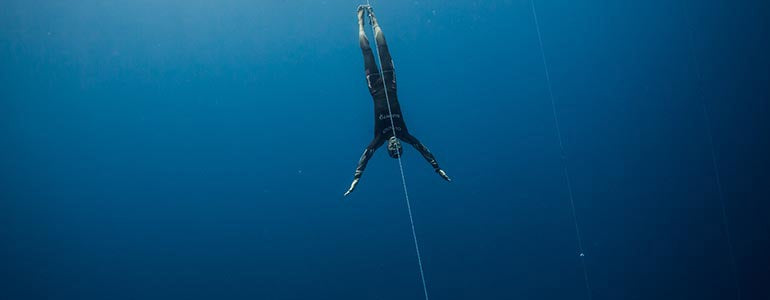

William Trubridge talks record attempts and the art of freediving
Events like Vertical Blue and the upcoming Return to the Deep promote freediving to the masses. But what contribution have they made to the sport? Record-breaking freediver William Trubridge tells us, read what he has to say here.
Image (and feature image) Alex St Jean
William Trubridge has been preparing to break yet another world record, he plans to dive to 102m unassisted in a single breath on July 21, 2016. He’ll do this in Dean’s Blue Hole, Bahamas as part of the Return To The Deep event produced by Steinlager Pure.
He’s been training hard for the event, and is feeling strong having recovered from a bout of illness. He says: “Training has been going really well recently. I’m in good shape. I got dysentery while trekking in Nepal and it’s taken time to get my health back. This year I’ve had a couple of niggles but nothing serious.”
He’s already broken records two years in a row at Suunto Vertical Blue and is clearly ready for this next attempt. These big events, William believes, have really contributed to the progress and development of the sport over the years.
Big events lead to revolutions in safety techniques
Image Daan Verhoeven
He says: “At Vertical Blue there was a lot of innovation we begun that went outside and elsewhere afterwards. Most importantly safety techniques were really revolutionised to make sure everyone in the team is trained to the highest level possible. That has set a standard that is now used in other events and at AIDA.”
These safety developments and innovations are key to ensuring athletes are able to push their boundaries and reach deeper and deeper depths. It’s particularly important when breaking records as it can have a big physical and mental impact on the body.
William has mentioned previously that when diving he leaves a part of himself behind. He says: “In a freedive there’s a subtraction of the stimuli around you, there’s no sound, very little light, no sensations of points of contact and that allows you to slow the mind through the absence of stimuli, pressure and the narcotic effects of gasses and high pressure add to that.”
Freediving is more than record attempts, it frees the mind
Image Daan Verhoeven
This meditative state is one of the attractions of freediving. “It almost feels like we’re cheating when we freedive because we can get into a meditative flow so quickly,” says William. That’s one of the beauties and attractions of it. Leave the rational, reasoning mind, for sure.”
This simple state, using your body, mind and not much else is also one of the reasons freediving is becoming more popular. William says: “There’s definitely a movement that is putting us in more intimate contact with nature and making us able to relate to it more clearly and deeply. Which is important in this age when nature is in such dire straits. I kind of feel that every freediver I teach, or everyone who is brought into the sport becomes a steward of the ocean.”
If it sounds like an all-encompassing sport, it really is, especially when record attempts are coming up. William has been dreaming about the attempt, he says: “Most of the dreams are related to the record attempts, competition or stress around the expectation and the whole event! They’re not related to the sensation of being underwater because I experience that so much I guess.”
Follow the event live with Steinlager. Learn more about William Trubridge on his website.


Justin Lewis takes over @suuntodive instagram
Underwater photographer and diver Justin Lewis is taking over the @suuntodive instagram for a week, starting today July 8th. Make sure to follow to see his incredible images and share his love for the ocean.
Tell us a little about yourself
Adventure and exploration are my passions. Growing up along the wild and beautiful coast of northern California, my family instilled in me strong values of conservation and respect for the natural world. I’ve been diving since I was eight and was certified at 12. On the water, in the water, beneath the water — free diving, scuba diving, surfing, ice diving, kayaking — water has been central to my life and my work. Through visual storytelling, I create rich, eye-catching content for national and international advertising agencies, editorial outlets, and conservation organizations.
Where do you dive?
I dive wherever my assignments take me, and I feel fortunate I have had the opportunity to dive in some incredible places around the world, including ice bergs in Greenland’s North Arctic, Fiji, the Maldives, Sipadan Island in Borneo, Tahiti and all over the Caribbean.
What inspires you in the underwater world?
I love working in unique underwater environments that provide a perspective rarely seen and often unexpected. For example, freshwater ecosystems and Mangrove forests. From an outside view you may not expect much is going on inside a mangrove forest, but once you get underwater the immense diversity and quantity of life is often staggering.
How would you describe your photography style?
I strive to create truthful imagery that moves the viewer and tells a powerful story.
What story do you wish to tell with your images?
Far too many stories. It seems like every day I think up a new project idea or am pitched a great potential story. Often the stories I feel motivated to work on, are the ones that require self-funding, and I can only do a handful of those each year. But if I could pick one to be funded it would be in the realm of marine conservation. Our oceans are changing at an unprecedented rate, and I am witnessing the changes first hand where I live on the Northern California coast.
Visit Justin’s website, Facebook and instagram for beautiful diving images and more information about his projects.


Sharks galore as Cristina Zenato takes over @suuntodive
Shark professional, cave diver, and PADI course director Cristina Zenato is taking over @suuntodive on Instagram for a week, beginning today. Make sure to follow to learn more about the world of sharks!© Victor Douieb
Tell us about yourself I am originally from Italy. I grew up in the African rainforest and I have lived the last 22 years in the Bahamas, where I follow my work and passion, which tend to blend into one activity. I am a shark professional and behaviourist; I specialize in human and sharks interactions. I’m also a cave diving instructor and active explorer and a PADI course director. I love to dive and share my diving through teaching it and through my images and presentations. My passion is my work, my work is my passion. Where do you dive? Primarily in the Bahamas, but I am always trying to find places where I can further my experience and knowledge about sharks and caves. I have been in many locations in the world to meet other people who work with sharks and learn more about cave, technical diving and exploration. Among them were Italy, England, Fiji, Rhode Island, California, South Africa, Mozambique, Dominican Republic, Cuba. What inspires you about the ocean? There are a lot of lessons to be learned from the underwater world and from nature in general. The most beautiful inspiration is in how everything seems to connect and flow together, in a perfect balance between beauty, life, death, darkness and light. The underwater world teaches a valuable lesson in the power of now and the power to accept all those around us and learn to coexist. Is there a story you wish to tell with your images? The story I wish to tell is the one of inspiration, I want people to see that dreams do come true, that if we listen and work where our hearts want to go we can get there. It's a story of communications with other animals, specifically with my sharks and one of acceptance and respect. It's a story of discoveries, of imagination, of a life rich of extraordinary mundane events. Visit Cristina’s website and Facebook page for incredible shark images.

Watch this underwater drone footage of Will Trubridge diving deep
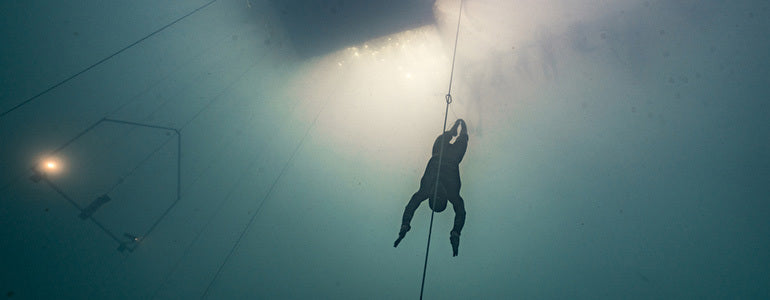
The X-Adventurer Freetracker is going to be a game changer for freediving.The X-Adventure Freetracker following William down. © Daan Verhoeven
When Suunto ambassador William Trubridge attempts to break his own freediving world record in July, an underwater drone will follow his dive.
He and his team tested the drone, called the X-Adventurer Freetracker, during Vertical Blue 2016 and hope at next year’s competition it will offer live video to audiences around the world.
It’s mounted on parallel tracks adjacent to the competition dive line, and descends and ascends with the diver, capturing the entire journey from the surface to the plate and back again.
See how long you can hold your breath as William dives!
“For this year we just got a proof of concept,” Will says, “but for next year’s Vertical Blue we hope to have it hooked up to a live internet feed, so people can watch from the other side of the world while an athlete grabs the tag at 120 m.”
“I think it’s going to be a real game changer for the sport because once people can tune in and be in their living room watching someone dive to 100 m as it happens, then that will really increase the spectatorship of the sport.”© Daan Verhoeven
Aside from making freediving more accessible to spectators, The X-Adventurer Freetracker will also improve safety. Never before have safety staff been able to see what’s happening for an athlete at depth before. If anything goes wrong, the safety crew will see it immediately via a live feed at the surface.
“It will definitely help with analysis of technique also,” Will says. “Because there's such a logistical difficulty in videographers going deeper than 40 m, a lot of freedivers have never seen what their technique looks like at depth from a good angle.”
William is attempting to break his current world record of 101 m this July and the X-Adventurer Freetracker will follow his journey into the depths.
Stay tuned!


Alex Mustard takes over @SuuntoDive Instagram
Marine biologist, author and pro photographer Alex Mustard is taking over @suuntodive for a week, beginning today. Make sure to catch his incredible images and the stories behind them! What’s your story, Alex? I’m an underwater photographer and marine biologist from the UK. I have been taking underwater photos since I was nine years old and diving since I was 13. I’ve recently distilled all I have learned into the new book Underwater Photography Masterclass. Where do you dive?
All over the world! In salt water or fresh water. In crystal clear blues of the Pacific Ocean to murky green-browns at home in England. What inspires you about the underwater world? The diversity. This can be the biodiversity of life – the ocean is home to such a variety of animals, that getting to know them, watching the different ways they live their lives, is certainly many lifetimes worth. But more than that it’s the diversity of diving experiences I love. One week I might be aiming my lens at a great white, and the next week I am just as excited to be framing up seaslugs back home. Then it is on to shooting in caverns, with cathedral like light beams spilling in through gaps in the ceiling. And next diving deep inside a wreck, searching for secrets that nobody has noticed before.
How would you describe your photography style? I would say diverse. The non-diving world sees me as a specialist underwater photographer, of course. But within underwater photography I challenge myself to be able to photograph everything well, from shipwrecks to seahorses. Is there a story you wish to tell with your images? Most of us who dive are very passionate about the underwater world. Yet we all see how humanity is hurting the oceans. Taking out too many large predators, damaging fragile environments with destructive fishing and polluting the seas. I think that all photographers hope that their images will inspire a change in attitude from the general public.
Follow @SuuntoDive to see Alex’s images or follow him on Instagram and Facebook. Check out his book Underwater Photography Masterclass.


