


Suunto Blog

Watch this underwater drone footage of Will Trubridge diving deep
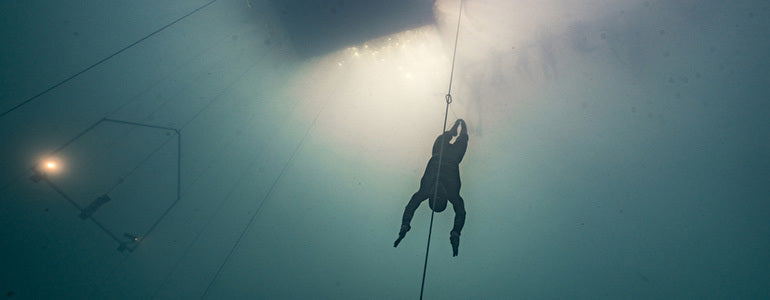
The X-Adventurer Freetracker is going to be a game changer for freediving.The X-Adventure Freetracker following William down. © Daan Verhoeven
When Suunto ambassador William Trubridge attempts to break his own freediving world record in July, an underwater drone will follow his dive.
He and his team tested the drone, called the X-Adventurer Freetracker, during Vertical Blue 2016 and hope at next year’s competition it will offer live video to audiences around the world.
It’s mounted on parallel tracks adjacent to the competition dive line, and descends and ascends with the diver, capturing the entire journey from the surface to the plate and back again.
See how long you can hold your breath as William dives!
“For this year we just got a proof of concept,” Will says, “but for next year’s Vertical Blue we hope to have it hooked up to a live internet feed, so people can watch from the other side of the world while an athlete grabs the tag at 120 m.”
“I think it’s going to be a real game changer for the sport because once people can tune in and be in their living room watching someone dive to 100 m as it happens, then that will really increase the spectatorship of the sport.”© Daan Verhoeven
Aside from making freediving more accessible to spectators, The X-Adventurer Freetracker will also improve safety. Never before have safety staff been able to see what’s happening for an athlete at depth before. If anything goes wrong, the safety crew will see it immediately via a live feed at the surface.
“It will definitely help with analysis of technique also,” Will says. “Because there's such a logistical difficulty in videographers going deeper than 40 m, a lot of freedivers have never seen what their technique looks like at depth from a good angle.”
William is attempting to break his current world record of 101 m this July and the X-Adventurer Freetracker will follow his journey into the depths.
Stay tuned!


Alex Mustard takes over @SuuntoDive Instagram
Marine biologist, author and pro photographer Alex Mustard is taking over @suuntodive for a week, beginning today. Make sure to catch his incredible images and the stories behind them! What’s your story, Alex? I’m an underwater photographer and marine biologist from the UK. I have been taking underwater photos since I was nine years old and diving since I was 13. I’ve recently distilled all I have learned into the new book Underwater Photography Masterclass. Where do you dive?
All over the world! In salt water or fresh water. In crystal clear blues of the Pacific Ocean to murky green-browns at home in England. What inspires you about the underwater world? The diversity. This can be the biodiversity of life – the ocean is home to such a variety of animals, that getting to know them, watching the different ways they live their lives, is certainly many lifetimes worth. But more than that it’s the diversity of diving experiences I love. One week I might be aiming my lens at a great white, and the next week I am just as excited to be framing up seaslugs back home. Then it is on to shooting in caverns, with cathedral like light beams spilling in through gaps in the ceiling. And next diving deep inside a wreck, searching for secrets that nobody has noticed before.
How would you describe your photography style? I would say diverse. The non-diving world sees me as a specialist underwater photographer, of course. But within underwater photography I challenge myself to be able to photograph everything well, from shipwrecks to seahorses. Is there a story you wish to tell with your images? Most of us who dive are very passionate about the underwater world. Yet we all see how humanity is hurting the oceans. Taking out too many large predators, damaging fragile environments with destructive fishing and polluting the seas. I think that all photographers hope that their images will inspire a change in attitude from the general public.
Follow @SuuntoDive to see Alex’s images or follow him on Instagram and Facebook. Check out his book Underwater Photography Masterclass.

7 tips to help you make amazing diving videos
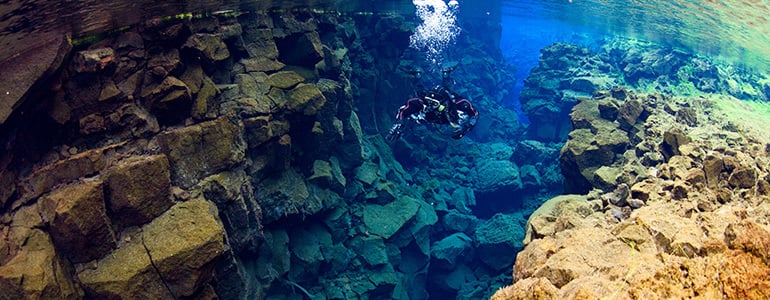
Jill exploring the Bell Island mine. © Cas Dobbin 2016
Today there are no barriers to entry for shooting underwater video. GoPro cameras have put awesome potential within easy reach both physically and financially. Even with this compact camera, 4K video can be shot, edited and uploaded to social media sites. However, with video capability in everyone’s hands, there are some key things you need to do to separate yourself from the pack.
First things first
General diving skills are critical with good buoyancy control being at the top of the list. Master this first!
Watch Jill's video of devil rays off the coast of Azores Islands.
The gear
Shooting underwater means you are filming through a filter. Colour and light are gradually absorbed the deeper you go. In many cases, visibility can be minimal. You need good quality, wide-angle video lights to help illuminate the scene and increase colour saturation. The closer you can get to your subject, the less filtering water between you and a great shot. Use a wide-angle lens for shooting or try macro work with a tripod – only if you can avoid damaging the environment.Watch Jill exploring Devil's Ear cave system, Ginnie Springs.
Shoot for easy editing
Don’t try to edit in the camera. That means you should shoot long sequences with a long “tail” after the action has passed. This gives you room to edit and use transitions.
Slowly, slowly!
Move very slowly and deliberately and consider holding long stationary shots to let the environment and marine life flow around you. Most beginners get overly enthusiastic and move the camera around too much. They are eager to film the next shot rather than patiently working on the current encounter. That type of footage is not just tough to edit but can give your viewers seasickness!Press play to see the shipwrecks of Bell Island.
Capture variety
When you shoot, try to capture a wide range of shot types. You need wide establishing shots that show context. You will want to capture things like jumping off the boat or preparing gear. You'll also need an endless supply of shots called cutaways. These short clips of a few seconds in length are the glue that holds longer shots together. When a diver is prepping gear we might see a cutaway of the pressure gauge needle popping up as the tank is turned on. We might see a quick okay signal close up on a hand. You can never have enough cutaway shots in the edit. You will use every single one you shoot.
Press play to watch Jill talk about her diving career.
Show the tranquillity
Remember, the beauty of the underwater world is best enjoyed drifting along rather than frenetically bouncing around from view to view. Let your shots breathe and allow your viewers to enjoy the same peace and tranquillity that you do on a swim along a perfect reef. The marine life will be more likely to cooperate and gracefully participate in your sequence too.
Keep it short
And finally, when you get into the postproduction phase, keep your edit short. Try to tell a story in less than three minutes. That is about the attention span of most viewers. Nobody wants to see the entire dive and the things you missed. If you only have 90 seconds of great footage, then keep your edit even tighter. You’ll get more hits and shares and enjoy watching your own masterpiece again and again.

10 tips to take amazing underwater photos
Basking Shark, UK. © Alex Mustard
Alex Mustard has been taking underwater photos since he was nine years old and began diving when he was 13. He’s the author of Underwater Photography Masterclass, which distils his know-how on this challenging form of photography.
“It’s the diversity of diving I love,” Alex says. “One week I might be aiming my lens at a great white, and the following week I am just as excited to be framing up sea slugs back home. Then it’s on to shooting in caverns, with cathedral-like light beams spilling in through gaps in the ceiling. And next, diving deep inside a wreck, searching for secrets nobody has noticed before. It’s all those things that I love.”Kittiwake Shipwreck, Cayman Islands. © Alex Mustard
First things first
The most important first step is to make sure you are as comfortable and as competent in the water as possible before you take a camera diving. Cameras take a lot of your attention underwater and you may not pay enough attention to your buddy, to your dive computer and remaining air pressure. If you're an experienced diver you will be used to paying attention to all those things. By being a better diver you get better pictures.
Get a feeling for it
Buoyancy and manoeuvrability are two of the biggest challenges to diving. Taking a camera down totally changes these two things. It’s good to know beforehand how this is going to feel. I always suggest people take an empty camera housing down as a good way to get used to it. Wrap a diving weight in bubble wrap or in a cloth and stuff it inside the underwater housing so it sinks. Then experiment with it in the shallows or in a pool.Kelp Forest, USA. © Alex Mustard
The camera isn’t so important
The camera is one of the least important parts of an underwater photography set up. It’s actually the lenses and the underwater flashguns that make far more of a difference to your photos than the camera. An expensive camera that’s not being adapted properly to underwater photography will always take poorer pictures than a very simple camera that has the right accessories. Invest in the accessories rather than the camera.
The lenses that counts
We use two types of lenses almost all the time. One is a close focusing macro lens for taking close ups from within touching distance and the other is an ultra wide-angle lens that focuses very close. Typically we use fish eye lenses a lot because they give us the widest possible view from as close as possible.Jellyfish Lake, Palau. © Alex Mustard
Lights, camera …
Almost every underwater photo is taken with a flash. We use flashguns on short, adjustable arms on either side of the camera to light up a subject. Water as you go deeper absorbs all the colour so if you don’t use a flash you’ll end up with blue or green pictures. Flashguns take time and skill to get used to. That’s really where the art of underwater photography lies.
Up close and personal
Almost every underwater photo is taken from within touching distance of the subject. This means you need to be able to maneuverer around a subject and in a way that doesn’t scare it away. If you’re thrashing about or racing around, you’re only ever going to see the tails of marine life. If you’re calm and at one with the environment you will get all the great encounters and that’s what gives you the good pictures.World War II Motorbike On Wreck, Egypt. © Alex Mustard
Plan ahead of the dive
If you go and speak to whomever is organising a dive ahead of time, they will tell you what you’ll see and where. There’s a huge amount of local knowledge you can benefit from just by asking people a few questions. Sometimes an advertisement will say it’s a great shark dive, but in reality they don’t come within five meters. But the coral scenery might be nice so you set up for that.
One dive, one lens
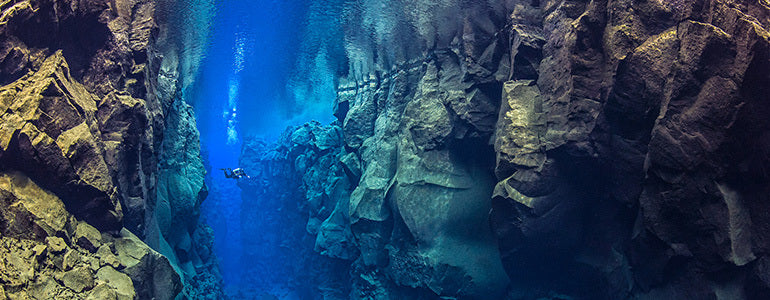
The only way to change your camera lens is to come up to the surface, change it and then go back down and that’s not very convenient. Usually it’s one lens for one dive. One of the big steps you make as an underwater photographer is when you realise the best photos come by realising the strengths and weaknesses of the particular lens your diving with and focusing your attention on the subjects that suit it.Diving Between The Continents, Iceland. © Alex Mustard
Don’t be rude
Underwater most marine life doesn't fear man. However you need to get within touching distance of it. Most wildlife doesn’t like heavy eye contact so try not to stare. Most wildlife doesn’t like you approaching fast so take your time to approach a subject. Don’t just race in as fast as you can because that’s bound to scare things away. If you see a subject slowly swimming along, swim parallel to it, and slowly close the gap.
Dive with a photographer
Diving with another photographer is a really good way to dive. You’ve got twice as many eyes. If you’re shooting scenery you can pose for each other. After the dive you have a friend who will be interested to see your pictures and talk about photography.
For more incredible images by Alex Mustard, like his Facebook page.
Lead image: © Alex Mustard


George Karbus takes over @SuuntoDive Instagram
Underwater photographer George Karbus is taking over @suuntodive starting tomorrow, May 26th. Make sure to follow!
Who is George Karbus?
I'm a wild ocean free soul photographer based on the west coast of Ireland. I love to dive in Ireland with our friendly bottlenose dolphin.
Where else do you dive besides Ireland?
I follow my favorite marine mammals around the world and have been diving in the Bahamas, Hawaii, Galapagos, Arctic Circle, Maldives, Azores and many more. I'm inspired by dolphin movements, energy, intelligence and social structure. Also the silence of the big blue inspires me.
How would you describe your photography style?
I always want to capture unleashed raw energy of Mother Nature and its excellence in beautiful light or dramatic clouds.
I try to capture beauties of our fragile world and show everyone the real treasures of life. It may inspire people to live in harmony with nature.
Follow @SuuntoDive and @georgekarbus to see more of George’s work. Check out also georgekarbusphotography.com and George Karbus Photography on Facebook.
Main image: George Karbus captured Fernando Stalla diving waves in the Maldives.


This guy broke two diving world records and he only has one leg
“Scuba diving saved my life,” says cancer survivor Leo Morales. He’s living proof that diving is for everyone.Flying underwater – Leo's happy place.
On the shore of Mexico’s Playa del Carmen, 43-year-old Leo Morales does what he lives for: sharing the joy of scuba diving. But his scuba school has a particular focus.“We’re making diving accessible for everyone,” he says. “We focus on teaching people with disabilities, people who use wheelchairs, and also the visually impaired. We want to break the old concept that you have to be tough for scuba, that it’s better for men.
“The most incredible reward is the look in their eyes when they discover they’re free from the wheelchair, from the crutches, from having to drag their weight. You show people they are able to fly. They’re always so grateful.”Leo aims to show people with disabilities can do amazing things. Leo’s passion for diving began after a close call with cancer. He was 28 years old, enjoying a successful career as a bank manager. At the office one day he felt a strange pain in his back and went to the doctor. The diagnosis rocked him: he had a cancerous tumor growing on the inside of his right leg and buttock – it weighed 3kg and was two years old. Having the leg amputated was his only chance of survival. And even then, doctors said he would only live for another five years. After 12 hours of surgery, Leo woke up and looked down and saw flat bed sheets where his right leg had once been. Out of hospital he had to learn to walk again, how to use the toilet, get in and out of bed – everything was hard work. After losing his job for simply having a disability, Leo fell into depression. He felt like his life was over. But then a friend invited Leo to join him on a scuba dive. The first dive was “a nightmare”. Leo sunk to the bottom and fought with the water. On the second dive, his friend grabbed him underwater and swam along with Leo until he worked out how to propel himself. “That moment changed my life,” Leo says. “After that experience I became addicted to the ocean.”Now Leo is a dive master, scuba instructor and technical diver. And he also holds two world records: for the deepest dive (125 m) by a person with a disability and the longest dive (16km in 8h16m) for a person with a disability. His next goal is to set a world record for the deepest cave dive by a person with a disability. “The main point is to send a powerful message that people with disabilities are no different than people who are physically normal,” Leo says. “We can achieve amazing things with the proper training and equipment.”