




If you want to run faster and hold a harder effort for longer, lactate threshold is worth understanding. It can help you choose training intensities that match your current fitness and track your progress over time.
This guide covers what lactate threshold is, what running near it feels like, and how to test it and read the results. It also looks at how the right training lifts your threshold pace so you can sustain faster running for longer.
At a Glance
- Lactate threshold is an exercise intensity marked by changes in your blood lactate levels.
- Knowing yours helps you pick training paces and gauge your endurance.
- Blood lactate testing pinpoints it. Performance tests and devices estimate it.
- There is no universal ideal. Track your own threshold pace or power over time.
- A mix of aerobic work, threshold training, and recovery raises your threshold.
Table of Contents
What Is Lactate Threshold?
Your body makes and uses lactate the whole time you exercise. Some fuels the muscles that produce it. Some travels through the blood to feed other tissues, including the heart. It is a constant cycle of production and reuse. At easy intensities, production and clearance stay roughly balanced, so blood lactate holds fairly steady.
Push harder and that balance shifts. Production starts to outpace your body's ability to move, use, and clear lactate, so blood levels climb. Lactate threshold marks the point where this response changes noticeably. It is a useful way to tell intensities apart, but the shift is gradual. You do not flip from one state to another the moment you cross it.

Three related concepts often come up when discussing lactate threshold: LT1, LT2, and MLSS.
- LT1 (First Lactate Threshold): The intensity at which blood lactate rises noticeably above its low-intensity baseline during an incremental exercise test. Exercise below LT1 generally feels relatively easy.
- LT2 (Second Lactate Threshold): The higher-intensity turning point where the blood lactate curve rises more sharply during an incremental exercise test. It is the main reference for threshold training in this article.

- MLSS (Maximal Lactate Steady State): The highest constant exercise intensity at which blood lactate remains approximately stable, determined through repeated constant-load tests. It is closely related to LT2, but the two are assessed differently and are not interchangeable.
Why Test Your Lactate Threshold?
A test gives you more than a heart rate, pace, or lactate reading. It tells you what effort you can hold at different intensities, so you can build training around your current fitness.
1. Understand endurance capacity
Endurance is about both how fast you can go and how long you can hold that speed. Two runners might match each other over a short distance, yet one holds a quicker steady pace for much longer. That gap comes down to who can sustain harder efforts. A faster threshold pace usually points to a greater ability to keep running fast.
2. Set training intensity
Two runners with the same max heart rate can hit threshold at very different intensities. Your results, read alongside heart rate, pace, cycling power, and lactate response, help you set intensities that fit you.
On Suunto Run series, for instance, you can build heart rate zones from max heart rate, heart rate reserve, or lactate threshold heart rate. You can set pace and power zones separately too, so you have several ways to manage intensity within one workout.

3. Track long-term improvement
Retesting every so often shows whether your training is paying off. Under similar conditions, a faster threshold pace means you can run quicker at an effort near your threshold. If your threshold heart rate holds steady while the pace at it improves, that points to better endurance.
How Can You Test or Estimate Your Lactate Threshold?
Lactate threshold can be determined through blood lactate testing or estimated indirectly from race results, field tests, or training data recorded by a device. These approaches provide different information, so choose one that fits your testing options and training needs.
1. Direct Method: Blood Lactate Testing
Blood lactate testing typically follows an incremental protocol. You start at a low intensity, then increase pace or power in stages, with blood samples taken at each stage to measure lactate concentration. The tester plots a lactate curve and uses it to identify a threshold and its corresponding pace, power, or heart rate.
The test measures blood lactate concentration directly, but the threshold itself must be determined by interpreting the curve. One common approach is D-max, or the maximal distance method, which uses the shape of the lactate curve to identify the threshold.

2. Indirect Methods: Performance Tests and Device Estimates
If blood lactate testing is not available, the following methods can provide estimates of threshold pace, power, or heart rate to guide your training:
- Race results: Training models use recent race performances to estimate threshold pace and help you choose training intensities. For example, VDOT uses race performance to estimate a threshold training pace, providing an indirect indication of your ability to run near lactate threshold.
- Field tests: A running test over a set duration or distance can use pace and heart rate data to estimate threshold pace or threshold heart rate.
-
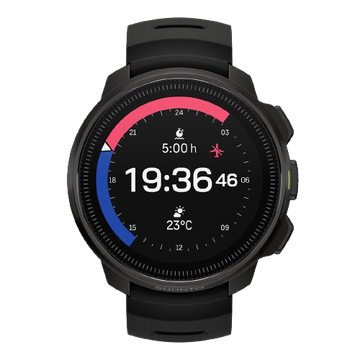
Sports watches: Some Suunto sports watches estimate metrics such as lactate threshold and VO₂ max from training data, helping runners choose training intensities and track changes over time.

These methods do not measure blood lactate directly. Results depend on your performance during the test, environmental conditions, data quality, and the algorithm used. Whichever approach you choose, keep the method, procedure, and conditions as consistent as possible when tracking progress over time.
What Is a Good Lactate Threshold?
For runners, a faster pace at lactate threshold generally indicates better endurance when measured using the same test method under similar conditions. A higher threshold heart rate or blood lactate concentration does not necessarily mean better fitness. Likewise, the percentage of VO₂ max or maximum heart rate at which your threshold occurs cannot tell the whole story. Focus on your threshold pace and how it changes over time.
1. Blood Lactate Concentration at Threshold
Researchers have traditionally used a blood lactate concentration of 4 mmol/L to define a fixed lactate threshold. This approach is also commonly associated with OBLA, or the onset of blood lactate accumulation. In the 1980s, Mader and colleagues further explored the rationale for using 4 mmol/L to identify the anaerobic threshold.
However, lactate responses vary considerably between individuals. The same physiological turning point can occur at different blood lactate concentrations. Some athletes show a sharper rise in lactate at lower concentrations, while others reach that point at higher levels.
Research has reported blood lactate concentrations ranging from approximately 1.4 to 7.5 mmol/L at the individual anaerobic threshold (IAT). A fixed concentration makes testing easier to standardize, but it may not accurately capture each athlete's physiological threshold.
2. Lactate Threshold as a Percentage of Maximum Effort
The intensity at which lactate threshold occurs can also be expressed relative to VO₂ max or maximum heart rate. Better-trained runners generally reach their threshold at a higher percentage of their maximum capacity, while beginners and less-trained runners tend to reach it at a lower relative intensity.
VO₂ max primarily reflects cardiorespiratory capacity, while lactate threshold is closely linked to metabolic function in the muscles. Research describes lactate threshold occurring at around 60% of VO₂ max in untrained individuals and approximately 75–90% of VO₂ max in endurance-trained individuals. These ranges help explain differences in training status, but they are not fixed benchmarks for deciding whether your own threshold is “normal.”
How to Improve Lactate Threshold?
Three types of training can help improve your lactate threshold: low-intensity aerobic work to build your base, threshold training to improve the pace you can sustain, and high-intensity intervals to develop your maximum aerobic capacity.
Low-Intensity Aerobic Training
Low-intensity aerobic training centers on easy, sustained running. Zone 2 training in commonly used five-zone models falls into this category. The effort generally stays below your LT1, with steady breathing and comfortable conversation. Start with a duration you can comfortably manage and gradually extend your runs as you adapt.

Over time, this training helps increase capillary density and mitochondrial content in your muscles, improving oxygen delivery and aerobic energy production. It also supports lactate transport and its use as fuel through oxidation. Together, these adaptations build the aerobic foundation for sustained running.
Lactate Threshold Training
Lactate threshold training involves running at an intensity close to your LT2. Your breathing is noticeably deeper, and you can speak only in short phrases, but your pace and form remain under control. Accumulating time at this intensity can improve your threshold pace, helping you sustain faster running.
You can train at this effort through continuous runs or intervals. A Tempo Run is often performed near lactate threshold, but its definition varies between training systems. A tempo run is therefore not always the same as a threshold run, so let the purpose of the workout guide your intensity.
Another common approach is cruise intervals. For example, you might break the workout into efforts of around 5–10 minutes, with 1–2 minutes of easy jogging between them. These short recoveries help you maintain a consistent effort and accumulate more time near lactate threshold without excessive fatigue.
Whether you choose a continuous run or cruise intervals, the goal is to hold the intended effort. If your pace drops sharply early in the workout or you need a long recovery between efforts, you may be running harder than the session calls for.
High-Intensity Interval Training
High-intensity intervals alternate faster running above lactate threshold with recovery periods. During the hard efforts, breathing is heavy and talking is difficult. Easy jogging between efforts helps you prepare for the next repetition. Aim for a consistent pace across repetitions, and adjust the amount of work to your fitness and recovery.
This training can improve VO₂ max, raising your aerobic ceiling and supporting further gains in threshold pace. Use it alongside threshold training, with easy runs or rest days between these harder sessions to allow for recovery.

Learn more about Recovery here.
Takeaways
Lactate threshold gives you a sharper way to read endurance. It explains why the same pace can feel very different to two runners, and it gives your training a clearer aim than just running faster.
A higher number isn't the whole point. The better question is whether you can run faster and hold it for longer at the same heart rate and effort. Track your threshold pace over time with a consistent method, and read it alongside VO₂ max, training load, and race results for the full picture.
FAQ
Are Lactate Threshold, Anaerobic Threshold, and Ventilatory Threshold the Same?
Not quite. Anaerobic threshold is an older idea describing a metabolic shift during exercise. Lactate and ventilatory thresholds come from changes in blood lactate and breathing gases. Runners often use LT2 and VT2 to estimate anaerobic threshold, but they don't always land at the same intensity.
What Is the Difference Between Lactate Threshold and Threshold Heart Rate?
Lactate threshold is an exercise intensity identified from changes in blood lactate. Threshold heart rate is your heart rate at that intensity. It can help guide your training, but a higher number does not necessarily mean better endurance.
Is VO₂ Max the Same as Lactate Threshold? Which Is More Important?
No. VO₂ max is the most oxygen you can take in and use. Lactate threshold shows how much of that capacity you can tap during sustained, harder efforts. Both shape endurance, and which matters more depends on your race distance, fitness, and training needs.
Is Lactic Acid Threshold the Same as Lactate Threshold?
People use them for the same thing. In exercise physiology, “lactate threshold” is the more accurate and widely used term.


