




Suunto Blog

TUTORIAL TUESDAY: WHERE AM I? FINDING YOUR LOCATION WITH AN AMBIT
Figuring out where you are is fairly simple when you have a map, the visibility is good and you can identify a few landmarks. But when the going gets rough, the weather is against you and the sun sets, the task isn’t so simple any more. In this tutorial you will learn how your Ambit can help you to find your location.
The basics are simple: you can find your current position with a few clicks of the Ambit.
Choose: Navigation – Location – Current
To make sure you get the satellite fix as quickly as possible, remember to sync your Ambit regularly and keep it up to date.
Once you have found the GPS signal you will get your current location in geographic coordinates. The most common coordinate system in GPS devices is WGS84, which is also used by default in Suunto GPS watches.
Use the same coordinate system on your watch and map
If you need to give your exact location to someone in a rescue situation, WGS84 works. But when you start using a map and defining your location on it, you will need to make sure your GPS watch and the map use the same coordinate system. (To change your Ambit’s coordinate system go to General – Formats – Position format.)
Latitude/longitude is the coordinate system used in marine navigation and is common on topographical outdoor maps. Latitude lines run horizontally. The zero latitude is the Equator. Longitudes run vertically and the zero longitude runs through Greenwich, England. The latitude is normally the first number expressed in lat/long coordinate (for example 60°16'19" N 24°58’23’’ E).
WGS84, which uses latitudes/longitudes, is actually more than a coordinate system: it also includes a model of the globe that enables the use of GPS altimeters.
UTM is a grid coordinate system that is used on many outdoor maps. It divides the map into a perpendicular grid in which each of the squares are the same size anywhere on the map. This means the coordinate system is tied directly to a distance in meters.
This Norwegian map has both WGS84 (black) and UTM (blue) coordinates.
The black numbers on the sides of the map are degrees latitude; the numbers on the top and bottom of the map are degrees longitude. To determine your location on the map, draw a west to east line through the corresponding latitude and a south to north line through the corresponding longitude. The intersection of the two lines indicates your position.
The blue numbers are the northings and eastings of the UTM coordinate system. You can use them like the lat/log when finding your location on the map.
You can get support for your Suunto product at support
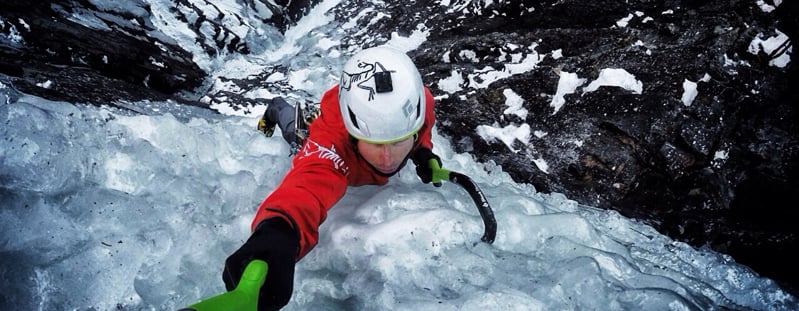

As hard as ice: Matthias Scherer's battle with a Norwegian winter
For ice-climber and Suunto ambassador, Matthias Scherer, winter is naturally a busy time. Recently, Matthias made a trip to Norway, where over the past few years, he’s gone in search of the ultimate ice lines. And this time, tucked away in the Fjords of the West Coast, he found just what he was looking for.
Approaching Fjåene Fossen © Matthias Scherer“Ice climbing, like alpinism is always a quest. A quest for the ultimate ice line,” says the German climber.It’s that quest which lead Matthias back to Norway – a place where he had tried twice in vain to scale the lines buried deep within in the Fjords near Bergen. He was forced to retreat on both occasions due to bad conditions.“This time we checked the temperatures via the internet and decided to give it a go during the beginning of February. We knew that we had to be prepared both mentally and physically to face this big adventure.”
A little clip of Matthias climbing in his home ground of Cogne, Italy in January.
Arriving in Norway, his ‘adventure’ started almost immediately when a snowstorm blocked all the roads on his way in. And when the expedition finally commenced, Matthias and his crew were faced with crossing a waist-deep river of freezing water before reaching their line.“The climb up ‘Fjåene Fossen’ proved to be, as expected, an epic battle: bad ice quality and lots of water and snow pouring down on us. After several hours we reached the top of the line in a raging storm,” he says. But for Matthias, achieving one objective only leads to the next, on the way down they discovered another awesome-looking line.“Two days later in an even heavier storm, we reached the top of that line. We named it 'Stormbringer'.”
On Pattinaggio © Matthias SchererYou’d think that after his Norwegian excursion, Matthias would kick back for a few days. Wrong. The climber has been busy climbing lines on his home turf of Cogne, Italy, as well as another trip back to Norway to climb in Rjukan. He's already looking forward to going back next year.
“And next winter, I’ll be back on Norwegian ice once again.”


KERBER’S AMAZING WINTER WING SUIT FLIGHT – IN THE DARK
Have you ever thought of BASE jumping? With a wingsuit? In full winter conditions? In the dark? With two burning torches? Neither have we. But Patrick Kerber and his friends did – and the result, a photo by Christian Meier, looks amazing.
© Christian Meier / www.chrigel.li
“My friend Simon Wandeler and I have wanted to do a wingsuit BASE flight at night during winter for a very long time. But somehow we never really managed to do it,” the Swiss wingsuit flyer says.
The idea picked up momentum after Kerber’s friend, photographer Fabian Wyss approached him with an idea of attaching some kind of light to the jumper.
“When he told me his idea, I instantly understood what he wanted to do and could envision how this picture could turn out.”
FLYING WITH A TORCH
The first problem they faced was how to attach a light to the jumper that would be bright enough to be seen from a distance of about two kilometers. And of course it is not easy to attach a light to a wingsuit without changing the flying characteristics of the suit.
“Then I had the idea of attaching flares to myself, exactly like the ones used for rescue missions or emergencies. But flares burn very, very hot and my biggest fear was burning holes or melting the suit. That would have been super dangerous.”
Another challenge was finding a proper location that could be accessed in winter conditions at night and also photographed. After some research and tests they chose one of Kerber’s regular jumping spots, the east face of Titlis in Engelberg in Switzerland. The two photographers, Fabian Wyss and Christian Meier, stood on the other side of the valley on the Fürrenalp.
“There definitely was a lot of pressure – even though we did intense testing before, I did not know for sure how it would turn out. Having fire really close to you on a wingsuit BASE flight leaves no margin for error. Everything has to work out.”
EVERY SECOND COUNTS
The big challenge for the image was timing. One single torch would burn for exactly one minute.
“I definitely did not want to open up my parachute with fire still around me, as this could be very dangerous. I only have one single parachute attached to me. If this one burns or melts, it's over!”
Kerber decided to use two torches. The first one he ignited before he took off and held in his right hand so it would be visible to the photographer. When the torch burned out, he quickly opened up his parachute and ignited a second torch attached to his foot. (That’s the break in the red line in the image.)
“I only had 20 seconds to ignite the second one as it also burned for one minute and I only had 1 minute and 15 seconds to the landing area. I did not want to land with a flare still on fire, as this could be very dangerous for my gear and for myself. Even though there was snow where I landed, those torches burn so hot that they even burn underwater!”
Patrick Kerber has jumped at night before, but not in winter and only at full moon.
“The feeling was very intense and amazing. It is much harder to orientate yourself, as you can't see as well. It feels much more intense because you fly with more feeling and awareness of your body and movements.”
For Kerber wingsuit flying is about freedom.
“For me freedom is a moment of pure perfection and pure happiness, a moment where all that matters is now.”
Watch a behind the scenes video of Patrick Kerber’s flight.
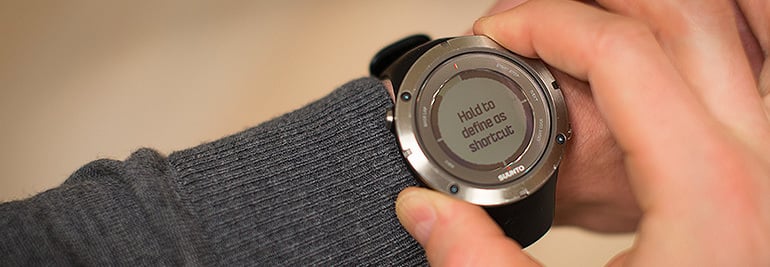

Tutorial Tuesday: Customize your Ambit’s shortcut button
Do you have a favorite Ambit feature that you wish you could access quicker? No worries, in time mode you can access any menu item with a single push of a button after you have taught your Ambit2 or Ambit3 what you wish the shortcut button will do.
The shortcut button comes in handy in many ways. For example, it is a quick way to set the wake-up alarm and travellers can use the shortcut to easily set the dual time to match the destination’s time zone. And for your most frequent activity the shortcut button can lead straight to the right sport mode setting you ready to go with a single push of a button.
Here's how to use your Ambit's shortcut.
DEFINE A SHORTCUT
By default, when you keep [View] pressed in TIME mode, you toggle the display between light and dark. This shortcut can be changed to a different menu item.
To define a shortcut:
1. Keep [Next] pressed to enter the options menu or press [Start Stop] to enter the start menu.2. Browse to the menu item to which you want to create a shortcut. 3. Keep [View] pressed to create the shortcut.
Your own shortcut works when the watch is in time mode. In other modes, keeping [View] pressed accesses predefined shortcuts. For example, when the compass is active, you can access the compass settings by keeping [View] pressed.
NOTE: Shortcuts cannot be created to all possible menu items, such as individual logs.
You can get support for your Suunto product at support
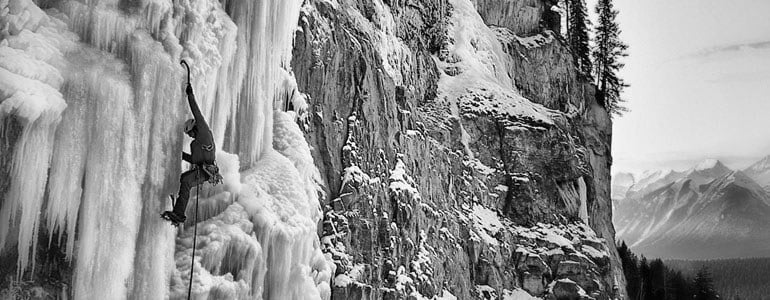

Early season ice score in Canada
Scoring early season ice: it's always a challenge and a gamble – but one that paid off for Tanja Schmitt and Matthias Scherer, who ventured to Canada in search of cold November climbs. In their own words, they tell the story of their adventure below and scroll down to see the video: Reborn.
The search for early season ice is always a voyage into the unknown. It causes many questions: has the ice already build up, how are temperatures going to develop, how many snow has fallen and is it going to be already a threat regarding avalanche risks?
Whilst the winter in the Alps often doesn't come before December, it can often be found full-on in November in the canadian Rockies. And so both climbers heeded towards the Rockies in hope for early season ice. But this year the Rockies were also still dripping with water instead of solid ice.Matthias on Whiteman Falls ©Tanja Schmitt
And so Matthias and Tanja found themselves Drytooling under a warm clear sky instead of ice climbing in cold winter light. The positive fact about that resulted in an enhanced training, and by the end of their Drytool-cycle both climbed 10 times M9+ in an hour: a fact which gave them confidence for what laid ahead.
In the second week of November the cold finally arrived with icy temperatures around minus 25°C. The ice formed. On November 12th Matthias and Tanja could start their ice season together with Steve Swenson with the classic ‘Murchison’ on Icefields parkway.
The climbs were freshly formed, kind of ‘shock-frozen’ and still thin. No traces indicated a previous climb, arising the common questions: is it already possible to climb? Might it not be a better idea to still wait? Is protection generally possible? Is the climb worth the risk? It is these questions early season ice climbing is all about.
Pointing the way to the Sorcerer
In the course of the second November week temperatures dropped even deeper: On november 29th the team climbed ‘Whiteman Falls’ with temperatures around minus 27°C, making the climb very interesting. Next day they went together with Canadian ice climbing legend Raffael Slawinski to Field for a longer gully climb.
With temperatures around minus 30°C degrees thin icicles and pillars were no option and steady movement a clever choice. So they soloed the easier parts just to keep moving and not to wait too long. It is when ice screws start to stick on your mouth whilst cleaning and your complete movements start to get slower that a cold day indicates itself...a very cold day. The ice becomes difficult to climb. The air crystal cold. Days unforgettable!
But no Canadian trip is complete without the ghost valley. And so at the end of their trip Matthias and Tanja once again teamed up with Steve Swenson for an adventurous trip. Next to hours long bush-walks and river crossings, ice climbing in the Ghost valley is all about getting in there first place with your car: snow packed roads, slippery river crossings and route finding in general are the challenges of the car 'pilot'. And so the four pitches of awesome ice were well earned: the ‘Sorcerer’ is by many means a great climb on an outstanding place and gave our trip an unforgettable ending!
Main image: ©Tanja Schmitt
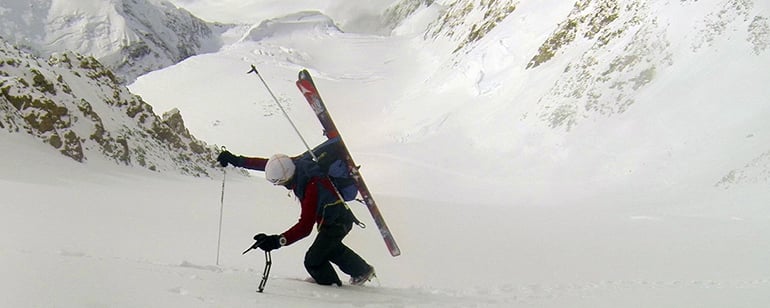

Kilian Jornet's perfect year
A week is a long time in the life of Kilian Jornet and there's rarely much time for rest. Recently back from running up the Americas' highest mountain Aconcagua, he's straight into competing in the Ski Mountaineering World Cup series. The record-breaking ascent of Aconcagua just before Christmas capped an incredible year for the athlete, possibly the most succesful ever, he tells us below.
2014 wasn't a bad year was it! I think it's been my best trail running season ever. [Kilian finished the trail running season with a hat trick in the World Cup and two gold medals in the world championships. He competed in a total of 14 races of different lengths as well as setting records on Denali 6,168 m and Aconcagua, 6,960 m.]
There were some good races but races with different disciplines. I started the summer with Transvulcania (83 km) and then Zegema Marathon, then it was to ski Denali then some vertical kilometer races, some mountaineering, some trail races... I don't like to specialize in one thing!
It's been a perfect year. I’m pleased about having been able to participate in so many varied races this summer in places with incredible landscapes and where I have met many people. At the end of the day, this is the essence of trail running and what drives me to continue.
So what's next?I do half a year running, half a year skiing. Ski-mo racing is a much more explosive sport than trail running. Races are much shorter and much more intense. It requires a lot of power! Much more fast but it's good for the muscles.
What's the appeal of ski-mo? It's fun because it's going up! You suffer! It's really hard because you want to go fast, you have to push, you have to have power to make every step. But ski mountaineering, not just racing, is great: you can go wherever you want. You don't have to follow a trail. You make your own track. It's this feeling of freedom.
You also have your sights on Everest in the spring? It's too ambitious to say it will be a record attempt. It will be an attempt and then we'll probably come back next spring for the record. The idea is to go the north side where there are more aesthetic lines.
Anything else in your sights? I have a lot of projects and always have things in the mind. I want to run, I want to be in the mountains. I will keep going out there winning races as that's my life and the thing that I love.
Check out the Suunto Movie of Kilian's record breaking ascent of Aconcagua here.
Main image ©Summits of my life, portraits above ©zooom.at/Markus Berger


