




Suunto Blog
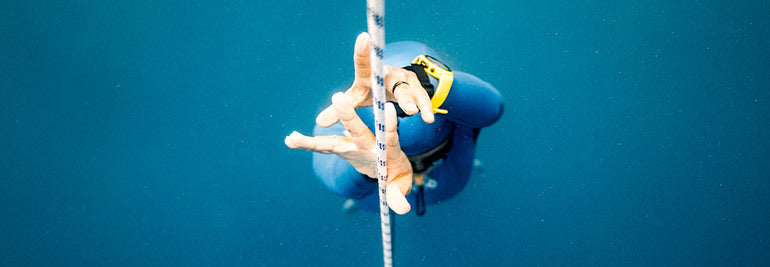

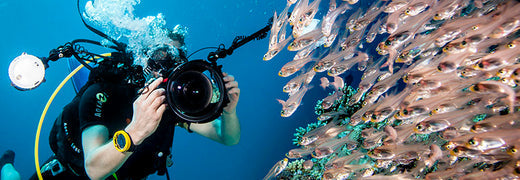
Want to take a great photo? Hold your breath
Diving was something I’d always done.
As a kid, while swimming, I spent more time beneath the surface than above it. But my free dive obsession really started with a SCUBA diving trip in Egypt. During that trip I actually was snorkeling with a friend, and trying to get our depth gauge as deep as we could. Which is a stupid thing to do, by the way. But I was having so much fun, I took a course in freediving… and haven’t been dry since.
My best was good enough for a Dutch National Record.
With fins to 60m, without to 55m, and free immersion to 65m. But I was a very average free diver during the time I was competing. At the time, 2011, the 55m was top 20. It’s nowhere near that anymore.
I’ve had seals kiss my camera
Last year, here in Cornwall, we were swimming with seals. Really shy in the beginning, but after a while, one was interested in my fins. Then he got close enough to my camera dome that his whiskers touched it. That was an interaction where you feel someone looking back at you.
I get in the water with a different mindset than the diver.
We both dive, but they have to go within themselves – all I do is look outside of myself. I look at them, the environment, the light. The same actions with completely opposite goals.
Safety dives helped me train.
At every comp, I did safety dives. There is a diver at depth and 30m. And because I did a lot of that, I knew I had a lot of stamina to do repeated dives. The deep guys go to 100m but do it once. The safety guys – and me – go to 30m, but we do it all day long.
I’m definitely, absolutely doing more work than the guys diving
I’m just not going as deep. I have to swim to 15m, see the diver, swim around him, get in front, crane your neck – and it’s a bad position. They’re going for maximum depth efficiency, I’m going for bursts of speed to get my shot. Totally inefficient as far as diving goes. I don’t become a better free diver by being a free dive photographer.
I love Will Trubridge
I met him first in 2007, but it took me till 2012 to work with him. Now we’re actually friends. He can be a bit shy. It took until I found out he had a wicked sense of humor for us to become friends. It’s nice to work with him – he’s a good delegator who tells you what he wants or expects, and he’s really clear about what he can do.
At Vertical Blue, I do fifty dives a day
Mostly hanging out between 10 – 20m. That’s my office, ten to twenty meters deep. That’s a depth where the light is still good, the background is good, and it’s easily achievable –I can do it on repeat all day long.
My dream dive is The Arch in the Blue Hole in Dahab
It’s an opening in a natural reef. The arch is at 58m, and then there’s a 30m overhang, then you have to go back up. To do the arch, with a camera, that would be spectacular.
All images © Daan Verhoeven / Vertical Blue
Read also 7 tips to help you make amazing diving videos and 10 tips to help you take amazing underwater photos
Learn more about Vertical Blue

Here are the three marine life contest winners
The three winners are Babak Davoudi from California, Ruben Castro Castillo from Spain and Kimberly Jeffries from Hawaii. Here are their pictures and stories.
Kimberly & hammerhead shark
By far the biggest myth people say about sharks is they are mindless, man eating monsters. Nothing could be farther from the truth. These are beautiful, majestic, sentient creatures that actually appreciate and return for affection over and over and over again. Jim Abernethy - Tales by Light - Happy Earth Day everyone 🌏 。 。 。 。 #shark #travel #freedive #rebreather #savesharks #subal #conservation #neverstopexploring #ocean #freediving #yourshotphotographer #oahu #explore #teamcanon #extinction #photo #hawaii #scuba #photooftheday #marine #marineconservation #photography #underwater #padi #galapagos #hammerheadshark #hammerhead #wild #suuntodive #earthday
A post shared by Kimberly (@kimberlyswimberly) on Apr 22, 2017 at 11:14am PDT
“Hammerhead sharks are among some of the most amazing ocean animals. Their head shape has evolved to act as a hydrofoil underwater and their bodies are capable of extreme maneuverability. They're absolutely beautiful to see moving underwater. Sadly, despite evolution, Scalloped hammerheads are considered endangered, with their population having decreased around 95% in the past thirty years due to over fishing and shark finning.”
“This particular photo is of a scalloped hammerhead off Darwin's Arch, Galapagos. Schools of sharks will gather to be cleaned by fish and to find mates. It's beautiful to see untouched nature like that.”
“Although this photo was shot in the Galapagos, I'm lucky enough to call Oahu home. We have crystal clear diving all year round and every island in Hawaii has a little different flavor so it's always an adventure in the water.”
–Kimberly Jeffries, California, USA
Ruben & angel shark
Ruben’s angel shark video (The same video was also shared on Instagram)
“I went diving again today and was lucky enough to meet an angel shark. They are fantastic creatures and it’s always good to see them. I think we have to protect them, and the best way to educate and teach people is through videos and images.”
“I am from Madrid, Spain, but live in Las Palmas de Gran Canaria. Usually I dive in the Canary Islands.”
–Ruben Castro Castillo, Gran Canaria, Spain
Babak & sea turtle
My favorite dive buddy of all time! Throwback to an amazing experience, diving in #turtlecanyon #Oahu and encountering with many of these giant #seaturtle #honu The average shell length of an adult honu is 3-4 feet and they weigh ~250 pounds, but they can grow to a weight of 500 pounds and their average life span could reach 80 years. #suuntodive #hawaii #scubadiving #paditv
A post shared by Babak Davoudi (@babakd) on Apr 20, 2017 at 11:24am PDT
“The picture is from my trip to Hawaii, Oahu, Turtle Canyon dive site, right after I got my open water certification and I was so excited diving in Hawaii. We saw a lot of these huge sea turtles surrounded by small fishes cleaning them. It was my first time seeing turtles that big. They are so calm and the way they swim and glide in the water looks like they are flying. Looking at their faces make me happy and smile. To me they look like ancient and prehistoric creatures.”
“I live in Irvine, California and normally dive around here in Catalina Island, Shaw's Cove, Channel Islands and sometimes going on trips to another places. I dove in Dubai, Hawaii (Molokini and Oahu). I'm getting more serious about diving, it's been my dream since I was a child to dive and it became true when I moved here to California.”
–Babak Davoudi, California, USA
Congratulations to the winners and thank you for participating and sharing your stories, everyone!
The three winners got easy-to-use, nitrox-capable, large-displayed Suunto Zoop Novo dive computers to accompany them on their future adventures.
Main image by Stephen R Woods / Suunto


WATCH THE WORLDS MOST AMAZING FREEDIVERS COMPETE TO WIN AT SUUNTO VERTICAL BLUE
In its 10th edition this year, the Vertical Blue competition is comprised of three depth disciplines: Constant Weight, Constant No-Fins and Free Immersion (CWT, CNF, FIM respectively). #VB2017 is an AIDA sanctioned event which offers competitors six official dives to challenge themselves to obtain the coveted title of “Champion” at the most elite freediving competition in the world.
William’s rival in free immersion, Miguel Lozano of Spain, will also be on hand to conquer new territory, as well as diving legends Davide Carrera & Homar Leuci of Italy. Heating things up for the ladies are world record holder Sayuri Kinoshita of Japan and first-time attendee (but renowned Italian mistress of the deep) Alessia Zecchini.
Over the course of the next 10 days freediving fans around the globe can watch the record-breaking battles among the world’s most talented athletes, who are literally pushing the limits on what was once thought impossible for the human body to do.
Stay tuned here and via the Suunto Diving + Vertical Blue Facebook pages, the VB event website, Suunto & VB Instagram, the VB Youtube Channel, Trubridge’s Twitter feed as well as the Vertical Blue twitter handle & hashtags #VB2017 and #verticalblue for a live feed from the platform, amazing videos & images and results.
Join us as we watch dive history in the making!
All images © Daan Verhoeven/Vertical Blue

Meet the most endangered sea mammal in existence: Hector’s Dolphins
How did you get involved?
It’s actually a bit of a quirky story – I became involved in the effort’s to save the Hector and Maui dolphins during the attempt to be the first man to free dive 100m in free diving. We called it Project Hector because 100m is a ‘hectometer’ – and to raise awareness of what’s happening to Hector’s Dolphins. We did the project, and it was a huge success, but my dedication to the cause didn’t end – so I've kept on campaigning.
How endangered are they?
Extremely. There’s only about 7,500 left worldwide – down from a population of 29,000 in the seventies. The Maui’s Dolphin sub-species of Hector’s Dolphins is thought to have only about 50 left in the population.
You’ve only had one chance to swim with them…
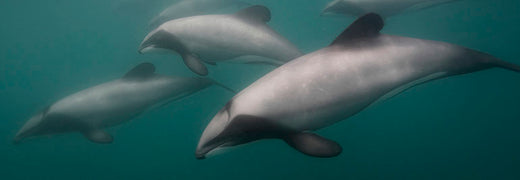
I’ve swum with other dolphins in the wild many times – where I live in the Bahamas, you see the Atlantic Spotted Dolphins, and Bottle-nosed Dolphins as well. But the swim with the Hector’s Dolphins was a really magical experience. It was in early 2011 when I was in New Zealand, and went to a place close to Christchurch – only a short encounter. Five or ten minutes. But even that was something I’ll never forget. They’re the 'Mickey Mouse' of the cetaceans – the dorsal fin is shaped like Mickey’s ear. They're all soft curves with colored shapes, gray and white, all over the body.
World champion freediver Will Trubridge wants to raise awareness to protect the endangered Hector’s Dolphins.
It’s much different to swim with a dolphin than any other marine life, no?
Or even terrestrial life. Alongside them, watching them and watching you, it’s very apparent from just the look in their eyes that they are aware of you, studying you, curious about you. It’s a look you don’t get from other animals even cats and dogs. Maybe some monkeys. They’re very present, very aware creatures. Being alongside that and encountering that is a very incredible experience.
Any other marine life you’ve bumped into down below?
All the interactions I’ve had with big marine life were dolphins, sharks and manta rays. I’ve never actually swum with whales yet, never had the opportunity! That’s something I’d like to do. I’ve been in the water when humpbacks were close, just haven’t spotted one. In my childhood was with a dubong – it’s like a manatee – in Vanuatu. We didn’t know about him, although he was quite famous – the locals had been feeding it for years, and it was living all alone in the harbor. We jumped in to go snorkeling, we almost got blown out of the water by a bus-sized hunk of flesh trying to mate with anything it found. As a kid that was quite intimidating!
How can we help the fight to save them?
The organization NABU is leading the fight to save the Hector’s Dolphin – the goal is a complete ban on trawling or gill nets in their habitats. But we are up against a very stubborn and short-sighted government. You can learn more at hectorsdolphins.com
Diving offers a unique chance for humans to observe marine animals in their native environment. Stay tuned to for even more incredible stories of divers and the denizens of the deep sharing space beneath the surface of the sea!
What is your favourite marine animal and why?
Share your story on Instagram by April 23 and tag your post with #suuntodive
The three most inspiring posts will win easy-to-use, nitrox-capable, large-displayed Suunto Zoop Novo dive computers. For the terms and conditions click here

The coolest dive partners aren’t humans – they’re sea lions!
There was easily a couple hundred sea lions around
The sea lion colony at Hornby Island is active, and has little fear of people. My dive happened to be right around the biggest herring spawn of the year, meaning they were all around waiting for a feast. Ones you see solo in the wild tend to be a lot more shy.
They just want to play…
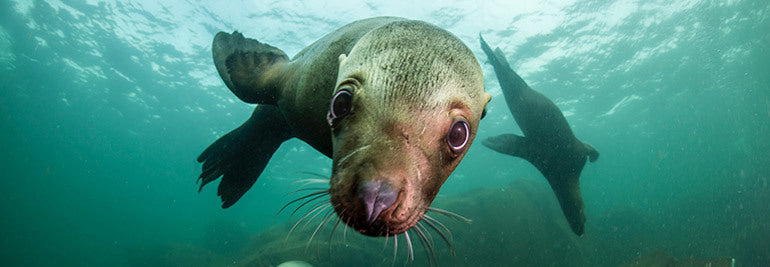
Of course, sea lions can be dangerous. I’m not saying you should go out and hug a sea lion – but if you happen to dive with this group you don’t have a choice. As soon as you’re in the water, they just want something to play with. They can come across as quite aggressive – they’ll nip at your suit, the top of your head, or tug on your wings, but they aren’t trying to injure you. I’ve had one put his full mouth on my dorm port – and another one yanked me up to the surface to play.
… but it’s on their terms
When they’re done, they’ll just head back to the rocks to sunbathe.
These are ‘Stellar Sea Lions’
That’s actually the name of the breed. I saw a few California Sea Lions as well, but mostly Stellars.
It’s super obvious they’re super smart
When you dive with these sea lions, you get the perception that it’s all play. They’re very curious, and they’re very trainable. At the seaquarium, they train the sea lions to undergo all sorts of vetinerary procedures to keep them healthy.
That part of British Columbia is absolutely stunning
On this trip I was diving a wreck called Capilano. There’s so much to see underwater. Some of the best diving in the world! Nutrient rich water year round. Stunning wildlife. Plenty of wrecks.
We dove during a blizzard
Full white-out topside. Great visibility below. Sure, the water is cold, but the air above was even colder. If you’ve got the right gear it’s no big deal.
One sea lion loved my Suunto Eon!
He kept tugging at my dive computer – at one point he even looked like he was checking out my dive stats. So maybe one day they’ll make a good diver partner anyways!
Diving offers a unique chance for humans to observe marine animals in their native environment. Stay tuned for even more incredible stories of divers and the denizens of the deep sharing space beneath the surface of the sea!

See what a diving expert wants you to know about SCUBA
It’s not suppose to hurt your ears
When I was a kid I dreamed about diving, but my ears and sinuses screamed in pain – but when you take a Scuba class you learn to equalize naturally. Diving should never be painful. Your ears hurt because of the effects of pressure – the volume of air spaces within your body are compressed by water pressure over your head. You need to adjust that change with equalization.
You’re not breathing what you breath on land
Most people mistakenly assume there’s an oxygen tank on your back. You’re not breathing oxgygen, you’re breathing what you’d breath on land, and that's 21% percent oxygen, 79% nitrogen and a few trace gasses – but it’s dried, filtered clean, and compressed. Technical divers may use exotic gasses like helium to conduct dives at much deeper levels, but recreational divers just breath, well, normal air.
How long can I stay under water, really?
That’s a tough questions! There’s a lot of factors that limit your dive. Important ones being how much air is in your tank and how deep you go. Recreational divers generally can ascend to the surface at any time during their dive with no need for de-compression stops on the way.
Uhhh, what are decompression stops?
Technical divers have an artificial ‘ceiling’ over their heads (or sometimes a real one). Artificial ceilings are created when you go deep or very long, and your body needs to time climatize and release gasses that have accumulated in the body. If you go higher, faster, you could get injured – it’s called decompression sickness (colloquially known as 'the bends’) and trust me, you don’t want to deal with it – symptoms include joint pain, headaches, neurological damage, even paralysis. But let me be clear: this is totally, 100% avoidable.
How safe is diving?
Statistically, diving is incredibly safe if you’re following the rules and know what’s going on. You’re more likely to suffer a fatal bowling injury! But you need to follow the sea conditions and weather, and follow the basic safety rules you learned in dive class.
Will my whole body wrinkle up like my fingers after too long in the pool?
Ha! That’s great, but no. You won’t come out looking like a prune.
What’s a dive algorithm?
A dive algorithm is a complex mathematical formula that attempts to simulate how the human body deals with the inert gas in scuba diving on descent and during the dive. It predicts how the body will off-gas that same inert gas to allow us to find the proper schedule for a safe ascent back to the surface. See the above statement about ‘decompression stops’.
Give us a sample dive profile?
A ‘dive profile’ is basically a map of how deep you go when (and for how long) during a dive. A rec-diver going to 30m of depth has only of 20min of bottom time before they ascend back to the surface with no safety stops. Alternatively, tech divers will spends hours at 30m, using rebreathers and different gasses to complete that dive, and they’ll have a number of decompression stops to come back to the surface.
Are there any long-term effects?
The current algorithms keep us in the safe envelope of exposure. I’ve got 7,000 dives, and sometimes am on projects that extend for months, diving every single day. Researchers are still looking at us (by that I mean people like me!) to see if there’s any long term effects. Decompression stress – the same thing that astronauts deal with, just on lesser levels – is of great interest to physiologists – there’s a lot of questions about how that stress expresses itself on bones or tissue over very long periods of time. But I’m 52 years old, and can still swim circles around most 20 year olds, so I’m not too worried for the long run!
Stay tuned for more articles about the science of diving.
READ MORE
Explore a frozen world with Jill Heinerth
How deep can we go?


