


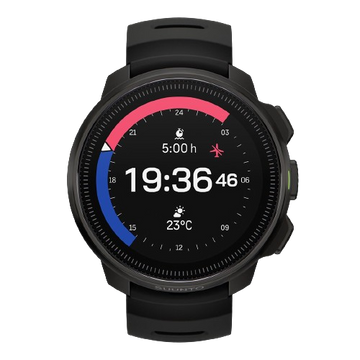


Stand along the course at any marathon and watch the pack go by. Even among runners holding the same pace, the difference is clear: some heads glide forward almost on a flat line, while others bob noticeably up and down. That bounce has a name: vertical oscillation.
Measuring it used to require a biomechanics lab with a force-plate treadmill or 3D motion capture. Today, a running watch logs it on every run. But having the number and knowing what to do with it are different things. What does it tell you? What counts as normal? And should you change your stride to bring it down? This guide covers what the research says, plus a practical way to track your progress on a Suunto watch.
What Is Vertical Oscillation in Running?
Vertical oscillation is the distance your body's center of mass moves up and down with each step, usually measured in centimeters (cm). Across a single gait cycle, it is the height difference between your highest point (typically around the flight phase) and your lowest point (usually at mid-stance, as your leg absorbs impact). A watch or pod can't measure your true center of mass directly, so consumer wearables estimate the metric by tracking the vertical movement of your torso or pelvis.
Picture two ways of moving forward. One is a rabbit, hopping into the air on every stride before dropping back down. The other is a rolling wheel, gliding smoothly ahead. Real running sits somewhere between the two. Because running includes a flight phase, some up-and-down motion is normal and necessary.
The real question is whether your amount of bounce works for you.

Why Does Vertical Oscillation Matter?
Vertical oscillation doesn't directly dictate how fast you can run, but it ties closely to three things every runner cares about.
- Running economy: Moving straight up doesn't move you toward the finish line, and lifting your body against gravity on every step costs muscular work. A 2024 systematic review and meta-analysis on running biomechanics and running economy found a moderate correlation between higher vertical oscillation and greater energy cost.
- Impact loading: What goes up has to come down—the higher you bounce, the more force your legs have to absorb on landing. Lab studies show that when runners actively reduce their vertical oscillation, both average vertical loading rate and peak vertical ground reaction force drop right along with it.
- Signs of fatigue: A 2023 meta-analysis on running fatigue and kinematics found that novice runners tend to bounce more as they tire. If you're newer to running and notice your vertical oscillation creeping up in the back half of a long run, it's often a sign that your form is starting to break down.
What Affects Vertical Oscillation?
No single "ideal" vertical oscillation applies to every runner, because several variables move the number. Knowing what drives it helps you make sense of day-to-day changes in your log and shows you where to focus if you want to improve.
- Cadence and stride length: At any given pace, nudging your cadence up and shortening your stride usually trims how much your center of mass rises and falls. That makes cadence the most practical starting point when working on your form.
- Running speed: Speed changes more than one thing at once—your cadence, stride length, flight time, and vertical movement all shift together. Still, the overall pattern is clear: research shows that as running speed increases, vertical displacement of the center of mass usually goes down. The practical takeaway is simple: only compare your vertical oscillation across runs at the same pace.
- Fatigue: As your muscles tire, leg stiffness, joint angles, and coordination all shift, and vertical oscillation often creeps up. That's why your numbers in the first mile of a workout can look quite different from the last mile.
- Height: Taller runners naturally post slightly higher raw numbers, though the gap isn't as big as many assume. Researchers looking at data from 860 runners found that taller runners tend to have higher absolute vertical oscillation.

What Is a Good Vertical Oscillation?
Biomechanics research hasn't settled on a universal "ideal range" that fits every runner.
What we do have are averages from large-sample studies: running at their preferred pace, men average around 8.0 cm and women around 7.3 cm, with most recreational runners falling between 6 and 9 cm.
In day-to-day training, you can also use the tiers in the Suunto App as a reference:
- Elite: < 6 cm
- Very good: 6–8 cm
- Normal: 8–10 cm
- Room for improvement: 10–13 cm
- Poor: ≥ 13 cm
Keep in mind that these tiers are based on the benchmarks of a specific system and should be used as a general reference rather than a clinical standard. Since different brands and devices use different measurement scales, raw values should not be directly compared across ecosystems.
Vertical Oscillation vs. Vertical Ratio
Those ranges raise an obvious catch: a vertical oscillation of 9 cm doesn't mean the same thing for every runner. It tells you how high you bounce, but not how far each step carries you forward. That's where Vertical Ratio comes in:
Vertical Ratio = Vertical Oscillation ÷ Stride Length × 100%
Vertical Ratio weighs your bounce against your stride length, showing how much up-and-down motion you pay for every unit of forward distance.
Say two runners both have a vertical oscillation of 9 cm. One covers 125 cm per stride, putting their vertical ratio at 7.2%. The other covers 95 cm per stride, which pushes that ratio up to 9.5%. Their raw bounce is identical, but the share of motion going up and down versus forward is very different. At everyday training paces, most runners land between 7% and 9%.
When you read your post-run stats, first check whether your raw vertical oscillation sits far outside the typical range, then use Vertical Ratio to see how your bounce balances against your forward stride. Treat neither number as a standalone grade on your form.
How Is Vertical Oscillation Measured?
Most running watches and pods estimate vertical oscillation using a built-in inertial measurement unit (IMU). An accelerometer tracks vertical acceleration on every step, and onboard algorithms convert that signal into vertical displacement.
A 2022 study compared four wearables worn at different spots on the body—upper back, chest, waist, and foot. All four reliably tracked changes in vertical oscillation, but their absolute readings differed by up to 26%. Sensor placement, proprietary algorithms, and treadmill versus outdoor surfaces all play a part in those gaps.
For runners, the rule of thumb is straightforward: comparing your own numbers over time on the same device is meaningful, but comparing raw numbers across different devices takes caution.

How to Improve Vertical Oscillation
Once you know what vertical oscillation is and where a typical range sits, the next question is: if my number is high, can I bring it down?
You can, with two caveats.
First, if you have a history of running injuries, get a professional gait assessment before changing your stride on your own. Second, lower isn't automatically better. Forcing yourself to run flat can leave you with a stiff, shuffling stride that hurts your efficiency. The goal is to settle into a range that fits your body.
Gait Adjustments: The Direct Route
The most direct fix is to slightly increase your cadence, shorten your stride at the same pace, and let your foot land closer to directly underneath your hips. It's the easiest adjustment to make and has the strongest evidence behind it.
In practice, try bumping your current cadence up by 5%–10% using a metronome app or the cadence alerts on your watch. Treat that 5%–10% window as a gentle starting guideline rather than a strict target you have to hit. Systematic reviews show that a quicker cadence and shorter stride reduce vertical oscillation along with several other injury-related biomechanical loads. Everyone has their own sweet spot for cadence, though, and higher isn't endlessly better. If a bigger jump feels awkward or sends your heart rate climbing, dial the increase back to a smaller step.
Strength and Plyometric Training: The Indirect Route
Strength Training
If tweaking your cadence is a direct technical fix, strength training builds the physical chassis that holds that form together.
While no study proves that lifting weights directly lowers vertical oscillation on its own, strong evidence shows it improves running economy. Because vertical oscillation is closely tied to economy, building strength can help indirectly.
For most runners, the goal in the weight room isn't maxing out a barbell; it's keeping your hips, legs, and core stable through thousands of single-leg landings. You don't need heavy weights on day one. If you're new to lifting, start with 1–2 sessions a week using bodyweight or light resistance. Focus on single-leg movements that mirror running (split squats, single-leg deadlifts, calf raises) paired with basic core stability work. Once the movement patterns feel solid, gradually add weight.

Plyometric Training
Once you have a basic strength foundation, you can use plyometrics to get a crisper rebound off the ground. Plyometric training builds elastic energy storage in your muscles and tendons and helps you produce force quickly. Because that closely mirrors the "land, absorb, and rebound" cycle of every running step, it helps trim ground contact time and cut down on unnecessary vertical sink and bounce.
Because plyometrics put real load on your Achilles tendons and plantar fascia, make sure you're injury-free and have a baseline of calf and ankle strength before jumping in. Start with 1–2 sessions a week of low-rep pogo jumps in place (say, 2–3 sets of 10–15 reps) right after your warm-up while your legs are still fresh. Think about using ankle stiffness to tap the ground lightly and pop right back up, rather than trying to jump high. Once you're comfortable with both, combining strength and plyometric training often works better than doing either one alone.
How to Track and Verify Improvement on Your Suunto Watch
Tweaking your cadence or building strength takes a few weeks to show up in your stride. Your Suunto watch gives you an objective way to track those changes over time.
What You Need and Where to Find Your Data
Start with a Suunto watch that natively tracks vertical oscillation, including Suunto Race 3S, Race 2, Run 2, Run, and Vertical 2, and stick with the same watch throughout your tracking block.
After a run, sync your watch with the Suunto app, open the workout under Activities, and scroll down to the Technique section to see your average vertical oscillation, ground contact time, and stride length.

Three Rules for Reading Your Data
Having the numbers is step one; reading them fairly is step two. Follow three basic rules:
- Compare at the same pace: Running speed changes vertical oscillation on its own, so compare only runs done at a similar pace.
- Watch the trend, not a single run: Sleep, terrain, weather, and even shoe rotation can nudge your numbers on any given day. Look at the overall trend across 4 to 8 weeks instead of reacting to a single workout.
- Look at the full picture: Check your cadence and ground contact time alongside vertical oscillation, and notice how the run feels, especially whether the same pace starts to feel easier.

Suggested Tracking Routine
- Spend the first 1 to 2 weeks logging a few regular easy runs at a steady, repeatable pace as your check-in window, noting your baseline vertical oscillation, cadence, and ground contact time.
- From week 2, bring in your cadence tweaks or strength work while you keep logging the same-pace check-in runs, ideally on the same route.
- After 4 to 8 weeks, look at the trend. If your vertical oscillation at that pace is trending down beyond normal day-to-day noise, backed by a steadier cadence, shorter ground contact time, and an easier perceived effort, your adjustments are likely paying off. If your vertical oscillation stays flat, a run that feels noticeably smoother and easier at the same pace is still a good sign that your training is moving in the right direction.
Conclusion
Tracking vertical oscillation helps you understand how you move so you can make smarter training adjustments.
You'll get the most out of this metric when you read it in context: at the same pace, over multi-week trends, and alongside stride length and ground contact time. If your long-term numbers show extra bounce, try raising your cadence by 5% to 10% and working in basic single-leg strength and ankle-stiffness drills. Give your body a few weeks to adapt, and let the data serve as an honest mirror as you settle into a smoother, more economical stride.
FAQ
What is elite runners' vertical oscillation?
At marathon race pace, elite distance runners typically hover around 6 cm, largely a byproduct of faster running speeds and higher cadence.
Is lower vertical oscillation always better?
No. Pushing vertical oscillation too low can actually hurt your efficiency. The goal is simply to land in a reasonable range that matches your stride length.
Should I change my form just because my watch says so?
No. If you're running pain-free and feel good, a high reading on its own isn't a reason to overhaul your stride. Watch your trend at the same pace over several weeks and weigh it alongside cadence, ground contact time, and how your body feels. If you have a history of injuries, check in with a physical therapist or running coach first.
How does running speed affect vertical oscillation?
When you change speed, your cadence, stride length, and vertical oscillation all shift together, though the exact amount varies from runner to runner. Whenever you compare vertical oscillation across different speeds, read it alongside pace, cadence, and stride length.


