




Suunto Blog


Fuelling the engine: a commonsense approach to nutrition
Eating well is essential for athletes. The bigger your goal, the more nutrition has to play a central part of your training plan. Take shortcuts on how you eat, and you’ll eventually pay for it.
But the topic of diet, what we should and shouldn’t eat, has become touchy and confusing. There are all sorts of diets out there – paleolithic, vegan, gluten-free, low carb, high carb – each one with advocates claiming their way is the one true way.
Matias Anthoni prefers a common sense approach to nutrition.
“Nowadays it’s become a big topic, and everyone has his or her own opinion, and it seems hard to find the real truth,” says Matias Anthoni, Suunto’s in-house personal trainer. “It’s become trendy to follow a kind of diet.”
Anthoni, 26, has a Bachelor in Sports and Health Promotion, and gives nutritional advice to Suunto employees, as well as personal fitness training. He takes a simple, “nonsectarian” approach to nutrition, rather than buying into the hype of one diet over another.
“As long as you get the nutrients it doesn’t really matter what diet you follow,” he says. “You can teach your body to thrive on different diets. The body is quite adaptable. But we do need certain basics. The question I always ask is, would my grandma recognize it as food?”
Here are Anthoni’s five down-to-earth tips for good nutrition:
1. Start with your meal rhythm
This is the first topic Anthoni’s raises with his clients during a consultation. Just improving how often you eat can improve what you eat. Many of his clients skip meals or have long breaks between meals; this results in blood sugar levels dropping, then tiredness, and then cravings and impulses for unhealthy snacks.“With a more steady meal rhythm you avoid big spikes in the blood levels, make better decisions, and are less likely to just reach for a chocolate bar,” he says.
Meals should be about three hours apart, and consist of a good breakfast, lunch and dinner, with smaller, healthy snacks in between. “It leads to healthier choices and you’ll have more energy,” Anthoni says.
2. Plan ahead
“You can’t be a top athlete if you are eating poorly; it’s not just about training, it’s about eating as well,” Anthoni says. “It really helps if you plan your meals like you plan your training. Know what you are going to buy and know what you are going to make. When you come home from work, or after a training session, it’s all ready to go.”
3. Follow the Nordic plate model
Anthoni says in Finland there’s a traditional “plate model” or a way to divide your plate into three sections: one half should be salad and vegetables, one quarter should be carbohydrates, and one quarter protein. This balanced plate ensures you will get enough of all the key nutrients.
4. Eat quality food
Quality can seem like a vague notion, so Anthoni recommends a common sense approach here, too. “Have a look at your plate – are there all the colours – red, green, yellow?” he asks. “Are you eating the same thing every day?” Anthoni suggests finding and following basic nutrition guidelines. “They provide a good start, and then make small changes to fit yourself from there,” he says.
5. There’s no one size fits all diet
Deciding what to eat depends on your goals. “The more you move the more you need,” Anthoni says. “If your goal is building muscle mass, then you need more protein. If you are an endurance athlete, eating enough carbohydrates becomes more important. There is no one size fits all, no one plan can fit everyone. You need to have your own plan.”
Lead image: Photo by Roosa Kulju on Unsplash.
READ MORE
Fuelling the engine: talking nutrition with ultra runner Lucy Bartholomew
Fuelling the engine: talking nutrition with triathlete Mel Hauschildt

4 reasons rock climbers should learn freediving
© Mike Board
When an earthquake struck Indonesia in August, Kate Middleton’s home on the island Gili Trawangan (neighbouring Bali) was shaken, but not destroyed. “We were lucky to have very little damage, just a couple of walls in the yoga hall,” she says.
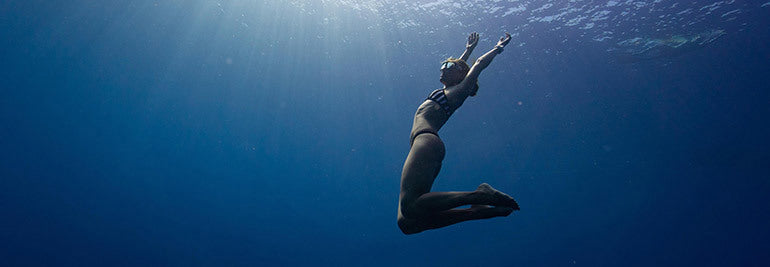
The 30-year-old Canadian-New Zealander owns a yoga studio, freediving school and organic cafe on the island. It’s in the clear waters, teeming with exotic marine life, around the island that Middleton trains as a competitive freediver.
Click here to donate to the Lombok Earthquake Support effort underway.
She wasn’t on Gili when the earthquake struck; she was thousands of kilometers away on a different island: Greece’s rock climbing mecca Kalymnous, in the southeastern Aegean sea.
“In 2015, I gifted myself a trip here to learn to rock climb,” the gold medalist says. “I did a beginners and intermediate course back to back, and was totally hooked. The following summer I returned and stayed for two months, climbing almost every day. Now I’m back again.”
© Kalyja Rain
Beginner’s mind
Currently working on climbing a grade 6c route, Middleton is focused on cultivating presence on her climbs, rather than being concerned about numbers and statistics. Competition freediving demands, structured, disciplined training, and what she calls a “monofocus”.
“What I love about both trail running and rock climbing is it’s really easy for me to maintain a ‘beginners mind’ with them,” Middleton says.
Here are her four reasons rock climbers should learn freediving
© Kate Middleton
1. Relaxing into it
The biggest challenge for people new to freediving is learning to relax. “Most of us know how to push and force our way into things, instead of knowing how to relax into our power,” Middleton says. In freediving, relaxation is key for being able to dive deeply on a single breath. Relaxation calms the breath and reduces the heart rate, which conserves oxygen. Tension, stress, force increase the heart rate, wasting energy and oxygen.
“I see where that crosses over into climbing,” she says. “I’ve seen my friends practically float up 50 m overhangs, and I feel they are relaxing into their ability, rather than forcing it. I also see a lot of climbers who climb in a different way, that is more aggressive, and that doesn’t seem to be as efficient or enjoyable.”
Click here to read more about Middelton’s yoga and freediving journey.
2. Breathing well
“Freediving gives you a really great awareness of your breathing and breathing patterns,” Middleton says. “Any time the breath is getting out of balance, maybe due to stress, it’s very easy to pick up on that. This has helped me a lot when I’m climbing. I notice when I’m in the crux of a climb, or when fear starts to edge in, and I start to hold my breath. I then take some deeper breaths, with a steadier rhythm, and then I come back to presence and can continue climbing.”
3. Mastering fear
“Freediving has given me such a sensitivity to what’s happening with me. Because relaxation is so critical for freediving, especial deep diving, I can see so clearly how fear manifests in the body and how tension escalates. If I can catch it early, then it’s a lot easier to regulate and work with.”
4. Finding your power
When most people hear about freediving it seems a little mad, dangerous, even suicidal. But in actual fact, learned properly, it is a safe sport that shows us we can do so much more than we believe. “What I’ve learned from freediving is this body is so capable,” Middleton says. “I know without me having to understand it, that my body knows how to adapt and wants to adapt. I thrive in these environments that aren’t our everyday comfortable spaces. That gives me a lot of trust.”
True grit
Middleton says it’s not only freediving helping her to climb, but vice versa, too. “I’m getting more grit from the climbing,” she says. “When I fall, it hurts a bit more. I have to want it more to get over the crux of a climb. I fail a lot more. It would be easy for me to give up and say it’s beyond me, and stick to easy climbs. I’m learning to tap into the inner determination and fire that really wants to overcome the hurdle.”
Lead image: © Mike Board
More stories about freediving:
Learning the joy of freediving.
Is the ultimate cross-training ... breathing?
The one thing every freediver needs.
How deep can we go?
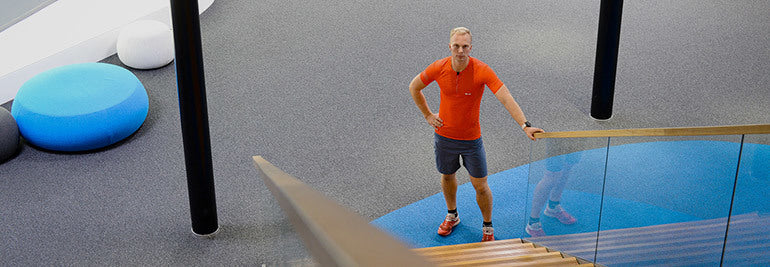

Make everything count: 7 tips for office workers to get moving
At Suunto headquarters in Finland we try to practice what we preach. Which is why we have an in-house personal trainer to motivate us all to stay fit and healthy.
Matias Anthoni, 26, roams the offices, dropping by rooms, calling on us to get up and to join him for short exercise breaks on the spot. Resistance is futile!
Matias sees stairs as an opportunity to stay active.
“My job is to maintain the health and wellbeing of everyone at Suunto,” the former footballer turned trail runner says. “Everyone who works for the company can use me free of charge. I offer group exercise classes, personal sessions, nutritional advice, and random exercise breaks. Everyone understands it’s a great opportunity.”
Matias has a Bachelor in Sports and Health Promotion, and believes there are many opportunities throughout the day for office workers to take care of their bodies and minds. Here are his tips:
1. Everything counts
Remember this phrase and make it your mantra. It cuts through all the excuses about not having time. Sometimes we get stuck in an “all or nothing” mindset; if we can’t, for example, go for an hour long run or a full gym workout, we don’t do anything at all, failing to see the possibilities that are often right in front of our faces, and don’t take much time. Matias says it’s about thinking laterally, and making everything count.
2. Three x three minutes
Take three, three-minute exercise breaks a day. Set a timer on your phone, and do it. Invite your colleagues to join you. To get you started, here’s a short video of Matias demonstrating a few simple movements – try them! “Getting the blood flowing is good for the brain,” Matias says.
3. Go out of your way
When you need to go to the bathroom or get water or coffee, rather than going to the closest option, get in some extra movement and take an extra flight of stairs to do what you need on a floor above or below. Go out of your way for the sake of a little extra movement. It all counts.
4. Have walking meetings
When you have a simple catch up meeting that doesn’t require technology, why not make it a walk and talk? Aside from the movement, people are generally less distracted and more engaged at a walking meeting. You’ll breathe better, and will feel more energized.
5. Use your lunch breaks wisely
Have a 25 or 30-minute workout before you have lunch and you’ll have more energy for the rest of your day. It could even be 15 minutes. Remember, everything counts. Do what you can, rather than getting stuck in what you can’t. “Studies show a small amount of exercise goes a long way,” Matias says.
6. Create team challenges
Try to create a culture where you encourage one another to stay active. Create a challenge to see which department or team can do the most pull-ups in a month, or can walk the most steps in a month.
7. Plan your day
When you plan your day in advance you will know when you have windows for exercise or movement breaks. Planning means you are more likely to take advantage of these. Lock them in, and make them count.


Suunto 3 Fitness Tracks Sleep Quality - What Can I Do to Improve It?
Thanks to your Suunto 3 you can see when things are heading in the right direction, know when it is time to stay the course, and when it’s time to make some changes. You can also follow along to learn which strategies and solutions are the most effective for you.
Here are 5 tips to improve your sleep quality
Avoid strenuous physical activity late in the evening.
Regular physical activity is an important part of a healthy lifestyle, but your body doesn’t stop working when you do. Your body can remain in an elevated state long after you finish a workout. As a result, your night time recovery levels may be delayed and diminished.
Establish a regular routine before bed.
We are all creatures of habit, and for the most part we have good instincts for what constitutes a good evening routine. A good stable routine signals your body that it’s time to start winding things down and allows your body to get head start on the work of recovery.
Regulate alcohol consumption.
A glass of wine in the evening is a popular way to relax in the evening, or a few drinks may help unwind after a stressful day. More than a few drinks, however, will almost certainly delay the onset of recovery at night and will result in poor recovery.
Improve your cardiorespiratory fitness (VO2max) with regular physical activity.
As if there weren’t enough reasons to improve your fitness level, here’s one more. The fitter you are the less your body is impacted by stress. You also become more resilient, so that when you do experience stress your body recovers more efficiently. This is true both day and night.
Sleep more.
It’s almost cruel, but sometimes the cause of bad sleep is… wait for it… bad sleep. Chronically poor sleep diminishes your body’s ability to repair itself. It also impairs your ability to interpret situations. This includes the ability to assess your own performance levels, losing touch with yourself and the impact of bad sleep on your effectiveness.
As you think about stress, recovery, and sleep in relation to your own daily routines and lifestyle decisions, it’s worth keeping in mind that stress increases your body’s need for good quality sleep. This is important because busy, hectic schedules that often produce a lot of stress also tend to result in the devaluation of sleep and recovery in favor of doing something more. In the long run, however, the health and productivity benefits of a balanced approach to stress and recovery are well worth it.
Blog post by Herman Bonner / Firstbeat
LEARN HOW TO USE SLEEP TRACKING ON SUUNTO 3 FITNESS


Knowing the ropes - staying safe with crevasse rescue online
It was 36 days, 1900 km of ski touring, about 90,000 m of ascent, and three times harder than anything 37-year-old Mark Smiley has ever done in the mountains.
The 2018 Red Bull Der Lange Weg (The Long Way) took everything he and his wife Janelle had in the tank. Plus some. The world’s longest ski tour from Vienna, Austria across the Alps to Nice, France started on March 17 and finished on April 26. Only seven athletes started, only five finished, including Mark and Janelle, who became the first woman to do so.
Their average moving time was 10.5 hours a day. They covered about 32 km a day and burned 12,000 calories everyday. No amount of Wiener schnitzel and potato dumplings could fill the hole. “It was insane,” Mark says back in the comfort of his own home in Jackson Hole, Wyoming.
The mountains have been Mark’s happy place since he first laid eyes on them as a kid. “I remember going on a family skiing trip when I was 11 and driving down Interstate Highway 70, which has big mountains on either side, and I was like, ‘why hasn’t anyone told me about this before now? I’ve been jipped!‘” After that he moved from the farming plains of Indiana, where he grew up, out to the Rocky Mountains. He’s been there ever since.
He and Janelle have attempted all of America’s 50 classic climbs, and have been successful on 48 of them. It’s took them seven years to get that far.
“No one has climbed all of them. We were trying to become the first,” Mark says. “Now I’m more psyched about combining technical climbing with technical skiing. The combination of the two is cutting edge. If I can get in both on a trip then I’m winning!”
Mark started mountain guiding 17 years ago, and has been doing it pro for five years. With many teachers in his family it’s not surprising he enjoys educating and empowering people in the outdoors. “I treat the people I guide like partners, rather than risks,” he says. “The best teachers can teach without the pupil feeling like they’re being taught.”
It was a logical next step for him to combine his knowledge and passion for outdoor education with his filmmaking skills. He recently produced an online video course on Crevasse Rescue for the Modern Climber, and it’s proving popular.
“This course is like a seat belt,” Mark says. “You wear a seat belt even though you probably won’t actually need it.
“Most of the time out there it‘s fine, but when you need it, you really need that rescue knowledge. Especially in the US, it could be days before someone else comes along and finds you. It’s crucial to be self-sufficient.”
“I‘ve spent 300 days on glaciers and have never fallen in. The chances of needing to use these rescue skills are pretty low. But when you need them, they’re suddenly super important.”
Mark is clear the course doesn’t replace in-person learning in the field. He says it’s always better if people can come out and do a three-day course with him, and drill the skills so they become muscle memory. However, the online course has some advantages.
“Online learning has limitations, but the benefits outweigh them,” he says. “You can rewind it, pause it, play it 100 times. You can’t do that in person. So if you’re a slow learner you can watch it until you get it. If you want to hire me for the day, it’s $600, plus travel, plus time away from work. So, for many people, this course is more accessible.”
He encourages people to try the course and if they don’t learn anything he offers a full money back guarantee. The course offers the latest, cutting-edge ways of carrying out crevasse rescue.
As a taster, Mark offers three tips:
1. "Tie butterfly knots every three or four meters apart in your rope between each two people. The butterfly knot acts like a boat anchor and it will drag the victim to a stop and potentially hold all of the victim's body weight."
2. "Buy a Petzl Micro Traxion and know how to use it. They’re a game changer."
3. "Getting yourself out of crevasse is five times faster than waiting for your buddy to haul you out. Have a good plan about how to get yourself out."
Mark is offering Suunto.com readers 20 % off the course price until July 22, 2018. The promo code is: suuntoclimb. Watch or download the course here.
All images are from Red Bull Der Lange Weg and taken by Philipp Reiter and Christian Gamsjäger. ©Red Bull Content Pool

Kilian Jornet – Running 30's
“I had a big accident four years ago and dislocated both of my shoulders at the same time. Since then I have dislocated them a few times every year. I knew I needed to get this surgery. It was mandatory,” says Kilian.
“I am an outdoor person. I don’t want to be stuck inside, but I knew I needed to stay one or two months indoors. That was hard, but I was mentally prepared for that.”
Watch the video and see the Kilian copes with the slow recovery process of two operated shoulders at once.


