


Suunto Blog


Competition Freediving: the secret to doing well
Will Trubridge explains the importance of psychological strength in freediving competitions – and why having a poker face is a very useful skill. To the observer, freediving is all about serenity and calmness – a peaceful interaction with the underwater world. It is exactly all these things, which is why competition freediving presents such a unique challenge, says Will Trubridge.
“The conditions of a competition are slightly different to a world record attempt. In a competition you have an official preset time and there's a lot more people around – spectators and media. It's not as controllable as with a world record attempt,” he says.
Trubridge surfaces after a competition dive at Dean's Blue Hole ©zooom.at/Samo VidicThe key ingredient to success is to be relaxed he says, which is much harder to achieve in the contest environment. “With other sports you can use the nerves and the anxiety which generates adrenalin to your advantage. In freediving it's completely detrimental.”The reason for this is the affect it has on heart rate. Stress and anxiety raises the heart rate. To be successful, freedivers need to have the lowest pulse possible to conserve oxygen. Trubridge is currently preparing for the AIDA Apnea Depth World Championship in Cyprus this September after a successful spring in which he won all titles and set a new competition No Fins personal best (PB) of 98m in Colombia. He says he’s getting better at handling the stresses of contests.
“I’m feeling really motivated for [Cyprus]. The lesson I've been learning a lot this year is the importance of being patient and taking my time and not feeling obliged to do a dive.”He also says that mind games play a part. When going for a world record or when competing at his own Suunto Vertical Blue contest, a freediver can have multiple attempts over several days. But in the world champs, they get just one chance. And that involves some psychological battles. “You announce your dive on that day. If something goes wrong, then you don't have a second chance. It creates more of an element of chance. There is also a lot of sleuthing and spying to find out what other freedivers have done in their training to gauge how they're performing, and using that information to make pronouncements.”
Watch as Will Trubridge attempts to break his own 102m record.
He says that if he underestimates a competitor’s ability and sets himself a target that’s too low, he risks losing, but set the target too high and the risk is to over-stretch and fail. “It creates an element of a poker game in the announcements themselves!” he adds. Trubridge says he’s can’t wait for the contest to begin. “I've never been to Cyprus. My goals are to do well in all three disciplines. I have the world records in no fins and free immersion. I would like to do my best at winning gold in those two disciplines and do as best as I can in constant weight.”We wish him the best of luck.


Divers retrieve a piece of WWII history
Suunto ambassador and underwater explorer Jill Heinerth documented a sensitive dive mission to recover an important piece of history.
A dive team successfully retrieved the sextant from a WWII wreck and have delivered it to a Newfoundland museum for posterity.
Diver Luc Michel discovered the sextant last year.
Suunto ambassador Jill Heinerth documented the dive and says it was a “huge privilege” being part of the team.
“The fear was that if left in place, in the open, underwater, [the sextant] would disappear into somebody's private collection which is not just illegal, but also a loss of cultural history,” Jill says. “Sharing the history and ensuring the safety of this important artifact for the museum was a huge privilege.”
Meet Jill face-to-face in episode 7 of the #SuuntoAdventure video series
The recovered sextant is being restored before being displayed at Newfoundland museum.
The sextant belonged to the SS Rose Castle, a steam merchant ship, that a German U-Boat sank during WWII while it was anchored at Bell Island, off the coast of Newfoundland. Iron ore mines on Bell Island supplied Cape Breton's steel mills, which accounted for one-third of Canada's steel production. Seeking to disrupt production, the German U-Boat entered the harbor at 3am one morning in September 1942 and sank the SS Castle Rose with two torpedoes before sinking French vessel PLM 27 and escaping into the darkness. The Castle Rose took 28 crewmembers down with her, five who were Newfoundlanders.
“We dive with great reverence, understanding that this site is essentially a war grave,” Jill says. “The many men who died were never expecting to be targets of the war and within site of some of their homes.”
The SS Lord Strathcona was also sunk in 1942. Above, divers explore its wreck.
Diver Luc Michel, from St. Pierre et Miquelon of Newfoundland, located the sextant last year. After restoration, the sextant will be displayed at The Rooms, a Newfoundland cultural center and museum.
Click here to read about Jill's journey as an underwater explorer.


Face to Face with Jill Heinerth, #SuuntoAdventure Video Series Episode 7
In this seventh installment of the #SuuntoAdventure Video Series you will meet inspiring underwater explorer Jill Heinerth.
“You can’t always say how to solve a really, really big problem, but you usually know what the next best step is,” the optimistic Canadian says. Read more about Jill here.
Face to Face with Jill Heinerth, #SuuntoAdventure Video Series Episode 7
Watch also the other episodes in the series:
Face to Face with Emelie Forsberg – #SuuntoAdventure Video Series, Episode 1
Face to Face with Greg Hill – #SuuntoAdventure Video Series, Episode 2
Face to Face with Kilian Jornet – #SuuntoAdventure Video Series, Episode 3
Face to Face with William Trubridge – #SuuntoAdventure Video Series, Episode 4
Face to Face with Conrad Stoltz – #SuuntoAdventure Video Series, Episode 5
Face to Face with Ueli Steck – #SuuntoAdventure Video Series, Episode 6

UNDERWATER EXPLORER
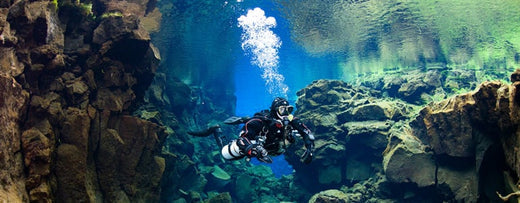
“Some people are repelled by the darkness of an underwater cave, but for me it’s an invitation into the unknown,” says Suunto Ambassador Jill Heinerth. Heinerth is a pioneering underwater explorer and filmmaker, leading technical diver, and world expert in rebreather technology.
Her love of the water began as a child and has persisted ever since. As a teen, Jill Heinerth was a volunteer swim instructor and lifeguard at her local swimming pool. Jacques Cousteau was her hero and by the age of 16 she was scuba diving.
Now, after more than a 20-year career, the Canadian underwater explorer and award-winning filmmaker has crossed the globe, diving in what she calls ‘the veins of mother earth’. Jill has dived deeper into the planet than any woman in history and seen some extraordinary places. She’s dived caves underneath the remote Ural mountains of Siberia, tickled the bellies of manatees near the Gulf of Mexico and explored sacred desert springs in Africa. In 2000, she was involved in one of her most ambitious projects to date — to dive inside a giant iceberg. In 2014 she was awarded the inaugural Sir Christopher Ondaatje Medal for Exploration by the Royal Canadian Geographical Society.
Jill is also a journalist and champion for women divers. She wrote a book called Women Underwater and in 2016 is part of a team of 10 women on an epic three-month journey, snorkeling more than 3000 km through frigid Arctic seas. “Some would suggest that exploration on this planet is done, but I disagree,” says Heinerth. “We know more about space than we do about our oceans and our underwater caves.”
Her abiding love of the ocean and watery places has also transformed her into a strong advocate for water conservation and protection, via her We Are Water Project. This important cause aims to raise awareness about global water issues, and encourage people to do more to protect our fresh water resources. Jill cycled across Canada, raising awareness along the way. With the same goal in mind, she wrote a fun children’s book about an itchy manatee that has an important message about water pollution.
Naturally, Suunto is the first choice of dive computer for Heinerth: “I’ve been using Suunto for a long time, and I think they represent the pinnacle of fine quality. The precise instruments and the ruggedness of the equipment have served me very well in some extreme diving expeditions over the years.”
She adds: “The Suunto DX is the key support device that serves as a backup for my rebreather. It’s easy to integrate it into a CCR dive plan, or any plan for that matter – open circuit or closed circuit. It also contains a very accurate digital compass, which I use to survey and make maps of new exploration.”


-111 m beneath the ice
After eight months exploring Greenland, members of the Under the Pole team push their ice diving limits to new depths.
The descent was five-minutes only, but the small hole dug in the ice 111 m above would demand a two hour return trip – in sub-zero waters.
In the icy darkness 111 m below the surface and the rest of the Under the Pole team, Martin Mellet and Ghislain Bardout smiled at one another – they’d reached a difficult new “summit” together.
© Lucas Santucci/Under the Pole
Like ambitious alpinists trying to reach the next peak, they are always tempted to descend to the next “summit” below them. Unlike alpinism, however, deep sea diving has no ultimate summit to reach. The deeper you dive, Martin says, the more complicated the dive becomes while at the same time not satisfying the craving for an ultimate end point.
“This frustration is a powerful motivation for deep diving, but a dangerous one because you constantly need to control the urge to go further,” he says.
Only two things would ensure their safe return; their trust and confidence in each other and the thin lifeline leading them back to the hole in the ice ceiling. “We get in the water through a small hole in the ice, and this opening is our only way out,” Martin wrote after the dive. “If we lose track of the life line that connects us to the hole, things can only end in tragedy.”
© Lucas Santucci/Under the Pole
The visibility was poor when they began their descent, but their spirits were high. After eight months of hard work and diving together as part of the Under the Pole expedition, Martin and Ghislain had achieved a level of trust to make such a risky dive possible.
On their descent to 90 m, they had dove along a steep, reassuring cliff face. After that, the cliff ended and the vast ocean expanded before them. “Everything was calm and quiet, intensely exhilarating,” Ghislain says. “We dive because we want that moment when the unimportant just fades away and everything we feel is suddenly amplified by our heightened senses.”
© Lucas Santucci/Under the Pole
At 111 m they stopped and contemplated their surroundings and situation. Going further was unnecessary; they were already deep enough.
“Being there, 111 m below the sea ice and icebergs, is a big deal – at that extreme depth, our lives were pending,” Ghislain says. “Like an alpinist who has reached his summit, we had just reached ours and it was time to ascend.”
To avoid decompression, the return trip took two hours, with 1h 30 spent at 12 m and above. But this meant they could take their time on the way up and better enjoy the dark shapes of the huge icebergs above them.
“After a little more than two hours, we emerged from the hole one after the other and entered a different world where the team welcomed us with satisfying smiles, cake and hot tea,” Ghislain says.
© Lucas Santucci/Under the Pole

New features for the Suunto EON Steel now available
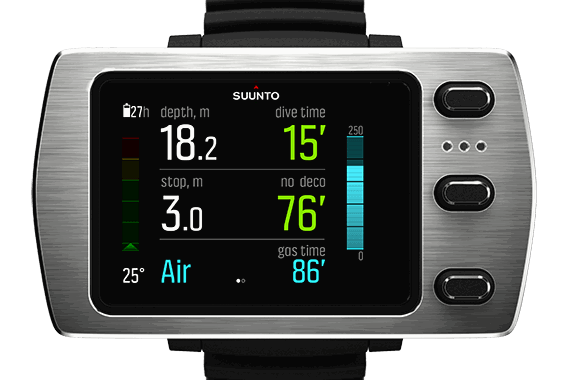
Software update brings gas time, CCR mode, real-time gas consumption and compass bearing lock.
Suunto EON Steel grows with you as your diving skills evolve, thanks to its customizability and durability. As communicated with its launch last fall, you can update the EON Steel software yourself. The update now coming out brings much sought after new features. Gas time
The new gas time reading allows you to estimate how long you can continue diving, taking into account your current tank pressure value and breathing rate.
Rebreather mode
Closed-circuit rebreather (CCR) mode makes Suunto EON Steel a great backup dive computer on rebreather dives. Combined with the Suunto Fused™ RGBM, the CCR features give you extra confidence on your rebreather dives.
Gas consumption
A first for dive computers, Suunto EON Steel calculates real-time gas consumption. As you improve your diving skills, you’ll see your comfort level reflected in the rate: the more relaxed you are, the less gas you consume.
Compass bearing lock
The new compass bearing lock helps you orientate yourself underwater and ensure you maintain your direction of travel. For example, you can set a bearing lock for the direction to the reef before leaving the boat.
You can download the free update to your EON Steel through the Suunto DM5 software.
Check out more details about the Suunto EON Steel software update 1.1.