




Suunto Blog

The canary in the coal mine
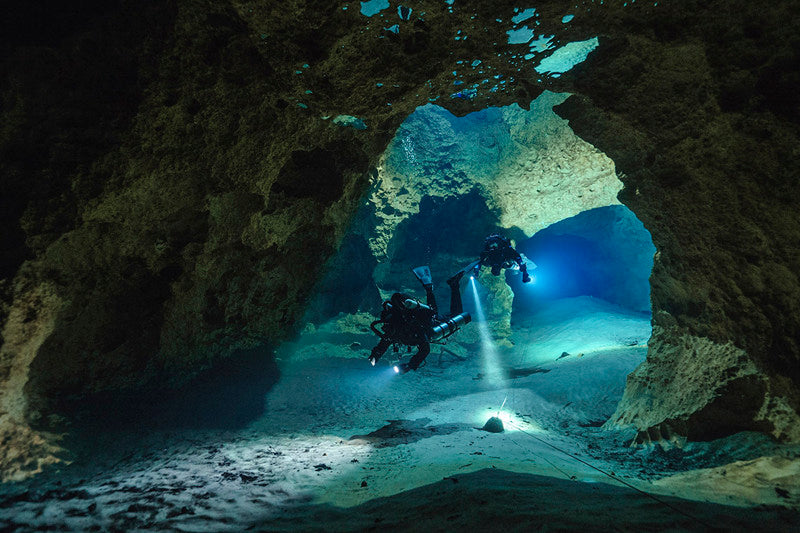
Suunto ambassador, pioneering underwater explorer and film maker, Jill Heinerth has dived in icebergs, explored deep underwater caves, and more recently documented the impacts of climate change in the Arctic Circle.
Capturing our changing planet and educating the public about the growing threat of climate change is what is increasingly moving her to dive and explore our blue planet. On World Ocean Day 2021, Jill shares insights from her 20 year career.
Press play to watch her incredible journey!
Where are you now and how has the pandemic treated you?
I live in a 200-year-old mill in a small town near Ottawa, Canada. It has actually been a bit of a gift to be home with my husband for a prolonged stretch, but I am certainly eager to get back to some of my travels. This has been a good time for rest, learning, and incubating new ideas.What’s been inspiring you lately?
I wrote the foreword for a new book by Frauke Bagusche. The book is called: The Blue Wonder: Why the Sea Glows, Fish Sing, and Other Astonishing Insights from the Ocean. I found it fascinating and quite inspirational.
What are you working on at the moment?
I'm exploring Canada's longest underwater cave system and documenting some of the endangered species I have found there. I am also actively involved in a documentary and educational initiative about the Great Lakes Watershed. With many of my projects on hold from COVID, it has been great to be involved in important projects close to home.It’s mind blowing how many incredible expeditions you’ve been on – how have they changed you?
Absolutely! As I get older, I feel more urgency to work on projects that really matter and that will leave a lasting educational legacy. I am drawn to work that communicates about water literacy and climate change. I think that motivational stories from the natural world and exploration can connect people to critical global issues.Is the underwater exploration and expedition scene attracting more women now?It is not happening quickly enough for my liking, but I am seeing more women involved in exploration. I think there are a lot of women that face serious roadblocks; difficulty getting career positions and opportunities.
You say you’re the canary in the coal mine – what are you seeing right now in terms of alarm bells?
Oh gosh, where should I begin? I'm 56 years old and I am truly shocked by the magnitude of change that I have seen in the natural world in my lifetime. The coral reefs I dived on 30+ years ago are dead and devoid of fish. The sea ice in the north sets up later and thaws earlier each year. The lakes that I learned to dive in have been grossly affected by invasive species. We are living in a rapidly transforming world. It frightens me, but I do not give up hope.What does humanity need to do to avoid crossing the tipping point?
I hope we have not already crossed the threshold, but I would say that we all need to stay optimistic. We might not have the big answers to the world's most pressing issues, but we all know small actions and changes that we can make in our lives that help move humanity in a positive direction. We need to urgently address the warming planet and water quality issues. They are all connected. Our actions against COVID-19 are a good example. We are delivering a vaccine that might have previously taken a decade to develop and test. We have the brain trust and the explorers that can solve big problems when we all work together.How has the development of Suunto dive tech aided your journeys?
I've been diving Suunto products for my entire career. They have always been innovative, well-built, and reliable. When somebody opens a box with a brand new Suunto product, they likely feel as I do... that this tool is going to accompany me on some of life's greatest adventures! One of the Suunto computers I used for record-breaking dives in 1998 is now on the wrist of a young whale researcher in Patagonia. I've passed on my older devices to others that are still using them today. That is quite an endorsement!Do you have any dream explorations you’d like to do?
I have not yet visited the Galapagos or Cocos Islands. I sure hope to make that possible one day. In the interim, I will have lots to keep me busy!
All images and video by Janne Suhonen, Divers of the dark

Help end plastic waste with your passion for running
Passionate runners don’t need an excuse to lace up and head out the door, but having the added motivation of cleaning up our oceans provides a welcome boost! More than five million runners across the world got that by joining Run for the Oceans 2021 and clocking up more than 56 million kilometers to help end plastic waste.
The campaign, which ran between May 28 and June 8, is a joint initiative of adidas and its partner Parley, which is an innovative space for thought leaders to come together to save our oceans. Parley’s Global Clean Up Network is dedicated to removing plastic waste from beaches, islands and coastal communities. With every kilometer participants ran, adidas supported the clean up of the equivalent of 10 plastic bottles. After the huge turnout, adidas is now committed to cleaning up 250 tons of plastic waste to prevent it entering our oceans. What a success!
Kimi Schreiber hit the trails between May 28 and June 8 to stack up kilometers.
It also raises awareness
German trail runner, blogger and Suunto athlete Kimi Schreiber participated in the global event and was excited to run a high volume of kilometers to help remove as much plastic waste from the environment as she can. “Sport can change lives and now it’s giving people around the world the chance to get actively involved in helping nature and preserving it,” Kimi says. “I think the most important argument for participating is the issue of attention. With such a large and global event, you can create awareness on a whole new level and bring the issue of environmental pollution into people’s minds.”
How to participate
Sync Suunto app with adidas Running app and make sure you track every kilometer you run with your Suunto!
To sync your Suunto runs with adidas Running, connect your Suunto app account with adidas Running: Open Suunto app and tap “Profile”. Then click on “Connect to other services”. Select adidas Running and enter your adidas Running login details to connect the two apps. Get the adidas Running app here.


Red Bull X-ALPS just got tougher
Austrian adventurer, pilot and athlete Paul Gauschlbauer can’t believe come June 20 he’ll be competing in Red Bull X-Alps for the sixth time, and again chasing the Eagle across the Alps. “It means I’ve experienced more than 50 percent of the race’s history, which seems crazy somehow,” he says. “I have really lived and developed along with that race.”
© Nico Holzmeyer
Making a tough race tougher
The 37-year-old Suunto athlete landed in third place in the last three editions of the hike and paragliding race that starts in Salzburg and has, until now, ended on the Mediterranean Sea in Monaco. He is continuing to chase the Eagle, aka Chrigel Maurer, the generational paragliding talent that has won every race since 2009, and seems unassailable in his dominance.
But perhaps the 10th edition will challenge him in new ways. The race organizers – always looking for fresh ways to make the race tougher – have implemented what Paul says is the biggest change in race history; instead of making their way from alpine peaks to the Mediterranean Sea, the 33 competitors will travel a full circle starting in Salzburg, to Mont Blanc and then ending back in the waters of Zell am See, Austria.
“I think it’s tougher to make it to the goal because it’s longer,” Paul says. “We are always staying up in the high mountains. I always had the feeling in previous races that once we made it to Mont Blanc we’d basically already made it to Monaco, because the last stage was usually really fast, no more than a day from Mont Blanc down to the sea. Now we are arriving at Mont Blanc and we have to do the same thing one more time. It’s going to be really challenging.”
© wisthaler.com
The longest Red Bull X-Alps ever
At 1,238 km, it’s the longest route in the race’s history, 100km further than 2019. “It’s a new chapter for the Red Bull X-Alps,” says race director Christoph Weber. “The race committee wanted to make the tenth edition of the race one to remember so we decided to break away from the past and design a completely new route; a route where athletes will be geographically closer together. The days when lead athletes enjoyed good conditions at the front while those further back suffered bad weather is less likely as they’ll all be experiencing the same weather. That will add an interesting dynamic to race.”
One watch for every kilometer
Suunto and Red Bull X-Alps have a long history of working together to help athletes push their limits. To celebrate the 10th and longest edition of the race, we are launching 1238 Suunto 9 Baro Titanium Red Bull X-Alps Limited Edition watches – one for each kilometre of the race. This rare watch has a titanium bezel with Red Bull X-Alps Limited Edition text on both sides and red ink-fill on top. Each one is numbered with a corresponding kilometre of the race. The Special Edition watch has a blue textile quick-release strap in two lengths with a Red Bull X-Alps and Suunto logo. An additional dual color silicone strap is included in the box. Snap one up here!
COVID-19 challenge
Paul and his support person are currently training hard to prepare for the race. The COVID-19 pandemic has made preparation more challenging – Paul and his whole family came down with virus and all fortunately recovered. “I've had a hard time preparing because there was really no assurance that we were really going to race at all, he says. “Now I hope it won’t affect the race anymore.”
© Nico Holtzmeyer
Follow the incredible action live
With Red Bull X-Alps you can count on every single day involving rocky ascents, dizzying flights and crucial, strategic decisions – a challenge for both body and mind. With a more demanding route than ever before, Red Bull X-Alps 2021 will be full of drama, adventure, and high-alpine action. The winner will need to be smart, strong, a master of both planning and reactivity – and have a little bit of luck.
Tune in to the race along with millions of fans via its Live Tracking! Find an athlete from your country and support them from afar!
Lead images: © Nico Holzmeyer


How pressure affect scuba divers - an introduction to diving
We've conquered all the territories above 0m and under. In this article, we set out to show you and explain what happens in your body as you descend into the big blue world.
Diving is an excellent activity with the potential for one-of-a-kind experiences you can only get in an aquatic environment. Our land-loving bodies, however, can react negatively to diving if we are not careful. We are drilling down the essential know-how of diving so you can enjoy it to the fullest.;
Pressure changes: your body needs to adapt.
There are constant fluctuations in the surrounding pressure while we hike or dive into the ocean. Pressure changes 1bar/14.7 PSI for every 10 meters and it increases much faster underwater because water is denser than air. The pressure we face underwater, also called ambient pressure, is caused by the water's weight. The deeper we dive, the greater the ambient pressure will become. Ten meters down is already twice the pressure at the surface.
Discomfort in the ears when taking off in an airplane is also felt just diving down to the bottom of a pool that is three meters deep. When a diver descends, the surrounding water pressure grows. The pressure change underwater will affect spaces that contain air, such as your ears, sinuses, BCD, and mask. But the most significant impact is on your circulatory and respiratory systems and the latter need to be taken seriously because they can lead to major health risks.
What happens after you immerse into water or hike up a mountain?
Our bodies are full of dissolved gases from the air we breathe. Our bodies actively use oxygen for us to function. Other gases, the so-called inert gases like nitrogen, are not used by our bodies but are stored in blood and tissues. While diving, the pressure increases, and our body is exposed to a higher absorption rate of nitrogen stored in our tissues. The amount of inert gas dissolved in our bodies depends on the ambient pressure. Why is it that e don't feel this effect? Because our body is mainly made up of liquids, we are not exposed to pressure. Nevertheless, we feel it in our ears and sinuses because of the air trapped in them.
When we ascend from a dive, the ambient pressure is reduced and the dissolved nitrogen needs to come out (off-gas). We have no problems as long as nitrogen comes out slowly and in a controlled manner without significant pressure differences. If thepressure is released too fast; the nitrogen will come out too fast and cause DCS, also known as decompression sickness, or "the bends."
The amount of gases dissolved in our bodies depends on the ambient pressure around us. That means that every gas has a specific partial pressure, and the combined pressures of the gases in our bodies stay in equilibrium with our environment. Your body is fully saturated with gases at the elevation where you can be found for an extended time. Here are two scenarios that will explain the changes in your body:
If you hike up a mountain, air pressure drops, making your body hold less gas. Your tissues are at this point supersaturated relative to the new ambient pressure. Our bodies release gas through diffusion and breathing to get back to equilibrium, also known as off-gassing.
When you go down to sea level and then underwater, you increase your bodies' pressure, allowing more gas to be carried by blood and tissues. Again, to equalize the pressures, your body takes on more dissolved gas from the air you breathe. This is called on-gassing.
Does the same thing happen when you ascend from a dive?
If we come up from a dive too quickly (therefore, dropping ambient pressure), the natural off-gassing mechanisms are overloaded. The dissolved gas in our bodies comes out of the solution too fast, forming bubbles that can cause decompression sickness or DCS. There are different stages and forms of DCS, and symptoms can range from minor joint pain and skin irritation to severe nerve damage and death. For a diver with DCS, the symptoms may already start while still underwater, or it may take several hours after surfacing. In some cases, the symptoms may not show for several days. Nevertheless, most cases are treatable with, for example, recompression chamber treatment (hyperbaric oxygen treatment).
Diving is made easy to understand and more accessible.
Over the decades, dive algorithms were incorporated into dive computers to calculate how long we can stay underwater with a limited risk of getting DCS. A dive computer knows your dive history and calculates the safety limits in real-time by considering the following metrics: depth, time, gas mix, and personal factors (if applicable).
What is a dive algorithm?
A dive algorithm is a theoretical mathematical formula and does not measure your body's actual physical state while diving. Everybody is different and no dive computer (to this day) can measure the amount of inert gas in every body tissue. Every dive computer has a level of conservatism built in to minimize the risk of DCS and by changing your personal settings, you can add or remove safety margins to your dive algorithm.
What does a dive algorithm do?
Algorithms are designed to give you a safe estimate of how long you can stay at different depths without developing the risk of DCS by considering time/depth/dissolved gas. Some algorithms provide longer dive times at the cost of a higher likelihood of DCS, while others limit the dive time to add a safety margin to your dive.They are used in dive computers based on how inert gases are absorbed and dissolved into and from the diver’s tissues. There are two decompression models most commonly used: the gas model, or the Haldane model, and then the bubble model, known as VPM and RGBM.
The first one is based on J.S Haldane's work and according to his theory, the body is grouped into theoretical tissue compartments, absorbing and releasing inert gas at different rates. This theory is based on avoiding bubble formation by controlling the absorption and release in different theoretical tissue compartments. One commonly used algorithm following the principles of the gas model is the Bühlmann ZHL- 16C.
The second commonly used decompression model is based on the assumption that bubble formation will always be present and the key is to control the size of the formed bubbles. Suunto Fused™ RGBM 2 has been developed with Dr. Bruce Wienke to combine the benefits of the VPM model with Dr. Wienke’s latest full RGBM work.
What should you do?
The important takeaway of this introduction is that every diver and dive are different, so are the underlying assumptions for this incredible sport. In the end, you as a diver will decide what your safety margins are and what theoretical model you want to use for your dives, and those choices will be based on your training, your experience, and eventually, your preferences. Take your time to discover the underworld safely and you will not be disappointed.


Emil Johansson’s long road to recovery
Swedish Slopestyle mountain biker and Suunto athlete Emil Johansson, 21, is most at home defying gravity with his incredible aerial moves. He started riding bikes at eight and 10 years later became the youngest free ride mountain biking world champion in history.
Slopestyle is a specific discipline of mountain biking which combines a lot of airtime with spectacular tricks. It’s similar to free skiing, just with a bike. Emil stunned the world with his talent at a young age.
Emil’s meteoric rise to the top of the sport hit a wall in 2018 and 2019 because he battled injuries and a mysterious autoimmune disease. The disease remained a mystery for some time, with no clear diagnosis, until Emil met Dr. Bachmann, Dr. Jacob and his trainer Lenz Westner, all based in Munich.
“Before I got diagnosed, I didn’t know what was going on,” Emil says. “I wondered why it was happening to me, over and over again? Why am I getting sick and why am I feeling miserable? It’s hard for me to stay healthy while training hard and it’s tough mentally to be comfortable with taking a step back, thinking about my future, rather than just riding flat out all the time.”
Once he was diagnosed, Emil used his Suunto watch to carefully monitor his state of health so he could better understand what was good for his body and mind. The data provided by the watch supported Emil’s rehabilitation and his road back to health and elite competition. After getting the right treatment and knowing what’s good for him, Emil came back stronger than before.
Emil is famous for his dedication and the hard work he puts into his life as a pro athlete. And like many pro athletes, he has tended to push too hard. “I often overtrained my body in the past with lots of sessions both on and off the bike, so I’ve started using my Suunto watch a long time ago to avoid this,” Emil says. “I felt it was the best way for me to get a second opinion on the condition of my body.”
The Slopestyle champion’s Suunto tells him where he is at with his sleep, recovery and heart rate variability. This helps him stay balanced, train efficiently and remain at the top of the sport. “Whatever I am doing, whether it’s gym training, trail riding, cross country skiing or something else, I always wear my Suunto 9 watch as a kind of silent observer of my health and recovery state,” Emil says.
All images by: © Niklas Wallner


Understand and manage your training load with Suunto
The key aspect of progressing in your fitness is your ability to increase your training load over a longer period of time. The variables you can play with are training frequency, duration and intensity. With long-term analysis tools powered by TrainingPeaks you can now manage your training better than ever.
To get started with the graphs it is important to understand the basics: Every workout gets a Training Stress Score (TSS) that is based on the intensity and duration of the workout. That’s the base for calculating training load for both short and long-time averages.
Training Stress Score (TSS) is based on your anaerobic threshold power, but it can also be calculated based on your threshold heart rate or your threshold running pace. You can learn more about TSS values here.
These single activities with their automatically calculated TSS values are then used to show your long-term training load. This long-term load is called Chronic Training Load (CTL) or simply “Fitness”. It is a 42-day weighted average of your TSS. The more you train – the more TSS you accumulate in your training – the higher your fitness is.
While your long-term load is shown as “Fitness”, the short-term training load is called “Fatigue” or Acute Training Load (ATL). Fatigue is a 7-day weighted average of your TSS. When increasing training load your fatigue increases faster than fitness.
These two values, fitness and fatigue, are shown in the upper graph in your Suunto app’s Diary’s ‘Progress’ view. The lower graph shows your “Form”, or Training Stress Balance. Form is basically the difference between long-term, chronic training load (CTL) and short-term, acute training load (ATL). This graph helps you understand if you are training in a way that is progressive or not. Too much load and you are too tired, too little and you are not moving forward.
In Suunto app the Form graph is divided into four areas: losing fitness, maintaining fitness, productive training and going too hard.
When your long-term, chronic training load is quite a bit higher than your acute, short-term load, you will start to lose fitness. Short-term hitting this area is good, for example when you want to be fresh for a race. However, training easier than you are used to for a longer time, will lead you to losing your fitness.
When your current training is roughly in balance with what you are used to doing, you’ll be maintaining your fitness. To improve, add variety and load in your training.
Adding more load will take you to the productive training phase: your fitness and fatigue are increasing in a manageable way. This means you are adding load but not too much compared to what you are used to doing.
If you push too hard and add a lot of training stress compared to your long-term load, your form will drop. This will increase risk of illness and injury and hinder your improvements. Take a step back and allow your body to recover.
Adjust the time frame
When viewing the long-term analyses graphs, you can change the time perspective. Really long-term trends can be seen in the yearly view, that shows the latest four years of your training. In the monthly view you will see the latest 13 months and can easily compare your loads to a year ago, for example. The weekly view with the latest 26 weeks and the daily view with the latest 41 days are more appropriate for managing your current training loads.
If you want to plan your training and see how the graphs will evolve, you can do that with TrainingPeaks’ Performance Management Chart. The activities you track with your Suunto can be automatically synced to TrainingPeaks so you can also use their advanced tools for managing and planning your training. As part of Suunto Value Pack you can get 30 days of TrainingPeaks Premium for free.
Four examples of training load
To make it easier for you to understand what to look for in the graphs, here are four different scenarios:
Example 1: Overload
This graph shows the impacts of a two-week training camp: The training load increases quickly, and at the same time the training stress balance drops very low. In this case the CTL before the camp was 66 and was pushed to 93. At the same time the training stress balance dropped to -79. These low numbers increase the risk of illness and injury.
In this case, the training camp was followed by a recovery week that brought the training stress balance close to zero. Chronic training load still remained at an elevated level (close to 90), so the training camp had a positive impact on this athlete’s fitness.
Example 2: Race
In this graph race preparation is going nicely: The long-term training load is increasing over a long period of time meaning “fitness” is getting better. As the event gets closer, training gets lighter, fatigue goes down and the training stress balance, “form” goes up. The athlete is fresh for the big day.
Example 3: Illness
This graph illustrates the effects of an illness (or other break in training). At first training is going smoothly as CTL is ramping up, but then training stops for one week. ATL goes down quickly and also CTL gets lower. After the break the athlete starts training again gently. It takes about three weeks before her CTL/Fitness starts to be close to the same level she had before the break in training.
Example 4: Normal
This graph illustrates what quite a typical training load graph for an active person may look like: The long-term load is on a fairly good level, but not ramping up. To improve fitness, one needs to add load.
Read more
Training with TSS and hrTSS
Training stress score in Suunto app
3 TrainingPeaks training metrics to adjust your running on the go
View TSS and other power-based cycling metrics in real-time
Figure out your training zones
Main image: © Roger Salanova / Suunto


