




Suunto Blog

How to sync Strava routes with Suunto GPS watches
If it’s not in Strava, it didn’t happen! And if it did happen, you can (try to) do it, too: Simply save the route and sync it to your Suunto for navigation.
In addition to sharing your activities with the community and chasing segment crowns, Strava is also a huge source of routes. You can, for example, create your own routes, use route suggestions, and save your friends’ routes for navigation.
To get started with using Strava routes together with your Suunto watch, connect the two accounts in Suunto app (Go to Profile -> Partner services -> Strava).
If you have already connected your Suunto account with Strava, you will need to reconnect the two to enable the route sync: Simply disconnect and reconnect to get the new feature in use. Reconnecting will allow the route content to flow to your Suunto app.
Once the two accounts are connected the routes marked with a star in “My Routes” in Strava will be synced to your Suunto app and Suunto watch. Strava routes work as any other route in a Suunto.
“Unstarring” a route in Strava will also remove it from Suunto app
NOTE: Syncing routes from Strava to Suunto app requires a Strava Premium subscription. You can get a 60-day trial as part of the Suunto Value Pack or by starting your free trial here.
Learn more about routes on Strava
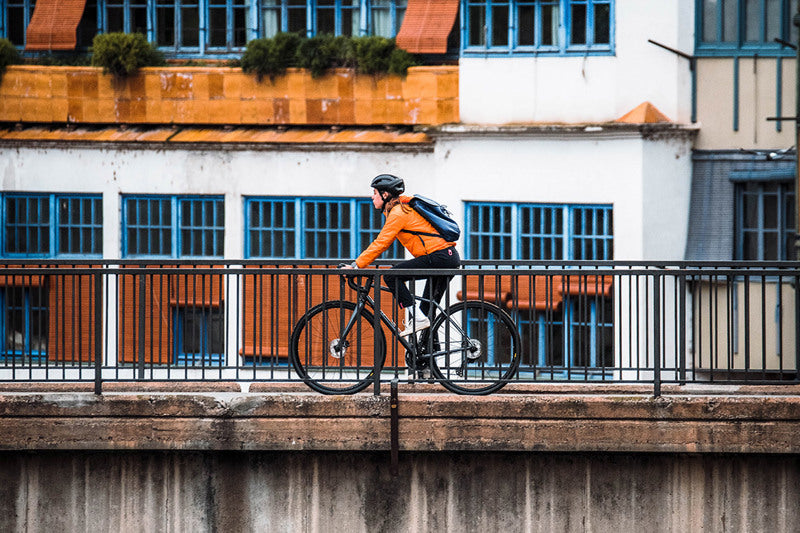

Track your human-powered commutes with Suunto
Living a more sustainable life starts with small, everyday choices. And, when done often enough and by enough people, these small changes will add up and start to have an impact.
To support you in this, we have added the ability to track your human-powered commutes with Suunto app: In addition to seeing how much you have exercised on your way to work, you will also see the climate impact of your commuting choices: Suunto app compares your commuting activities with driving the same distance and gives an estimate on the CO2e emissions you have saved.
To start tracking, you don’t need to do more than ride, run or walk from point A to point B and save your activity. On the first occasion a commuting activity has been tracked, you will be asked if you would like to activate the automatic tagging with the “commute” tag. Suunto app can automatically tag one-way trips that start and end at least 500 meters (0.3 miles) apart as commutes.
The reduced CO2e emissions for a single activity will be shown in the workout summary and the new commuting widget on the app’s home page will show your monthly total for CO2e saved.
You can easily encourage your friends to follow your example: add a photo to your commuting activity and share it with the CO2e value as a data overlay.
Happy commuting and CO2e saving!
Calculating Saved CO2e emissions
CO2e demonstrates the global warming potential (GWP) of all six greenhouse gases in one number. We calculate your emission reduction by comparing cycling, walking or running to driving your car.
About the calculation
CO2e (Carbon Dioxide Equivalent) emissions of travel by car (average of a petrol/diesel powered car). Emission factor: 0,170652 kg CO2e/km. CO2e demonstrates the global warming potential (GWP) of all six greenhouse gases: CO2, CH4, N2O, HFCs, PFCs, SF6, NF3 in one number. Data source: Govt of UK, Dept. of Business, Energy & Industrial Strategy, 2022.
Read more:
Committed to be better – Suunto’s approach to sustainability


Read this and understand how to have mental toughness
It’s almost become a cliché: our biggest obstacle is usually ourselves. It’s not “out there”, but usually “in here”. Recognizing this marks an important transition in life. It’s often when we really start to fly as individuals.
In endurance sports our inner obstacles get magnified and compressed into a short period of time. Especially at the elite level, our head space has a massive impact on our game.
Suunto ambassador Anton Krupicka has had a long career as an elite endurance athlete. Through the years he’s had ample opportunity to explore what it takes to build mental toughness. It’s a slippery thing, he says. Something we must take hold of again and again.
Read on for Anton’s eloquent take on the secrets of mental toughness.
Waiting for the start at Unbound XL 2022. Photo by Sami Sauri
By Anton Krupicka
Unbound XL 2021
In 2021, when I first rode the Unbound XL–an approximately 350-mile (563 km) gravel race in the Flint Hills of Kansas–I came away from the weekend a bit, I don’t know, unimpressed, I guess. Underwhelmed, nonplussed. I hadn’t found the experience of riding my bike over the course of 28hr as emotionally affecting or significant as I had expected or hoped. Pedaling back into Emporia at the finish contained none of the end-of-race euphoria, relief, or satisfaction that I’ve come to associate with such ultra-endurance pursuits.
After letting the effort marinate for a few days, however, I realized the flatness of my experience was on me. For the first 250 miles (402 km) or so I had done a relatively good job of staying focused and engaged, riding to the best of my abilities. In the last 100 miles (161 km), though, I had let heat and drowsiness (the race starts at 3pm; riding through the night is mandatory) dominate my mindset; I basically soft pedaled the last 100 miles. At the finish, I already knew I had let myself down, and as a result, the whole event left me feeling unfulfilled. This didn’t sit well, and after some reflection, I was determined to return in 2022 with a more resolute attitude and give the event the opportunity to have an impact on me. There’s a certain kernel of truth to the cliche “nothing risked, nothing gained”. I hadn’t taken any chances, and I was, appropriately, not rewarded.
When the tough get going ... Photo by Sami Sauri
Motivation & Racing
Recently, I was asked by a friend, after such a long career in endurance racing—primarily as a mountain ultrarunner—why do I still line up for races like the Unbound XL? It’s a good question, and I’ve asked myself that often. Over the last 15 years, my motivations for racing have shifted significantly. Ten years ago, I think I was still firmly operating from a place of seeking external validation. I was racing for my ego, to beat people, to garner respect from the community and my peers as a top athlete.
After years of injury, and a certain amount of maturation, however, my perspective has changed. I’ve realized that races are rare opportunities for us to try our best. To try to be at our best. Now, my motivation is not external—I would say my physical prime has passed, and, in general, I’m simply more comfortable with who I am and my place in the world.Today, my motivation to race is more internal. I want to embrace the opportunity of working with other competitors to confront a significant challenge and be pushed and pulled to give it my best effort. To be proud of the way in which I conduct myself in the face of absurd difficulties. To fully experience life at an elevated level. The intensity of racing ratchets up the richness of life. So many emotions are crammed into a race—by time you get to the end, you feel as if you’ve lived a year’s worth of experiences, not just a day. Those are experiences that I never want to take for granted or stop seeking.
But, the nature of these events is such, that, to get there, you must, by definition, endure. This requires mental toughness. Last year’s Unbound XL taught me that a race is only as momentous an experience as the amount of effort that you put into it. Trying my best—regardless of finishing rank—is the essential ingredient to having an experience that will push me to grow, leave me satisfied and form a lasting memory.
Things don't always go to plan. Photo by Sami Sauri
Sagebrush & Summits: A Tour of Enduring
About a month after the Unbound XL last year, I embarked on a three-week, 2300-mile (3700 km) bike tour that involved running and climbing six of the highest, most remote peaks in the Rocky Mountains. It was arduous. Every single day I was forced to confront some kind of weakness about myself, some inadequacy to deal with the challenge. For the first week or so, it was really tough.
By the end, however, I felt that I could detect a subtle, but important, shift in my mindset. When things got hard, it did not feel as mentally difficult to bear as it had at the beginning of the trip. I had realized an important lesson–when things got tough, they were only unbearable if I let my mind turn negative and project to somewhere in the future. If only this hill/headwind/washboard/rain/heat/dust (etc. etc. etc.) would end! If only I were already at the top of the climb, or the next gas station, or the next town! I realized that living with that future-focused mindset is untenable. If I let my mind fall into such a pattern, the task at hand would always feel interminable.
The alternative, of course, is to strive for contentment in the moment. Once I could accept my inadequacies in the moment and make peace with the fact that all I could do was try my best, the angst would fall away. The present moment would become bearable, even enjoyable.
That lesson was the great gift of that long tour.
One thing at a time. Stay in the moment. Photo by Sami Sauri
Unbound XL 2022
In preparing for the Unbound XL this spring, I set out on a planned three-day tour of 150 miles a day in late March. My first night out went horribly. It was colder than I’d anticipated; my sleeping bag was too light. Out of desperation, I ended up sleeping in a Port-a-Pottie, desperate for any extra warmth. The next morning I woke up feeling depraved and haggard after hardly having slept at all. In defeat, I tucked my tail, and, after several cups of coffee, pedaled my bike the shortest distance possible back to my home (it was still over 100mi, but not at all what I had intended).
I had taken the lesson of the 2021 Sagebrush & Summits tour for granted. I thought I was permanently more mentally tough. This overnighter taught me that cultivating mental toughness—which really means mental equanimity in the face of hardship–was necessarily an on-going process. One never arrives at a state of mental toughness; it is a trait that must be constantly born anew.
I am satisfied to say that my experience at the Unbound XL a couple weeks ago was much different than last year. There were plenty of challenges. After only 70 miles I crashed hard, gashing my left knee, hip, elbow and hand. Despite all the raw wounds and torn up hand I was able to figure out a way to keep holding onto the handlebars for the next 280 miles. I fixed flats and didn’t give up when I no longer had anyone to ride with through the night. When the skies opened up with torrential rain in the last 50 miles, I just tried to smile and think about what a good story all the mud and water would make when we got to the finish line. I’m already looking forward to next year, but I know that having a satisfying race again won’t just happen. I’ll have to stay engaged and keep tending a mindset of contentment and equanimity. The trap of pining away for something different in the future is ever-present, but I’m now confident that with vigilance I can avoid it and have the adventure I’m looking for.
Lead image by: © Fred Marmsater


Find the right road surface for your adventure with Suunto app
Are you exploring new regions this summer or just want to find new adventures close to home but are unsure if a trail or path is suitable for your ride or run? To help you in planning, Suunto app’s map has been upgraded with a road surface map layer.
To view the road surface info, go to the map view on your Suunto app, tap the road surface button and select between paved, smooth unpaved and rough unpaved surfaces – or all at once. You can change the selection while you plan your route.
The streets, paths and trails are colour-coded based on the surface, allowing for a quick distinction between the three types of roads:
Paved roads, light blue, include roads with asphalt and concrete, they are especially good for road cycling and roller skiing.
Smooth unpaved roads, yellow, will show roads with gravel and dirt that are suitable for gravel cycling.
Rough unpaved roads, red, can include surfaces such as soil, grass, mud, or rock. These roads are good for trail running and mountain biking.
The road surface data comes from OpenStreetMap, which is an open source website. The information is based on community contribution and varies from one region to another.
Once you are back from your adventure you too can assist in improving the map data by creating an account and then editing and adding information on the OpenStreetMap.
You can learn more about OpenStreerMap’s surface types here.
Lead image: @thecyclingculture / The Traka
READ MORE:
Using Suunto app on big screen devices like iPads and Android tablets
Living peak adventure: find routes that rock
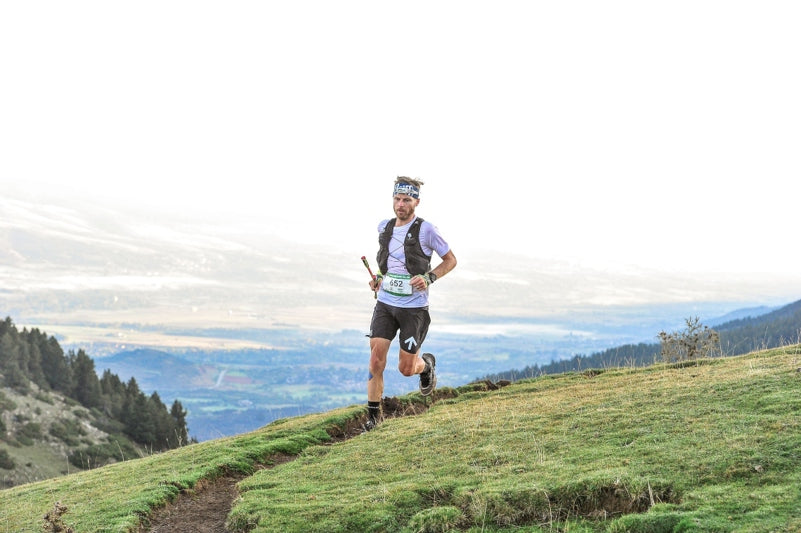

The athlete-entrepreneur who knows the value of hard work
Talk to Christian Meier for a few minutes and it’s clear the former pro road cyclist who competed in all three European Grand Tours during his career is spilling over with ideas and passion to make good things happen.
Exuding entrepreneurial self-belief and drive, Christian lives in Girona, Spain where he juggles multiple businesses while finding time to ride bikes and train for trail running ultra marathons. He’s currently training for the 101 km Courmayeur-Champex-Chamonix (CCC), one of the flagship races at Ultra-Trail du Mont-Blanc (UTMB).
“Ultra races are like grand adventures where you go through the whole range of emotions while spending the day and sometimes night in nature while pushing yourself to your physical limits,” Christian says. “These types of adventures need equipment that can keep up; tough, accurate and with a battery life that makes the journey - it’s the Suunto 9 Baro for me!”
Christian competing at Salomon Ultra Pirineu.
Building businesses for good
While he’s not preparing for that, riding bikes, overseeing his and his wife’s Espresso Mafia roastery and cafe and specialist cycling cafe La Fabrica, he’s building Chance Running, a revolutionary running apparel brand that prioritizes doing good for the planet. With every purchase, Chance Running plants two trees with its partner Tree Nation and offsets 200 kg of carbon and removes one kilogram of ocean bound plastic.
“Chance is an opportunity to rethink the mission of a company - making it mission driven rather than profit driven,” Christian says. “It has allowed us to try and help the planet we are out enjoying everyday, through the avenue we know best, sport. Being carbon neutral is no longer enough and we want to push the boundaries of what’s possible with a planet first approach.”
Where it began
Christian grew up in a hard-working German-Canadian family in a small rural community in New Brunswick in Canada. The “farm-to-table” family worked a farm and ran a butcher shop and restaurant. His mother worked the farm while his father, a machinist, was a capable craftsman who built the family home.
“We lived from the land and I was exposed to an incredible set of skills and work ethic while the whole time being immersed in nature,” Christian says. “Though at the time it was tough being a kid and my summers weren’t at camp like the other kids, but spent on my grandparents farm working. It shaped me into who I am today.”
Christian competing at the Atlas Mountain Race in Morocco, 2019. © Lian van Leeuwen/Atlas Mountain Race
Falling in love with bikes
That upbringing prepared him for the grind of a competitive cycling career. One day as a kid he picked up a mountain biking magazine and that was it - he got a bike and was 100% committed. Cross-country, downhill, road to track - he lived and breathed bikes. So much so he decided he wanted to make riding his job. Pro road cycling was where the money was so he went to Belgium to test the waters. There, by chance, he met a couple of roadies while out cycling and they invited him to train with their team.
“I got my ass kicked to be honest,” he says. “But rather than quit I went home and trained even harder.”
Hard work pays off
It paid off because Christian eventually raced professionally for the Symmetrics, Garmin-Chipotle, United Healthcare and Orica-GreenEdge teams from 2005 to 2016. He won Canada’s National Road Championships in 2008 and had many more domestic race victories. He also placed 15th on day 11 at the 2012 Giro d'Italia.
Now based in the cycling haven Girona, he’s still crazy about bikes; from road, to gravel to bike packing trips and is a prominent member of the local cycling culture.
“Suunto connected to me on a personal level because they take sustainability seriously,” Christian says. “Manufactured in Finland, using renewable energy, refurbishing returned watches. Besides the performance features these are factors that are quite important to me and I am proud to form a part of their community.”
Lead image: © Ultra Pirineu


Was this MTB adventure actually a MTB adventure?
Sure, they had their mountain bikes with them. But with terrain so tough it’s hard to even hike it, what to speak of riding it, the question of what to call this madcap adventure arises.
The ragtag group of riding buddies consisting of Kevin Landry, JF Newton, Margus Riga, Kenny Smith, and Peter Wojnar set off on a freeriding adventure deep into British Columbia’s wild and rugged Chilcotin mountain range in search of new freeride lines.
The word expedition suits it better than adventure and 'challenge' doesn’t really do it justice. Watch the video below and read the report from the film crew below and maybe you’ll reach a satisfying way to define it.
One thing is for sure, hardcore!
So Far… We’ve Made It This Far
“No sympathy for the devil; keep that in mind. Buy the ticket, take the ride...and if it occasionally gets a little heavier than what you had in mind, well...maybe chalk it up to forced consciousness expansion: Tune in, freak out, get beaten.”― Hunter S. Thompson, Fear and Loathing in Las Vegas
Niut Valley // North Chilcotins // British Columbia, CanadaLat/long = 51.5900° N, 124.6917° WDay #4 of 810:90 Biking to Hiking Ratio [so far…]
“There may as well have been fucking cows grazing over there and it was the hardest shit ever,” Kenny says, looking back at the snarled mess of terrain we’d spent the last two days traversing through, over and around.
He was bang on, as compared to the convoluted mess of sheer granite, talus fields, and ancient glaciers that lay before us; where we had come from really did look like an idyllic pasture, one that cows could be happily grazing – and it really was the hardest shit ever. We’d ridden our bikes less than 10 % of the time, pushing or carrying them for the other 90… great bike riding trip.
This wasn’t our ‘first rodeo’ as they say but looking down into the ‘venus fly trap’ valley this was the first time we’d contemplated changing our route because the terrain was too complex. Maybe we are getting smarter, realistically we’re just getting softer older. The steady decline in barometric pressure coupled with a few ‘storm warnings’ from our Suunto 9 watches helped to justify our decision while preserving a fraction of our collective egos.
“Stuck in the bottom of the flytrap on a sunny day would be soul-crushing, add 20 centimeters of snow, and hell we might still be there.”
The route, as planned by Captain Kenny from the comfort of his office back in Campbell River BC would wind its way through approximately 200 km, over eight days through the Niut Valley, a remote northern section of the infamous Chilcotins. The Niut, is where the Coast Range meets the Chilcotin Plateau but unlike the ‘Chill’cotins it has no trail network and rarely sees even the most intrepid hikers let alone mountain bikers. I’m not saying we were the first, but I’d bet we’ll be the last [mountain bikers] to that zone.
Since 2016/2017 our little ragtag crew has been refining this style, colloquially referred to as ‘freeride bike packing, by our friend Brice Minnigh. A weird chimera of big mountain MTB riding, ski touring, thru-hiking, bike packing, and mountaineering. The route is usually a point-to-point attempting to link up ridable ridgelines and chutes while minimizing any travel at valley bottom where one must contend with soul-crushing bush.
This brings us back to the siren song of the Venus flytrap, which became easier to ignore as the rain’s tempo crescendo picked up outside our shelters. Turning around the way we came was not an option, it was hard enough once, and would only be harder dragging our tails between our legs. It was becoming clear our only option was to head over the pass at the head of the valley we were currently camped in and attempt to link back up with our original route.
As the crow flies, this was a ‘shortcut’, but not without its own unique challenges. Specifically, a glacier, which fed into an unstable talus field, immediately leading into a few pitches of grade five scrambling. One hand to balance your bike on your pack, one hand on the rock at all times steep. Topping out we were greeted with sideways rain, and a fresh cutting wind no longer sheltered by the lee side. At least this was the easy way I mused.
At the most reductionist, trips in the mountains either work out or they don’t, it's binary once you get down to it. While we didn’t know it yet – the four of us were still shivering in Fraser’s tent at ridgetop – this trip was about to work out. Waiting for us just outside the tent was a phenomenal descent into a valley framed wall to wall with chutes just begging to be lapped. I won't bore you with the details, but we set base camp up for two days and methodically ticked off each one right to left. The weather was beautiful, the dirt was tacky, even went for a few swims in the lake by our camp. Of course, the fireside yarns always worked their way back around to the Venus Fly Trap.
Granted, at that time we didn’t know the mellow 15 km “trail” back to the trucks was actually a 25 km overgrown mess of pain and frustration. Bush so thick we had to remove our pedals just to punch through.
All images © Margus Riga


