




Suunto Blog


Learn how augmented reality can empower your performance now
Suunto athlete and outdoor sports junky Gregor Strasser has been using ActiveLook-powered Julbo smart glasses with his Suunto for a few months, but is already liking what he’s seeing. He’s been testing them in the mountains above Salzburg in Austria and loves the way the most important performance data is always right there, displayed on a lens.
“I’m a technology freak and hoped they would make my everyday training easier,” Gregor says. “Of course, you have to get used to the new field of view, but once everything is perfectly adjusted, you can hardly imagine it any other way.”
Focus on what matters
ActiveLook is a division of Microoled, the second largest micro OLED supplier in the world. ActiveLook produces an embedded head-up display technology that fits into sleek, lightweight frames and lenses. Marketing & partnerships director of ActiveLook, Xavier Bonjour believes smart glasses are going to revolutionize outdoor sports.
“When you have the data displayed in your field of vision, you can better manage your effort and no longer need to look at your watch anymore,” he says. “We’ve tested our technology with athletes at the Copenhagen, Boston and Paris marathons. All the users beat their personal bests by two to five minutes.”
All Suunto 9 and Suunto 5 watches are compatible
ActiveLook is a display technology used by various sport glass brands such as Engo, Julbo and Cosmo. And now this technology is compatible with the all the Suunto 9 and Suunto 5 watches, including the the new Suunto 9 Peak Pro. It gives Suunto watch owners their key data directly in their field of view, on the inside of their lenses.
“Thanks to the overhead display, you always have the most important training parameters in view,” Gregor says. “Especially in urban areas with a lot of traffic or on rough trails in the mountains, it's great not to be distracted by having to look at my watch or bike computer. This increases safety during the training sessions because you always have everything in view and can fully concentrate. I have never been able to track my performance data in such detail and always stay up-to-date. The glasses give me completely new insights that I didn't have before.”
How the technology works
ActiveLook display technology consists of the following components:
A high-precision micro-projector: the data is projected to the right eye, and the perceived position is between the upper center and upper left. It varies from user to user based on individual morphology, head size, and distance between pupils.
A low power display
Dialog based ”Smart Wearable on Chip”
Custom lens coatings to maximize visual experience
Ambient light and gesture sensors
A battery with up to 12 hours power
A charge connection on the bridge
A high brightness, 304 x 256 pixel, yellow data display
Low power (1mW) thanks to a “memory pixel” that avoids the need for refresh scanning.
Smart sport glasses weigh between 30 and 40g
The miniaturized and invisible augmented reality technology displays essential performance data without obstructing the field of vision. A smart chip integrated into the eyewear projects data to a discrete near-eye display that “melts” into the optics. It gives access in real time to whatever data is monitored by athletes as they train or compete, such as distance, duration, speed, pace, power, or heartbeat.
Train smart and boost motivation
Activelook-powered smart glasses are the perfect gadget for activities when looking at a watch is difficult, such as mountain biking in technical terrain, running hard intervals, or cross-country skiing. The technology displays the essential workout data from the watch, such as heart rate, pace, power as well as turn-by-turn navigation information.
“When you have visual data right in front of you it can be very motivating,” Xavier says. “Like your own personal coach.”
Getting used to them
Xavier says it’s hard to explain how they feel to wear. “It’s a little like wearing a watch or a ring for the first time,” he says. “The first time you put the glasses on it’s a new experience , but once you start moving you forget about them and it becomes natural. When you look ahead, the display disappears - you intuitively learn where to look to see the data. And when you take them off again, you feel something is missing. Like misplacing your smartphone.”
If possible, test them at a shop before you buy, Gregor advises. “Unfortunately, these glasses are not cheap and everything should feel good and fit perfectly.”
How to use with Suunto
After turning on your ActiveLook glasses, simply open the SuuntoPlus ActiveLook sport app in your watch and start your activity. If you don’t have ActiveLook sport app available in your watch yet, go to SuuntoPlus Store in Suunto app and select "Add to watch".
During your activity, the app will send data to the glasses (types of data available varies model to model). When using navigation with waypoints, notifications will be delivered ahead of the waypoint so you don’t miss your turns.
Note: Make sure your Suunto 9 or Suunto 5 watch is updated to the latest software.
Discover ActiveLook-powered sport glasses
ENGO sport glasses
Cosmo Vision sport glasses
Julbo's Evad-1 sport glasses
All images by Gregor Strasser


Why navigating with a Suunto has never been better
GPS is just one of many. It stands for Global Positioning System and is a US based global navigation satellite system (GNSS). There are four other GNSS and counting. With more of them connecting to your navigation device you’ll get better accuracy, more often, than with one only. That’s because it’s more likely a satellite will be directly above your position and able to send and receive clear, fast, unobstructed signals.
How GNSS work
It almost seems like science fiction: hundreds of satellites in orbit around the planet sending and receiving signals from billions of devices. But how does it all work?
A GNSS system is a group of satellites strategically placed in orbit to generate and relay geospatial data via radio signals to connected sensors on the earth – including your Suunto watch. GNSS satellites orbit the planet once every 11 hours, 58 minutes and two seconds. Each satellite transmits coded signals containing the satellite’s precise orbit details and a very stable time stamp from an atomic clock.
GNSS systems have three parts:
Space: the satellites orbiting our planet.
Control: This part includes ground stations located around the equator to control, monitor, track and communicate with all the satellites.
Users: That’s you and your Suunto watch. Or your mobile phone. Your car’s navigation system. The entire IoT! Each device includes a GNSS receiver which comprises an antenna and a processor. The former receives the signal, while the latter decodes it.
Five systems is better than one
With the release of the Suunto 9 Peak Pro, navigating with a Suunto watch and accurately tracking the route of your activity has never been better. The GPS, Galileo, GLONASS, BeiDou and the QZSS global navigation satellite systems all work with the new sleek and versatile watch. Moreover, the watch’s navigation system is controlled by a new Sony chip that requires less power, resulting in less drain on the battery.
“The increased number of visible satellites that can be utilized simultaneously will improve the likelihood your watch positions you accurately,” says Markus Kemetter, product manager at Suunto. “This is especially the case when you’re in areas with obstacles, such as a city with skyscrapers or between steep mountains where part of the sky is blocked. “In addition to being more accurate, the Suunto 9 Peak Pro’s navigation system consumes less power giving the user longer battery life.”
“Another super important thing affecting your tracking accuracy is the assistant data coming from Suunto app every time you sync,” Markus continues. “Keeping that up to date is crucial for accuracy – so sync regularly.”
They work together by default
With all those satellites orbiting the planet and connecting to your watch, it doesn’t matter whether you’re running in Manhattan or mountaineering in the Himalayas. You can count on the best accuracy of any Suunto device we’ve ever made. And there’s no need to fiddle with the settings to make any selections.
In the Suunto 9 Peak Pro all five GNSS are simultaneously active by default. You don't need to do anything"
Change your navigation settings to extend your battery life
You can change the Suunto 9 Peak Pro’s navigation settings to extend its battery life.
Performance mode
This is the setting for optimal accuracy. In Performance modem, the Suunto 9 Peak Pro’s battery can last for 40 hours before requiring a charge.
Endurance mode
Selecting Endurance mode in your Suunto 9 Peak Pro puts the watch’s navigation chip into “duty cycle mode” – it sleeps half a second and switches on for half a second to get a fix. This extends the battery life and provides a less accurate, but still reliable track. The accuracy will, however, become poorer in more difficult terrain.
Tour mode
In this mode, the watch’s battery can last up to 300 hours. The mode extends the battery life by having the navigation chip on for 1–2 minutes every 30 minutes. This reduces the accuracy and is usually used by people who are traveling light and fast, can't regularly access a charge and don’t want to carry a battery pack with them.
Lead image: © Philipp Reiter

Bikepacking the Arctic Post Road
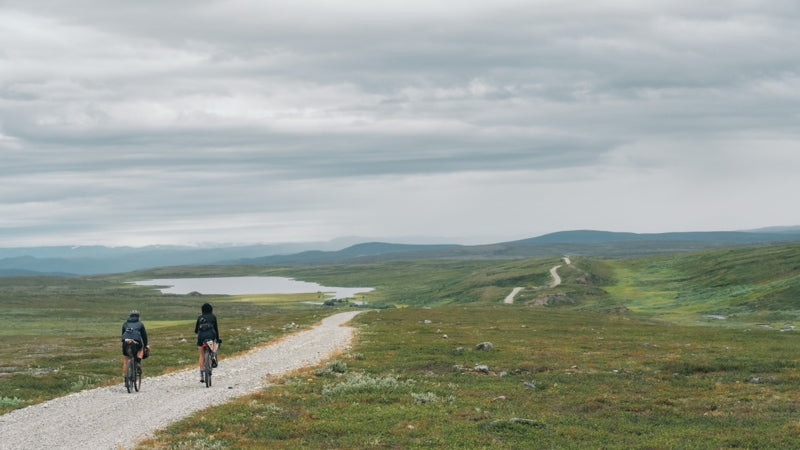
The Arctic Post Road goes through one of Europe’s largest wilderness areas.
You don’t have to ask Suunto ambassador and bikepacking maniac Sami Sauri twice if she’d like to go on an adventure. And sure enough, when fellow Suunto ambassador Henna Palosaari sent Sami an email asking if she’d like to join her on a summer bikepacking trip up above the Arctic Circle, the emojis she got as a reply said it all.
Adventure starts here.
The two had never ventured into this kind of territory before. At least not on bikes. The trail follows remnants of the old Kopenhagen-Alta post road. They had an incredible experience. Long days in the saddle without seeing another human being. Or anything for that matter. Just trees, hills and lakes. Apparently the most wild mushrooms in 60 years. Oh, and reindeer of course. Hundreds of them. Same with mosquitos. They also experienced the kindness of the locals.
“Experiencing the simplicity of life up north and the local culture combined with the tranquility of the long wilderness sections creates a bikepacking experience that takes you miles away from the city hustle,” Henna says.
Press play to watch their short film and see for yourself.
The route
By the numbers:
430 km distance
7215 m total ascent
749 m is the highest point
81 % is unpaved
45 % single track
Duration: six to eight days
All images by Mikko-Pekka Karlin

Great effort by Suunto community to slash CO2e together
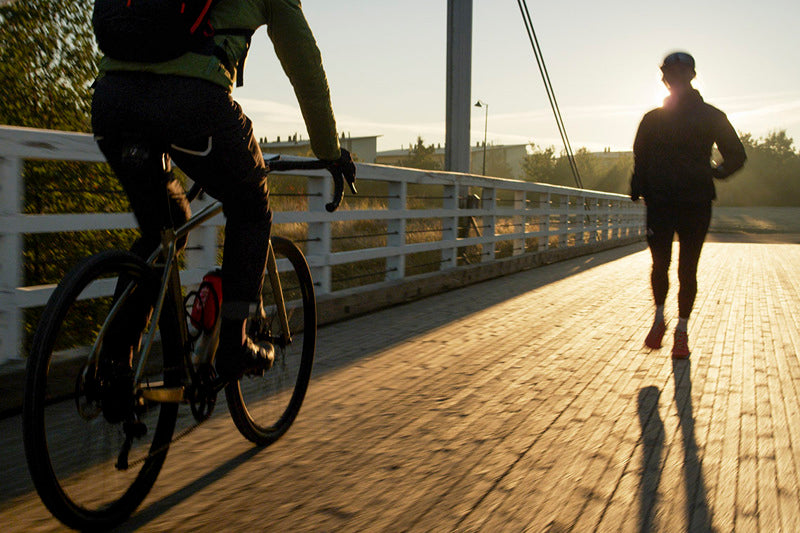
To motivate people to ride and run to work and to slash their CO₂ emissions (CO2e), we invited our community to join the first ever Suunto Commuting Day on September 22. The response was great: the community tracked nearly 380.000 km of human-powered commutes with their Suunto watches and Hammerhead bike computers. That’s just about the same distance as going from Earth to the moon!
Impressive first time results
The most popular commuting activity types were cycling, running and walking. Half of the commutes were cycling, a third was running and the rest walking – with some skateboarding, roller skiing and even swimming thrown in the mix.
The most common commuting distance for cyclists was 8,4 km, for runners 6,1 km and walkers 2,9 km. When looked closer at the cycling distances the distribution is quite equal:
Less than 5km commuting distance 26%
5–10 km commuting distance 32%
10–20 km commuting distance 25%
More than 20 km commuting distance 17%
Time-wise, runners had the longest duration commutes. The most common commuting durations were:
Running 39 min
Walking 37min
Cycling 29min
When looking at different nations, the Swedes were the most active bike commuters as the ratio between their bike commutes and bike rides in general was the highest. Other countries on the active commuter list were Germany, France, Finland and the UK.
Choosing human-powered travel
Human-powered commutes are good for both you and the planet as transportation is one of the biggest sources of emissions worldwide. When comparing the distance the community traveled with driving that same distance in a combustion-powered car, the estimated CO2e savings were over 65.000 kg. That’s the equivalent of 260 one hour passenger flights.
France, Japan, Finland, Spain and Germany accounted for the top 5 largest CO2e savings in total.
“We are stoked that we got so much participation even though it was the first Suunto Commuting Day and we had very little lead in time,” says Suunto’s Sustainability manager Heidi Heikkinen. “This shows how much interest there is — we expect the CO2e savings to increase next time.
“One single bike ride to work may not seem like a big commitment, but once you do that on a regular basis, you will start to see how it all adds up. And, when looking at the entire community, it is clear that thousands of people choosing human-powered commutes regularly can definitely make a difference.”
Track your commutes
In its increased focus on sustainability, Suunto has given its community the ability to track human-powered commutes and – as an extra motivation – see the estimated CO2e savings compared to driving that same distance.
To get started, track your commutes with a Suunto watch or a Hammerhead bike computer and tag the activity as a commute in Suunto app. In Suunto app you will see how much CO2e you have saved. You don’t even need to have a Suunto watch or a Suunto compatible Hammerhead bike computer to track your human-powered commutes: you can also use Suunto app and track with it for free. You can download Suunto app for iOS here and for Android here.
Committed to be a force for good
Promoting sustainable everyday choices is part of Suunto’s commitment to being a more responsible company. Today, more than 90 % of Suunto products are made in its factory in Vantaa, Finland. Since 2021, its HQ and factory have used 100% renewable energy. And to keep things transparent, it has recently published its first annual sustainability report that you can read here.“Suunto’s approach to sustainability is to increase positive effects, not just to reduce the negative ones. These are called, respectively, our handprint and footprint. We aim to tread lightly, and be a force for good. We believe in the power of community. Together, we can affect change by raising our voices and taking real action. Our ambassadors and our community care as much as we do,” says Brand manager Antti Laiho.
Read more
Learn more about tracking human-powered commutes and your CO2e savingsLearn more about Suunto’s approach to sustainabilityLearn more about Suunto’s comprehensive offering to cyclists

Join Suunto Commuting Day and fight CO2e emissions together
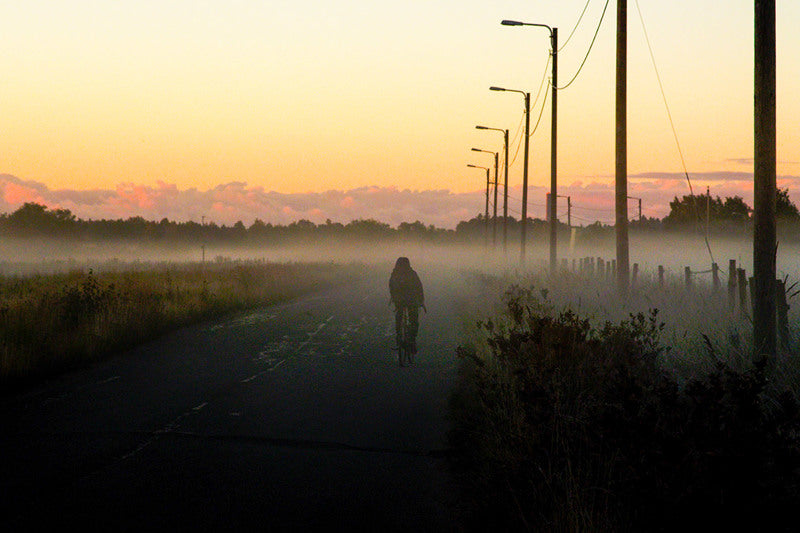
We are stoked to announce our inaugural Suunto Commuting Day to be held on Thursday, September 22. It’s simple to join: track your commute with a Suunto watch or a Hammerhead bike computer and tag the activity as a commute in Suunto app. After the event, we’ll show how much CO2e emissions our community has saved.
“One single bike ride to work may not seem like a big commitment,” says Suunto’s Sustainability manager Heidi Heikkinen. “But once you do that on a regular basis, you will start to see how it all adds up. And, when looking at the entire community, it is clear that thousands of people choosing human-powered commutes can definitely make a difference. Especially knowing that transportation is one of the biggest sources of emissions.”
You don’t even need to have a Suunto watch or a Suunto compatible Hammerhead bike computer to start tracking your human-powered commutes: you can also use Suunto app and track with it for free. You can download Suunto app for iOS here and for Android here.
“Suunto’s approach to sustainability is to increase positive effects, not just to reduce the negative ones. These are called, respectively, our handprint and footprint. We aim to tread lightly, and be a force for good. We believe in the power of community. Together, we can affect change by raising our voices and taking real action. Our ambassadors and our community care as much as we do,” says Brand manager Antti Laiho.
Learn more about tracking human-powered commutes and your CO2e savings
Learn more about Suunto’s approach to sustainability


Who’s having the most fun exercising? Here’s the answer – based on data!
Feeling is an excellent metric for recovery. If your feelings after exercise start to trend downwards, something is not right. You may be pushing too hard, not recovering well enough or might be getting sick. Consider taking a break or doing something different for a change.
But in addition to helping you track your recovery, feeling data reveals more. Here are six interesting findings about Suunto community, based on the data from Suunto app database.
1. Activity type does matter: The best feelings on average are recorded after dancing, downhill skiing, horseback riding, badminton and snowboarding.
2. Two activity types stand out as exceptionally poor: The feelings after running and trail running are clearly below other activity types.
3. Weather does not have a big impact on the feeling – unless it is a torrential downpour: The activity type, for example choosing cycling over running, has a much bigger impact.
4. Gender makes a difference: Women have more (or at least as much) fun as men in all other activity types except soccer.
5. Age does not matter: The age of the athlete did not have a correlation with the mood after exercise.
6. Country heavily impacts the mood: People exercising in Austria, China, Croatia, Poland and Serbia are generally feeling exceptionally well after a training session, while France, Italy, Japan, Spain and Sweden are in the opposite end of the list with much poorer feelings after working out.
In addition to fun facts, the data also reveals interesting trends: As an example, the feeling in cycling, swimming and walking rose to a new, higher level in March 2020 and has stayed on that higher level. Changes in other activity types since Covid pandemic started have not been as clear.
Happy adventures – and keep on tracking your activity feelings for your own wellbeing and our shared interest!
Lead image: Harald Wisthaler Bikewash image: Anthony Bonello


