





Suunto Blog


Dive into the world of a freediver
Will Trubridge has broken numerous freediving records but below, he reveals why he dives for the sense of exploration. Are you training for anything special? The fall is always the period of the year when I try and peak my training, so if everything has been going well over the summer then I will try to focus my efforts on one of the disciplines and see where I can get to. Is Molchanov's CWT record breakable? Every record is breakable! I worked hard on my CWT technique between 2012-2013, and I had an attempt in 2012 at the world record which failed by a whisker –forgetting to remove my nose clip on the surface. That dive was 125 m, and the record is now 128 m, so it is now an even bigger challenge, but not out of reach. My speciality has always been the no-fins discipline though, and it is also the one I enjoy the most. This year I'm concentrating more of my energy there.
Remind us why you freedive and what the sport means to you.I do it mostly for the sense of exploration and the challenge. By diving deeper than the human body has ever been we are redefining our limits as a species, and it is exciting to be on this frontier. I'm also the kind of person who needs to be challenged, mentally and physically, and freediving is a sport that supplies both.
Beyond both these answers, the sensation of merging with the water, and sinking deeper into a place where sounds, light, and all other stimuli are muted is an other-world experience that I am blessed to be able to enjoy.It must be tough having to train in all these locations like the Caribbean, Honduras...Tell me about it. I often long for a cold drizzle or snowfall... not! In fact I try not to forget that being able to combine a passion with a career and to be able to travel to all these magnificent places and dive in them is a dream. I'm grateful for every day and every second underwater.
It seems freedivers must lead very pure lives. Do you have any vices? I get so much fulfillment and nourishment from what I do that I really don't feel the need for anything more, especially something that comes at a price, like a vice does! However, could you call drinking hot sauce from the bottle a vice?Looking ahead, where do you think the sport is headed? Is it going to get more popular?Yes, I think it is. Some say our generation is living in an environmental and spiritual revolution, and freediving is a sport that ties in well with both those ideas. It simultaneously brings you back into touch with yourself and the environment in a way few other performance sports do. It is also the only truly aquatic (immersed) sport, so it offers an experience that is unparalleled in any other activity. A lot of people are discovering this, and finding a rewarding sport that leaves a light impression on our planet while drawing us closer to it and ourselves.Main image and portrait ©Samo Vidic. Underwater image ©Agustin Munoz


Why take a dive computer?
It's one of the most important bits of diving gear you can take underwater. The Scuba Diver Girls explain why.
A dive computer is one of your most essential bits of gear and can keep you safe when your dive plan changes, says Margo Sanchez, president of Scuba Diver Girls.“I saw a hammerhead shark,” says Margo. She and her buddy Stephanie had been diving a wall in Papua New Guinea with Tufi Resort. Their plan had been to stay at around 25m (80 ft) – but then they spotted this beautiful hammerhead, which typically patrols deeper depths. “It is better to have a computer that will help you adjust on the fly.”Sanchez did not want to pass up this amazing opportunity to get closer to this majestic animal and swam deeper. Her Suunto D6i alerted her of the depth. She kept her eye on her wrist so she could monitor how long she could stay at her new deeper depth while she filmed the great hammerhead. “Even though I wanted to continue to follow that beautiful shark, I used my Suunto to gauge when it was time to begin my ascent to shallower waters.”“Manual gauges won’t be there to assist you with your dive profile when your dive strays from your plan, and you can really get yourself into trouble.”
Margo notes that many things can change your plan while diving, and it is better to have a computer that will help you adjust on the fly. “Three minutes can seem really long when you are just hanging out in the big blue.”Sanchez finds that the upgrade to a computer from manual gauges has further benefits. “It’s also a timer – it counts your safety stop down for you,” she says. “Three minutes can seem really long when you are just hanging out in the big blue with not much to do. The computer tells you when it is safe to make your ascent to the surface.” Dive computers also track your time out of the water, so you know the second that the pool is open again for a second dive. Says Sanchez: “You can figure your surface interval with dive tables, but it is much easier to push a button on your computer and see exactly when it’s time to dive again.”She also likes her dive computer for its accuracy. “Gauges often aren’t accurate – on a number of occasions my air pressure gauge has been off by as much as 300 psi.” She likes the air integration with the computer where she can see very accurately what her psi is during a dive. Finally, Margo notes that there are other features of her Suunto that she loves. “The ability to check the temperature when I am diving in Southern California is great. The water can get pretty cold and it is fun to see real time what the temperature is.”
Also she likes to be able to scroll through her dive profile after the dive and see air consumption throughout the profile. “It is fun to keep track of all the amazing places we have been, where we dove, and what we saw there. You don’t get that with manual gauges!”
Image: ©Larisa Steele
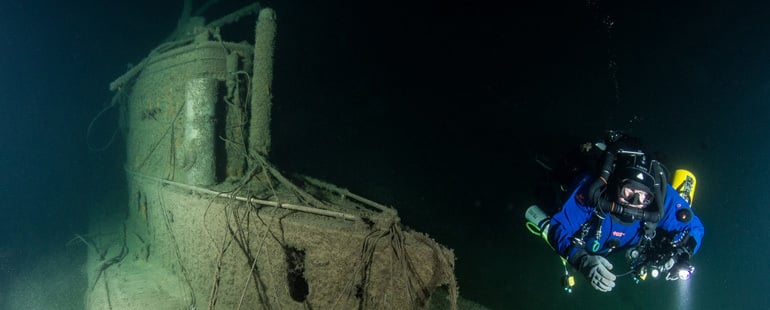

The amazing discovery of U 26
This is the full, incredible story of how Finnish diving group Badewanne discovered the wreck of first world war German submarine U 26. In their own words, the group's Juha Flinkman tells the story:
Late May in Gulf of Finland, weather is perfect with slight seas and some overcast, but good visibility. We’re kitting up to dive in one of the Europe’s busiest sea lanes. Ships of all sizes and shapes steam buy westbound along the lane leading out of the Gulf to the Baltic Proper. And where we’re diving is right at the bend, where every skipper wants to cut the corner as close as possible to save time and precious fuel. Subsequently, with the kind help of Helsinki Traffic Control, we have received a special permit to dive the site. Traffic control directs all ships approaching the site to pass us, and informs them of our intentions. Hence the VHF is constantly blaring instructions to approaching traffic, approximately one ship every 10 minutes!What lies on the seabed that could be so worthwhile to dive to, that would warrant such grandiose operation? Well no other than U 26, one of the first “Ace” boats in the First World War, and certainly the most successful submarine operating in the Baltic during the entire conflict. The U 26, under command of Kapitänleutnant Egewolff Freiherr von Berckheim, sank Imperial Russian Navy armored cruiser Pallada in October 1914, during the first months of the war. This made von Berckheim one of the first “Aces” of the emerging Ubootswaffe branch in the Kaiser Navy.
Von Berckheim and his entire crew received the Iron Cross from the enthusiastic Kaiser for their efforts, and in late summer 1915 they returned to Gulf of Finland with their trusty mount U 26, to wreak havoc among Russian shipping. This they did with good success, until late in August the luck that carried them through their dashing exploits ran out. Russian Navy had for a long time been very annoyed with the success of German U boats in the Gulf, and in order to stop this, had ordered minelayer Ladoga to lay a barrage across the mouth of the Gulf. However, U 26 was already inside the barrage, trying to get back to its base after a successful patrol. What happened, and when, we will never know, but U 26 hit one of Ladoga’s mines and sank with all 30 hands.A couple of weeks earlier, while running a side scan sonar sweep along the line of barrage laid by Ladoga, Immi Wallin observed a submarine wreck forming on the screen. Subsequent sweeps revealed that the boat is old, and most probably German, so the practical possibilities were U 10 or U 26. Soon we would find out!JJ-CCR’s strapped to our backs, bailouts and deco tanks snapped to place, fins on. Immi manouvers Yoldia right by the buoy and we go over the side. The water is rather clear even on the surface, but whatever waits at the bottom we have no idea. However, now as we descend the shotline it gets clearer and clearer as our lights probe the darkness. And suddenly she’s there! Visibility is absolutely brilliant all the way to bottom, which seems to be glacial clay. The shot weight hasn’t touched the wreck, but lies almost two meters to the side. Closer inspection reveals that the sediment is saturated with oil that has seeped from U 26’s tanks during her 99 years stay at the seabed. We swim towards the stern, which has sank deep into sediment as we could already see from side scan images.
The deck casing is visible maybe 10 meters behind the conning tower before disappearing into the clay. Broad, flat-topped saddle tanks typical to the U-23 class appear from the clay and run along the sides of the hull. On top of starboard side tanks we can see the collapsible radio aereal masts with their raising/lowering mechanisms. There is some trawl wrapped around the bows and conning tower, and only apparent damage to the boat seems to have come from the trawl: conning tower railings have been twisted and ripped off, and the ship's wheel which has stood on the open bridge, has been torn away by the trawl, and by an insane twist of fate has ended up in a space behind a ripped off hatch on the starboard side of the conning tower. There the wheel rests, still wrapped in trawl netting. Most importantly, the conning tower layout is definitely class U-23, so it seems we really are looking at U 26. But we need to check further.As we approach the bows, we can clearly see the for’ard diving planes, which are distinctly located low on the hull, well below water line when surfaced. This detail excludes U 10, which has these diving planes located above waterline. Everything else also matches what we know of the U 26: torpedo tubes, their outer hatches, bow shape.
We can now be sure we’re looking at the elusive U 26, one of the most sought after wrecks in the Baltic. Here she is, resting on the seabed with her crew and Kaleu’nt von Berckheim. An even 100 years after she was commissioned to the Kaiser Fleet, and 99 years after she last reported in. I have heard somewhere that old submariners don’t consider the boats that never returned from patrol as “lost”, but refer to them as “still on patrol”. Well, here she is, resting on the Gulf seabed, proud and alone as she was when she still patrolled these waters. A touching memorial to fates of war: brief success followed by swift and inevitable death. We swim silently along the side towards our shotline, our RB’s not breaking the silence of almost a century.As we can now be sure we have the U 26, we call the dive at runtime minute 17, and start our ascent along the shotline. Deco stops tick by, and eventually we surface. Yoldia is ready and picks us up quickly. It’s only after we are seated, and remove the loop from our mouths, that the whooping starts. Yes, it’s the twenty-six! And yes, the viz is bloody excellent! As the whoops echo around the deck of Yoldia, the next crew is preparing to dive, this time to shoot video. We quickly brief them with Jouni, and then they disappear over the side. Well folks, just another day at the Gulf of Finland, the Definite Wreck Paradise of the World.
Images ©Badewanne
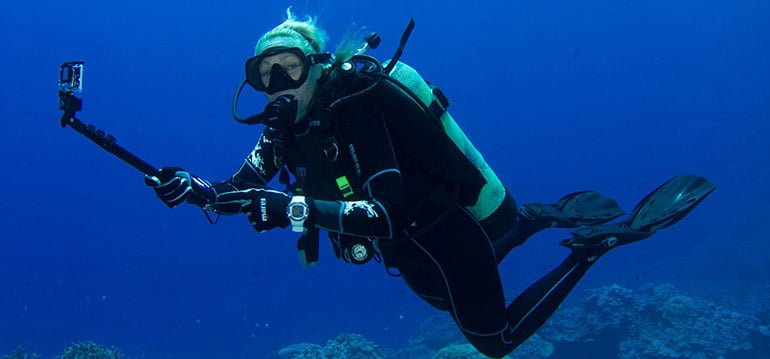

Dive like a Scuba Diver Girl
You’ve seen the diving videos of the Scuba Diver Girls and now you’re wondering how to get started with your own adventures. Margo Sanchez, president of the team, shares their secrets.
“It’s what everyone asks,” says Margo Sanchez when discussing the girls' many adventures. Along with her sister-in-law Stephanie Adamson, Sanchez formed what is perhaps the most-watched team of female divers in the world, with large followings on Facebook and beyond.
Whether it's advice for the newly certified diver about meeting more local dive buddies or suggestions for the veteran divers about their next exotic scuba trip, Sanchez suggests utilizing local resources.
Dive shops are always a good hook-up. “Look for your local Suunto dealer dive centers,” says Sanchez. “They're usually a great starting point for training, equipment as well as adventure and travel.” She adds that dive clubs are another fantastic resource for organized dive trips, group events and making new friends. Meetup.com is also a popular online resource used by many divers to find and join local dive clubs.
“Most importantly, local dive clubs, groups and shops are all good for one thing – meeting buddies who share a passion for the same sport and are excited to experience the next adventure,” says Sanchez.
Images © Brad Holland and Jennah Caster


Dive in with the Scuba Diver Girls
They are one of the most popular team of female divers in the world. Co-founder Margo Sanchez gives us the lowdown.
The Scuba Diver Girls are perhaps the most popular girls in the underwater community – and certainly some of the most active. Located in San Diego, California, the ocean is the girls' backyard. In their cold water dive gear and their Suunto dive computers, Margo Sanchez and Stephanie Adamson dive multiple times each week. If they are not diving in their local southern California waters, they are traveling the world looking for the next hot spot for amazing sea life.
This fun, adventurous dive team got started when Stephanie, a PADI dive instructor, invited Margo to learn how to dive. Stephanie wanted to share her love with the ocean and the amazing experience of being under the water with her family. Margo instantly felt a connection to the underwater realm, but also was amazed at how much fun it was to dive with Stephanie, her sister-in-law.
As the girls began to dive together and share their adventures with their friends on socialmedia their popularity grew in the dive community. Industry leaders and manufacturers commented that the girls were 'bringing the fun back to diving'. Margo and Stephanie quickly realized that there was a lack focus on women in the dive industry. From dive gear to online content much of the industry was focused on men. The girls decided it was time to put a female spin on the sport and began to build their online presence as Scuba Diver Girls.
“When we started posting our dive photos and videos on social media, there was a lack of interesting content about and for women in diving – we received an overwhelming response,” says Sanchez. She says the team made it their mission to put a brighter focus on females in the sport. The girls worked with various manufacturers, including Suunto, to test dive gear and give feedback to the companies from the female diver perspective on fit, usability, as well as look and feel. "Much of the gear we were originally using was designed with a man's body as a base for fit and then they just put some pink on it and called it women's gear,” Sanchez explained.
Together the girls began racking up dive destinations and posting photos and footage of their amazing adventures online. Their community, which started back in 2009, has grown to over 500,000 Facebook fans who actively interact and communicate with the girls each day.
You can join the community via their many social channels and get the best content and information on their dives, gear and amazing destinations.
Facebook
Instagram
Twitter
Youtube
Images © Tanya G Burnett, Brian Kirby and Margo Sanchez


Tutorial Tuesday: How to enter and change the nitrox settings on Suunto Zoop
Suunto Zoop is a great choice for your first dive computer, its full decompression capabilities and nitrox mode mean it's designed to give you years of serious fun. This Tuesday we take a look at how to enter and change the nitrox settings on the Zoop.
Get support for your Suunto product at support


