




blog
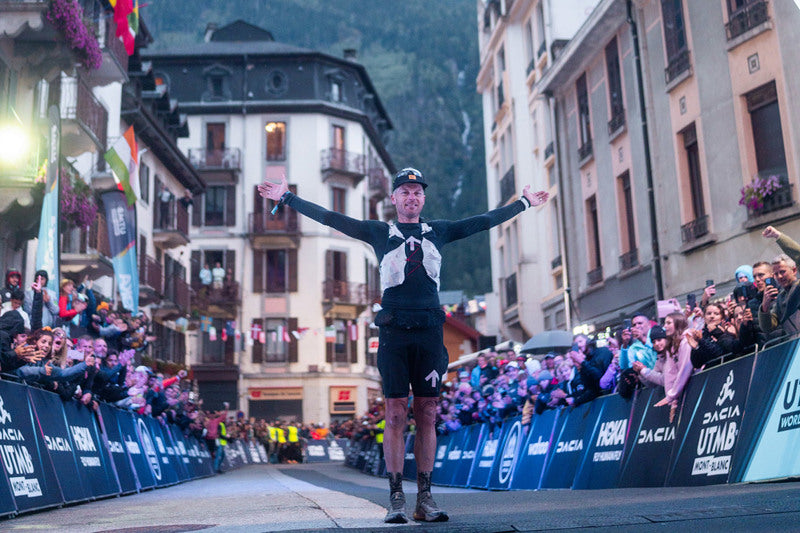

Christian Meier wins the TDS in severe conditions
TDS was the toughest race of this year's UTMB week. Even in normal conditions, it is one of the most technical races of the week-long festival and, this time, the temperatures dropped and brought snow and poor visibility to make it even harder. The days before the race, it was over 30°c in Chamonix Valley. On the race day the temperatures barely rose to 10°c.
The organizers had to change the route slightly which made it eight kilometers longer than normal. So, when standing at the start line in Courmayeur at midnight on August 28, the runners had 153 kilometers of mountain terrain ahead of them.
The TDS stands for Les Traces du Duc de Savoy (“In the footsteps of the Dukes of Savoie”). The route starts in Courmayeur in Italy and circles Mont-Blanc on the west side to finish in Chamonix in France. It has over 9000 meters of total ascent.
Suunto ambassador Christian Meier took his biggest international ultra-running win to date at the TDS with a winning time of 19:36:35.
“This is definitely my biggest victory to date. As I am quite new to running, this has been the first year, I could considerably increase my training volume in line to what I believe you need to do at this level of the sport,” he said after the race. With “quite new to running” Meier referred to his background: he has built his strong endurance engine as a professional cyclist and turned to running only three years ago.
“Even though fitness may not have previously been the factor, leg conditioning definitely was; too many miles and I would end up injured. Like all good things in life, it took time and patience to build up the resistance to be able to go the distance. I was fortunate to train the months leading up to the race with some world-class running mates so I knew my form was pretty good but at the end of the day you need everything to come together during the race. I thought maybe I could fight for the podium, but the win was a pleasant surprise!”
Christian planned to race conservatively and at his own pace. He took the lead at around the 90 km mark and never looked back.
“My best results have come when I have run within myself,” he says. “This race was going to be 6-8 hours longer than anything I had previously done, and I had a lot of respect for that. I did feel that the plan worked well and I managed to pace well, eat well, and look after some details that make the difference.”
The severe weather was a big factor. It had brought freezing temperatures, and low visibility, and made trails muddy. The snow line was at around 2200 meters on the course that topped out at 2581 meters. In some places, there was 15–20 cm of new snow.
“What really saved my race was navigation. There were moments when it was a total white-out. No trail, you could barely see the markers. Navigation really saved me there. And it was really an advantage. Some guys didn’t have navigation. They definitely lost time and it worked to my advantage. I am grateful for that.”
Christian raced with a Suunto Vertical. Suunto Vertical has detailed terrain maps, route navigation, altimeter, barometer, 85 hours of exercise tracking on the most accurate GPS setting, and more. Get to know Suunto Vertical HERE.
All images by The Adventure Bakery
READ MORE
The athlete-entrepreneur who knows the value of hard work
Courtney Dauwalter makes history at the UTMB
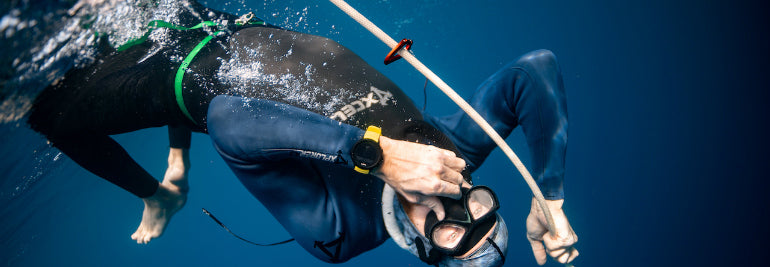

Experience the Blue Element freediving competition
Blue Element kicks off tomorrow for their 3rd event in Dominica. Suunto Dive caught up with one of the founders, Johnathan Sunnex, to find out what it is all about before media manager and freediver Francesca Koe takes over our Instagram feed tomorrow.
Photo by Daan Verhoeven
What is Blue Element?
Blue Element is an international freediving experience that encompasses multiple days of diving, beach clean-ups, island exploration and much more! It is held annually in the picture perfect island of Dominica! Sofia Gomez Uribe and I founded Blue Element freediving in 2016.
This is the third BE competition which was founded in 2016. Hurricane Maria prevented the 2017 edition, but last year the BE team were able to re-establish the event despite the country still being in recovery mode after the hurricane devastation.
The event is held in Soufriere Bay/Scotts Head in the very south of Dominica. Dominica is a small island nation, a part of the Lesser Antilles island chain in the Caribbean.
Why is the location so amazing?
The Soufriere Bay offers world class conditions year round, unlike any other location on earth. The water temperature ranges between 26-30°C, the visibility is between 20-30m and there are no waves, no currents and effectively no depth limit. To add to this, the bay is surrounded by high mountains carpeted with lush tropical jungles creating the perfect backdrop.
The custom built freediving platform is currently set in 160 m and just a five minute swim from shore.
Are you expecting any records?
The Blue Element team pride themselves in creating an atmosphere where athletes can perform at their very best. Dozens of national records and several world records have already been set here over the past four years and we expect this event to be no different!Blue Element 2019 will be attended by 30 athletes from around the world, including many national record holders, vice and world champions. We can expect to see many records fall at this event including national, continental and possibly world records.
What disciplines compete and on what days?
Athletes have the choice to compete in as many or as few of the competitive depth disciplines as they choose. There are six days of diving split into three sets of two. We are expecting 30 athletes to be competing this year and more than 150 official performances.
Have you seen the event grow?
Hurricane Maria was quite a setback and it took a lot to regain momentum. The event continues to grow each year and this year we will have almost three times the number of athletes than attended the inaugural competition.
Photograph by Daan Verhoeven
What can the athletes win?
Suunto D6i’s, Suunto D5’s, carbon blade Alchemy fins and shirts, custom made Elios wetsuits, Octopus nose prize packs, All-Swim swimwear, high end Pacsafe back packs made of recycled fishing nets, ADIDAS shirts, Recycled plastic Blue Element T-shirts, custom medals.
Who are the judges?
Two of the world’s leading judges, Carla Hansen and Vedran Milat.
Who runs the safety team?
Chief of Safety Louisa Collyns of the UK returns to lead our experienced team of safety divers. The safety team have been hand selected and are comprised of several 80-90m divers in their own right.
Will the rules be governed by AIDA or CMAS standards?
AIDA International.
Who is taking the official pictures?
Predominantly the man, the myth the legend, Daan Verhoeven. I will likely join him behind the camera for some session.
Will you have Dive Eye?
Not this year but the event will be covered by our professional media team with event videos and live streaming from the platform. We have cameras placed strategically to get all of the best angles from both above and below the surface! You will be able to catch the live stream from our Facebook page, and the videos will be uploaded to our social media channels. We will also be taking over the Suunto Dive Instagram feed live from the dive platform.
Photograph by Daan Verhoeven
What is your history in freediving?
I have been involved with freediving since 2011. I competed for the first time the same year in Kalamata for the Med Cup and then the AIDA World Championship. I placed somewhere in the middle of the field, but these events and the athletes who were in attendance inspired me to make a full commitment to freediving. I vowed to myself that when I would return I would be there for a podium placing.
I moved to Egypt and I started to teach and train full time. Living next to the ocean mean't I had easier access to depth which allowed me to progress quickly and I made my first dive below 100 m in November of 2012. The following year I returned to Kalamata for the AIDA Depth World Championship and, as I had hoped, this time I managed to place third in free immersion, winning a bronze medal. I ranked third overall for depth diving in 2012 and 2013 with deepest official results of 105 m CWT, 101 m FIM and 65 m CNF set in the Bahamas at Vertical Blue.
After the death of two friends (fellow freedivers) I switched my focus towards coaching and safety diving. I had thoughts about leaving the sport, but I soon realised that that wouldn’t change anything and that I would be better off staying and trying to make the sport safer. I ran safety seminars and returned to Long Island in the Bahamas, this time as the Chief of Safety and co-organiser. I hand selected a group of free divers that I knew would be up to the task of looking after the deepest divers in the world pushing their bodies to the absolute limit. I applied the same mindset to running the safety team to what I had used in my own personal training. We approached safety diving with performance in mind. Team bonding for cohesion, rescue drills and emergency training to sharpen our skills, incident reviews for learning opportunities and to strive for improvement. This approach has since been adopted by many other events and has set the standard for the international freediving community.
Since then, I have coached athletes to more than 70 national and continental records as well as seven world records. I am an instructor trainer with AIDA International and I continue to organise freediving events. I enjoy exploring and documenting the underwater world with my camera, and have dived in all continents, including both polar regions.
Will you compete?
Once the competition is underway and everything is running how it should, then yes, I plan to take off my organizers hat for a few minutes each day to perform some dives!
Photograph by Daan Verhoeven
Any hot tips or words of inspiration you would like to share?
Freediving, like life, is often a trial of tribulations. Success takes patience and persistence but inevitably hard work and determination pays off.
Links:
Photography by Daan Verhoeven
Blue Element Facebook
Blue Element Instagram
Blue Element Website
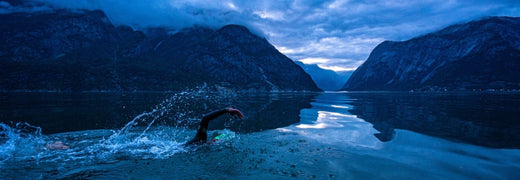

What you need to know about cold water swimming
With public swimming pools closed in many countries, swimming in open water ensures we keep our training moving forward. However, open water is usually colder water, especially earlier in the year.
We talked to Norseman Xtreme Triathlon chief medical and safety officer Jørgen Melau about how to stay safe swimming in cold water. Jorgen is currently finishing a PhD on cold water swimming and before starting his research he served in Norway’s Arctic air ambulance rescue operations.
“There are many benefits to cold water swimming,” Jørgen says “And although our research is focused on the dangers, I want to stress that the benefits of open water swimming far outweigh the risks. So I really encourage everyone to try it!”
Joakim Dokka Nordstad/nxtri.com
The benefits
Ask any dedicated cold water swimmer and they will tell you how amazing it makes them feel. This is probably because of the massive endorphin (feel good hormones) release swimming in cold water generates. Plunging into uncomfortably cold water stimulates our body’s pain system, which releases those delightful endorphins to help us manage it.
Cold water swimming is also touted to improve circulation, burn more calories, increase libido, reduce stress and strengthen the immune system.
The risks
When you suddenly enter cold water it strongly activates several branches of the nervous system. “These are strong and powerful activations, and for some vulnerable people, it can be very dangerous because it can generate arrhythmias,” Jørgen says. “It is called the autonomic conflict, if anyone is interested in learning more.”
The second risk is hypothermia, due to the cooling of the body’s core temperature. “Hypothermia is a problem only if the water is cold and the swim is very long,” Jørgen explains. “However, there are huge individual variations, and this is why it is so hard to give any exact limits. We do not recommend swimming in water colder than 12°C. And for some, it should probably be much warmer.”
Study demonstrates risk
In the 2015 Norseman Xtreme Triathlon the water temperature dropped to 10°C so Jørgen and the race organisers shortened the swim. A few months later Jorgen asked 20 triathletes to swim in 10°C water for a controlled study. The study showed that if Norseman had allowed a full distance swim in 2015, almost 50% of the athletes would have suffered from medical hypothermia. “This was a real eye opener, and something we believe is very important to know,” Jørgen says.
How to begin
Start with brief sessions
To give your body and mind time to adapt, start cold water swimming with brief sessions. Then as you become accustomed, you can gradually lengthen them.
Enter the water gradually
Jørgen advises not to jump or dive into cold water, but to enter gradually. “The human body is very adaptable to different environments. Yet, we help ourself a lot if we give the body some time to readjust. Enter the water slowly, taking half a minute to a minute.”
Stay active after
After exiting the water, stay active to warm up your body. “Your body is excellent in producing its own heat, and you do that by keeping your muscles busy,” Jørgen says. “So go for a run or hop onto the bike. “An additional tip is to dry off your wet skin when you have finished your swim; you waste a lot of heat if the body needs to dry your skin from its internal heat supply.”
Joakim Dokka Nordstad/nxtri.com
The Norseman open and cold water swimming code
Never swim alone
This really is essential. Before embracing adventure and bracing for the cold you need to find a buddy to share the journey to help keep one another safe. Alternatively, you can find someone to monitor your progress from a boat or by the shore.
Out on swims together, stay close and be observant of your swim buddy. If you swim in a group, always team up with a buddy, so you can look out for each other. It’s safer and more fun.
Avoid water colder than 12°C
Norseman advises people 12°C should be the minimum for cold water wetsuit swims. And for such low temperatures, the swims should be short.
“For many people, it’s probably wise to have a higher water temperature than this,” Jorgen cautions.
If you feel cold for more than 10 minutes, abort the swim, and get yourself warm. Be aware that the temperature and wind on land may pose a risk for hypothermia even after exiting the water.
In cold water, swim for 20 minutes only before exiting the water to warm up.
Plan your swim
Cold water swimming is a little like going up into an alpine environment in the sense you shouldn’t just wing it, and hope everything will be hunky dory. It’s asking for trouble
Research your swimming spot. Be aware of hazards like shallow water, tides, rip currents, marine life, or boat traffic. With Suunto App, use Suunto Heatmaps to find places to swim and ask people in the Suunto community who swim there for info.
Let someone at home know where you plan to swim and what time you will finish.Check the weather forecast.
Know your ability
To stay safe and to keep it enjoyable, make sure you have the ability and fitness to complete the swim you’ve planned. Keep an eye on the conditions; a wind change can quickly increase wave or swell size.
Under no circumstances go swimming during a thunderstorm. A lightning strike in water may be lethal.
Swim close to shore
If the conditions change or you get tired or start getting cramps, being close to shore means you can get out quickly. You are also easier to spot and help close to shore, and you avoid encountering potentially dangerous marine traffic.
Be prepared for emergencies
Have a plan in mind for what to do if anything happens to you or your swim buddy. Know exactly where the nearest phone (your swim tow, the car). Consider having a third person observing you both from shore. If there are known rips or currents in the area, know how to respond if you get caught in one. Where are alternative exit points?
Alexander Koerner/nxtri.com
Get emergency training
Practice how to help your buddies in open water, transiting him or her to shore, and getting them out of the water. This is important to know in the eventuality your buddy cramps.
Know your CPR and take a course regularly to maintain your knowledge.
Have the right gear
A Suunto watch paired with a Suunto Smart Sensor heart rate belt: These track your level of exertion, give you data about your stroke rate, time and distance, and the GPS will allow you to see post-swim whether you swam in a straight line or not. Plus, Suunto Heatmaps makes it easy to find popular open water swimming spots near you.
A swim tow float: these are an extra safety aid. They act as a flotation device in the event you get cramp or need to rest. They are brightly coloured so improve your visibility and can be used to store your car keys, wallet and smartphone.
A silicone hat or wetsuit hood. Try to find a brightly coloured hat so you are easily visible on the surface.
Goggles: Make sure they are comfortable to wear for an extended period and consider choosing polarized goggles to reduce sun glare for better vision.
Anti chafe balm: applying this under your wetsuit helps to prevent chafed and cracked skin.
Boots, gloves, wetsuit socks: these not only keep your feet and hands warm, they also prevent injury by providing some grip as you enter and exit the water.
Lead images: Alexander Koerner/nxtri.com
Read more articles
10 reasons to enjoy open water simming with Suunto
5 steps to therapeutic breathing to combat COVID-19
Blaze fresh routes
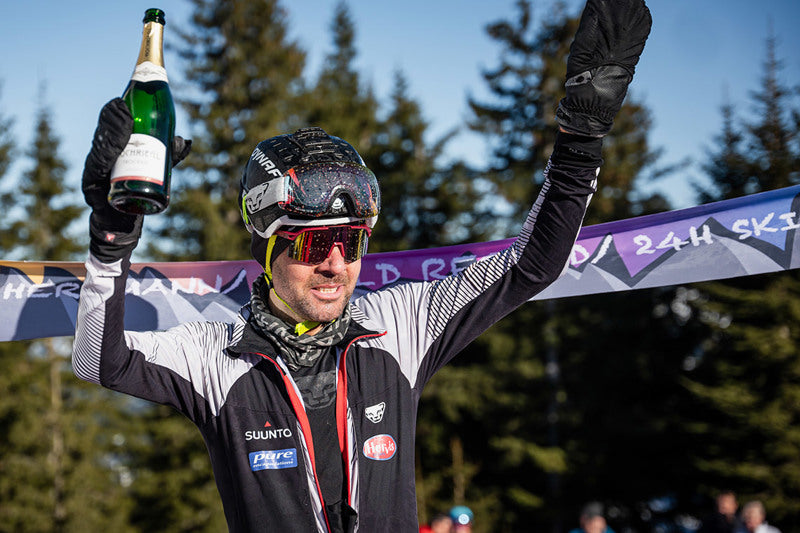

Jakob Herrmann breaks the 24h skimo world record!
Last weekend Jakob Herrmann, Austrian ski mountaineer and Suunto ambassador broke the 24-hour skimo world record. He ascended 24.242 meters (79.534ft) in 24 hours in Radstadt, Austria. To put that into perspective, Jakob’s average hourly ascent was over 1.000 meters, and the total ascent was more than equal to six laps up to Mont Blanc, the tallest mountain in the Alps, from the valley floor in Chamonix.
The previous 24-hour world record was 23.486 meters set by Kilian Jornet. Jakob not only broke the record but was also the first person ever to climb over the 24.000-meter mark.
Jakob skied all together 34 laps up and down a ski slope that has 713 meters of ascent. A single lap was 2,55 km and in total he skied more than 170 kilometers. During one of his descents, he hit a max speed of 108 km/h!
We caught up with Jakob shortly after his record-breaking ski. Read on to learn more!
Suunto: When did you set the 24-hour record as your target?
Jakob: I just love to spend time on my skis for hours! It has always been a dream for me to go on touring skis for 24 hours to see how many meters in altitude I can manage. I just want to know what limits I can reach and how far beyond them I can go.
Did you do some specific training for it?
In November and December, I did a lot of long and easy sessions on my skis followed by short and hard interval sessions to get the speed and strength. In the last two weeks before my 24h I only did short, easy sessions and some short, but hard ones and one race to get used to the suffering!
Have you tried a personal 24h challenge before?
No, but I did one session with 10.000m of ascent in 9h30m in the middle of December. I felt super strong although I did it self-supported. I think with more long sessions my head and muscles would have gotten tired and the pace would have gone down. So, I did more split sessions with 5.000m+ in the morning and a second session in the evening.
How did you pace yourself?
For 90% I listened to my feelings. When I felt strong, I went faster and when I felt tired, I went a bit slower! My supporters always gave me the lap times. In addition, I observed the vertical speed per hour on my Suunto Race.
How did your pace change through the 24 hours?
I did the first loops very fast – my first uphill was in 30’. The first 10 loops were all between 30-36’. After that, I was between 37-40’. My slowest uphill was 42’ on the 24th loop when I had my lowest point. The hardest part for me was the early morning when I felt the freezing cold temperatures of around -8 degrees, especially during the downhills.
In the end, I was able to push again, and the last 7 loops were all between 38-40’. The average was 38’20”. So, I think the secret to my success was that I was able to keep the pace constant.
Did you have some surprises on the way?
I didn’t have any negative surprises – only positive ones! I was surprised that so many friends joined me on my way and so many people followed me on-site or in the live stream.
Did you have anyone keeping you company?
Yes! I was only 7 hours in total alone: 4 hours during the night and 3 hours during the day. I am super happy I had so many friends on my side, but I enjoyed also the loops when I was alone!
When did you realize that you would make it?
From the beginning… No joke! I had a strong day, and after some laps, I knew, that I could do it. After 18h I was 100% sure that I would make a new record, but I wasn’t sure if it would be more than 24.000m. After 21h I was sure I’d do the extra lap to climb more than 24.000 meters.
Which Suunto did you use?
I had the Suunto Race – and it worked perfectly. The battery lasted unbelievably well; I had more than 40% of the battery left in the end even though I had the GPS on the best settings, the light was always on and I used the SuuntoPlus Loop sport app.
What was your nutrition strategy?
100 grams of carbs per hour. I always had 300ml of Maurten Drink Mix320 with me. Every loop I had a Maurten gel and every 4th loop I ate a Moonvalley bar and no gel. After the 8th and 16th loops, I had warm salted potatoes and a warm soup on the top.
For the last 6 loops, I stopped with Maurten Drink Mix320 and Moonvalley bars and changed to Red Bull, water, and Pringles!
Did you have a big crew supporting you?
I had two supporters in the valley and two on the top. Philipp [Reiter] was everywhere taking pictures and pushing me! Also, my parents were nearly 24 hours on my side to give me a good feeling!
How do you feel now, one day after the enormous effort?
I feel super good. My energy and legs are strong – only my feet are swollen, and I have some blisters. I am surprised… but I think my nutrition strategy was really good. I never felt completely out of energy.
Check out Jakob’s record-breaking activity in Strava
Follow Jakob’s adventures on Instagram
All images by Philipp Reiter / The Adventure Bakery
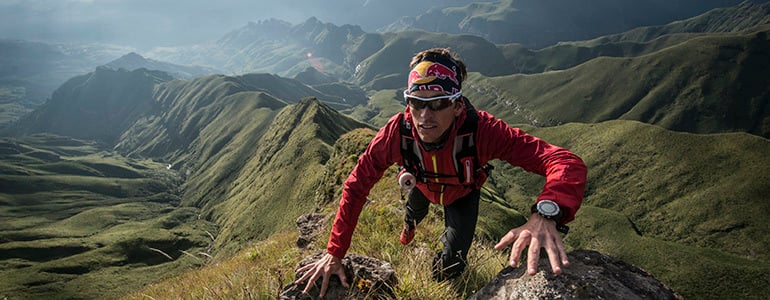

Why runners need to mix it up, says Ryan Sandes
In part two of this three part series, Suunto ambassador Ryan Sandes offers more tips to help you become an ultra runner.
1. Focus on your goals
It's important you have a schedule and that you know where your peak weeks are and when you need to back off and at the same time that schedule needs to be really flexible. Some weeks you just might not feel up to it, whereas others weeks you feel on top of the world and can maybe even do a bit more. The training schedule allows you to know where you're going and enables you to focus on your goals.
South African ultra runner Ryan Sandes. ©Kolesky/Nikon/Red Bull Content Pool
3. Mix it up by cross training
Strength work, a little mountain biking. cross country skiing, ski mountaineering are really great to help become a stronger runner. Doing strength work is a completely different stimulus and good balance to long distance running as it helps to prevent injury. For guys who are really heavy a long run can really take it out of you. Doing it on a bike might be better. Swimming can also help. Aqua jogging is also quite good as it stimulates your cardiovascular system and also aids recovery.
4. Go hot and cold
Doing regular sessions in a sauna also helps. It increases your production of testosterone and stimulates recovery. Cold showers, cold tubs... they reset your neuromuscular system. Try different things and see what works for you. A lot of people break themselves by doing the same type of training so it's important to mix it up.Ryan checks his Suunto Ambit once every 30 minutes. ©Kelvin Trautman / Red Bull Content Pool
5. Warm up properly
Often before I run I do ten to fifteen minutes of basic mobility work to make sure everything is moving. People working a full time job might say they don't have the time, but I think you can do two or three minutes to warm up before you start running. Doing side bridge, push top leg back, basic mountain climbers bear crawls, basic lunges etc.
6. Quality over quantity
Running a high mileage works for some people, but it’s important you don’t follow others blindly and instead find out what works best for you. Doing more quality training and dropping the quantity is definitely a good idea. For beginners, it’s better to do less and to focus more on recovery.
Click here to read the first installment in this three part series from ultra running champion Ryan Sandes
7. Find your breath
It’s important to train your diaphragm as well as your legs. One of the first things that will slow you down and make you fatigued is poor breathing. Your diaphragm is almost like a muscle so you need to train it as well. Practice deep belly breathing and you will improve your oxygen intake.
8. Break it down
With ultra distance running you’ll constantly go through highs and lows and how you manage those will decide how your race will end up. It’s so important to stay positive. To help with this, try to break a long run or race down into lots of mini goals. Focusing on getting to the next aid station, for example, or getting up the next climb or to the next tree can trick your mind and make it all more achievable.
9. Get absorbed
When you’re doing your long trail runs it’s important to have fun and to get absorbed in your surroundings. I know a lot of guys who come from a marathon or 10 km background and they constantly look at their watches and worry about how many minutes each kilometer is taking. This makes it difficult for them to enjoy themselves. I look at my watch once only every half an hour because it boosts my motivation to know how long I’ve been out, how far I’ve gone or how much I’ve climbed.
Setting mini goals throughout the race helps to stay positive. ©Kelvin Trautman / Red Bull Content Pool
10. Go social
A lot of people like running on their own, and that’s cool, I enjoy it too, but it’s also nice to mix it up and run with other people. It makes it more fun. You’ve got to be careful if your trail buddies are a lot faster than you. It can be good for them to push you a little bit, but don’t do all your runs with them if you’re a lot slower. Do half your long runs with them and then go off on your own.
Regular strength training helps to prevent injury, Ryan says. ©Kolesky/Nikon/Red Bull Content Pool
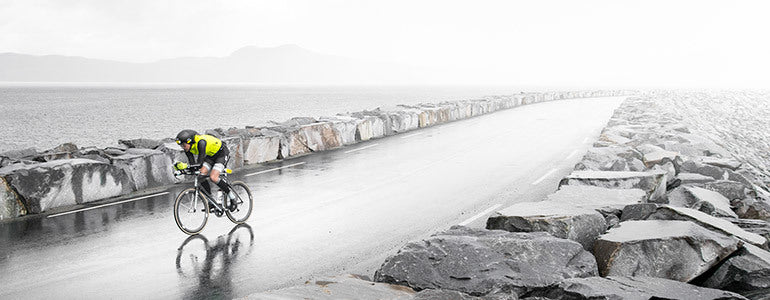

Testing human physiology at the Norseman Xtreme Triathlon
© Kyle Meyr/nxtri.com
Ask Jonny Hisdal about the 226 km Isklar Norseman Xtreme Triathlon and you’ll get the honest truth. He should know afterall – not only has he completed the race course 12 times, as a physiologist he’s also researching what it does to the human body.
“Most of your biomarkers (chemicals, molecules, and hormones present in the blood indicating different forms of illness) are sky high when you reach the finish line,” he says. “If a doctor tested your blood immediately afterwards it would look like you are really sick, or having heart and kidney failure.”
© Kyle Meyr/nxtri.com
The good news is this alarming biomarker profile only lasts a short time. A day after the race the biomarkers are already on the way back down. Whereas, if you were really sick, the biomarkers would remain at the same level.
Hisdal is currently preparing to sample the blood of more than 40 finishers immediately after the end of the race, which starts on August 4. The goal is to understand what the normal blood levels are after such an extreme race. He’s also participated in a study looking at the possibilities and limitations of cold water swimming – the race includes a 3.8 km swim in a fjord with water temperature ranging between 13 and 15.5 °C.
To reach the finish line of the Norseman demands more than endurance fitness. “Yes, it requires really good base fitness, and a high level of endurance,” Hisdal says, “but also a lot of mental strength to compete for so many hours. The average athlete needs about fourteen fifteen hours.”
© Kyle Meyr/nxtri.com
Hisdal is also on the safety team for the race, and recently completed the course along with the rest of the crew, making it his 12th time. He first competed in the race as an athlete in 2005, and did so the following five years. Since then, he has been on the race organising team.
“The swimming is the easiest part, something that everyone should be able to do,” he says. “Average athletes are in the water for one and a half hours – that’s a long time if you are not used to it.”
“After that you jump on the bike and cycle for 180 km, including 3000 m elevation gain. If you are not used to cycling uphill it's impossible to do it. Then you are running 25 km on the flat, and the remaining 20 km uphill for 2000 m of ascent. It's brutal.”
© Kyle Meyr/nxtri.com
Some people, he says, quit before the race has even started. Others pull out 1000 m into the swim, and some on the bike during the climb. But the majority make the finish line, after giving their blood, sweat and tears to the terrain. “The biggest problem is people train too much so they get injured,” he says. “Almost everyone overtrains.”
Click here to see Suunto's range of triathlon watches!
The race has played a central role in popularising triathlon in Norway. Before it began in 2003, triathletes were hard to find in the country, whereas since the inaugural race triathlon clubs have been growing in membership. Only about 20 athletes signed up for the first race in 2003. Now, 4000 people from all over the world apply, vying for only 280 start positions.
“The reason why I do it is because it's an incredible experience, and it keeps me motivated to train and stay in shape,” Hisdal says. “It's not really like a normal competition; it's more like adventure or travelling. It's travelling through breathtaking geography, and also mentally; you travel through really deep lows and up to some really big highs.”
© Kyle Meyr/nxtri.com
Here are Hisdal’s five tips for the Isklar Norseman Xtreme Triathlon:
1. Train uphill
“It's essential to train uphill, both bike and running, because the race includes 5000 m of it.”
2. Get used to cold water
“It’s a necessity to train your swimming in cold water. It should not be the first time when you start the race because it will give you problems.”
3. Train longer sessions
“It’s important to have some long training sessions of at least six or seven hours so you know what you will experience during the race.”
4. Know your fuel
“You need to be able to eat and drink for the race length. What you should eat, when and how much, is something you need to practice well in advance. It's very individual. You need to learn what your body can tolerate.”
5. Race smart with a sports watch
“Learn to control your intensity with a sports watch like the new Suunto 9. The most important thing is not to start too hard. If you are too high in intensity in the first few hours you will suffer for the rest of the race.
“I have used sport watches and a heart rate monitor to make sure I'm not too high in intensity. I have a max heart rate I can tolerate, and if I reach that I slow down a little. It's very easy to be too eager in the beginning, when people are passing you. You are blinded by adrenaline at the start and cannot trust your feelings. You will feel very strong, but suddenly the hammer comes down and you're finished. Sport watches help manage this – just make sure your one has enough battery life.”
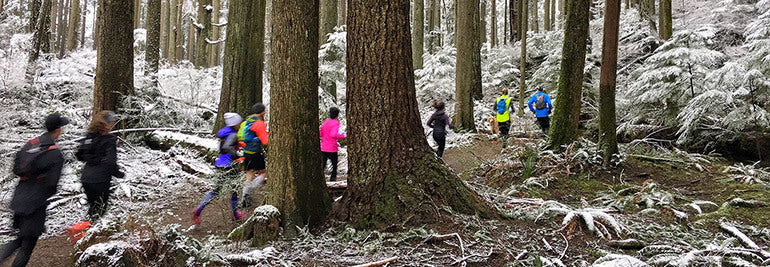

Hollie, Sami and Christoph are the Vertical Week photo contest winners
World Vertical Week was held last week and the hundreds of pictures tagged with #verticalweek on Instagram give a great overall look into what people have been up to during the week. Three of the most inspirational photos were taken by Hollie Holden, Sami Renner and Christoph Oberschneider. Each one of the winners will receive a new Suunto Spartan Ultra to accompany them on their future adventures.
🌲// Legs/entire body felt like an 🐘 at this weeks @vanrunco trail ✈️ crew BUT I managed to hit my @suunto #VerticalWeek goal of 4000m (1k more than my 1st goal! 🙌) of climbing and we were blessed with a pretty layer of 'convenient snow', right @coralie2700 ? 😉🤣❄️
A post shared by Hollie Holden (@holholden) on Mar 5, 2017 at 12:59pm PST
“The Vertical Week was a great opportunity for me to start building my strength and climbing skills ahead of my upcoming training season for my 1st 50 mile Ultra Marathon - the Squamish 50 in August which is a tough, mountainous course with 11,000 feet (3350m) of climbing!
I set myself the goal of covering a similar amount of climbing during Vertical Week so I spent a lot of time on a local trail called the BCMC which starts at the base of Grouse Mountain climbing to the top. This trail has 850m of elevation gain in just 3km of climbing! I ended up doing this trail 4 times in the week (3 times within one 24hr period!) then finished off the week running trails with my local run crew, Vancouver Running Company Flight Crew, surpassing my 3k goal and hit 4000m for the week instead!
The weather in Vancouver has been unseasonably cold, with lots of snow & wet rain and I wouldn't have done anywhere near as much climbing last week if it wasn't for the awesome community of friends that I have here who are willing to come climb mountains in a snow storm with me!”
–Hollie Holden, BC, Canada
Cause she asked so friendly... 🐦 #lovemountains #skimo #verticalweek #collectingmoments #mountaineering #watzmann
A post shared by Sami (@samirenner) on Mar 5, 2017 at 10:10am PST
“The photo was taken on the last of three summits at the “Watzmann-überschreitung”, a famous summer tour in my hometown with over 24km and 2500m of climbing. The goal for me was to do this very technical tour with skis. As I reached the third summit, I shared my last Powerbar with a bird.
A few days earlier during the Vertical Week I was in Zermatt, reaching Breithorn’s (4164m) west and east summits on skis, and on two more skitours. All in all, my Vertical Week was about 7500m of elevation gain over 65km.”
–Sami Renner, Germany
Welcome back, #winter! Yesterday was a great #powderday in @visitgastein. Can't wait for more!
A post shared by Christoph Oberschneider (@coberschneider) on Mar 2, 2017 at 3:09am PST
“I work as a backcountry skiing photographer in Austria, so my goal each winter season is to capture the beauty of backcountry skiing & ski touring, to share my passion for the sport with as many people as possible and ultimately to get more people to enjoy life in the outdoors.
So far we have had a very dry winter here in the Alps, so getting good shots has not been an easy task. So when it finally started snowing 10 days ago, I headed out to Sportgastein (a freeride spot close to Salzburg) with two good friends. We found some beautiful lines in the backcountry with lift-supported ski touring and I managed to get some good shots. And that's how I also spent the rest of the Vertical Week, ski touring in the mountains around Salzburg and trying to capture the beauty of the winter landscape and some more skiing action before the snow starts melting again.”
–Christophe Oberschneider, Austria
Congratulations to our three winners and thank you very much everyone for sharing your Vertical Week moments!


Meeting Nepalese trail runner Mira Rai
Meet the former Maoist child soldier turned trail runner who is blazing a trail for Nepalese women.
© Martina ValmassoiYou can be forgiven if you haven’t heard of Mira Rai. But the young Nepalese trail runner is fast making a big impression after turning up on European soil. In June last year she won the Mt Blanc 80 km, 20 minutes ahead of her nearest rival and came second, just four minutes behind Emelie Forsberg, at the 100 km Ultra Pireneu in the Pyrenees last September. Hers is a remarkable story: she grew up in small village with just three families living on top of a hill, escaped aged 14 to join the Maoists and trained as a soldier. Always competitive, she later took up running, was talent-spotted in Kathmandu and switched to trail running, winning her first race, a 50 k, in March 2014 wearing a $4 pair of shoes. During the race, she stopped once to borrow 50 rupees to buy noodles and a carton of orange juice.
© Richard BullIt was tough growing up, she says, but also rewarding. “From a young age I carried water and collected fodder for the animals, and later I did a lot of work carrying heavy bags of rice to the market. It was hard, but now I know it made a difference for me.” It may seem surprising but she volunteered for the Maoists for the opportunities they afforded. “I joined for different reasons,” she says. “We certainly had financial difficulties in home, I wanted an opportunity to learn new things, and I wanted a chance to prove that women can be equal to men. Maoists respected women soldiers also.” Her manager Richard Bull, who arranged for her to compete in Europe, takes up the story. “Mira has told me that it was a choice between being stuck in the village doing the hard work required to keep life going, or taking a chance and seeing where it would lead. It’s a tough life in the village, and especially tough for girls as they are ultimately the workers.”
© Martina ValmassoiBeing competitive is in her blood though. “She and her friends would compete at the daily household chores, like who could cut grass for the animals quicker, who could carry the bigger load or reach the destination faster,” says Bull. Her good fortune was to join the Maoists as Nepal’s 10 year civil was ending and she never saw combat. “We did a lot of training in different sports, and different exercises, drills and skills to be fit. It was also a chance to compete against others in sports which I enjoyed a lot.” Her big opportunity came years later after her Maoist sports coach Dhruba Bikram Malla heard she was thinking of moving to Malaysia to work in a factory. He invited her to Kathmandu to try to run seriously. However, mountain running was unheard of. “Athletics organisations in Nepal focus on track up to marathon distance - IAAF recognised distances,” adds Bull. “The coaches dislike trail running as ‘it makes runners slow’. So all focus is on the track and marathon. In Kathmandu in her early 20s, she was trying for any event that came up – 10 km, 15 km etc.”
And that’s when she had a chance encounter with some runners who invited her to the 50k race that she won. “A week afterwards I met her,” adds Bull. “I told her about this sport and asked if she would like to try it. She looked a little bit incredulous, as if she thought ‘hilly up down running’ as she called it was a ridiculous idea. But slowly she came around to the idea that her potential was not on the track and she could try ‘hilly up down running’.” It’s safe to say there’s now no turning back for the athlete. “My goal is to run for a few years, to run really hard and do the best I can,” adds Rai, “then to help more Mira Rais to run, and to try and support them as best I can!”
Nepal is struggling to recover from a devastating earthquake that struck in 2015. To support the recovery, Suunto created the Ambit3 Nepal Variant. With every watch sold, Suunto will donate €25 to the Nepal earthquake rehabilitation operation. More here.
MAIN IMAGE: Lloyd Belcher
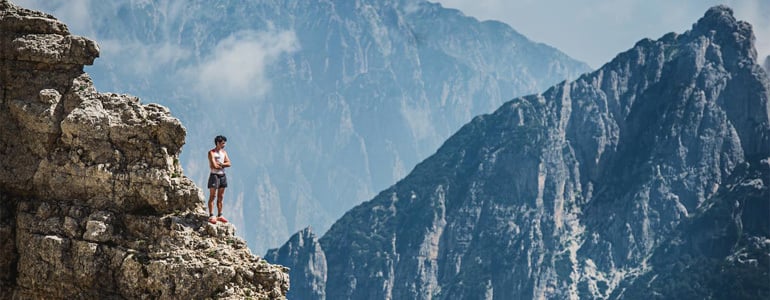

Dynamic duo crush mountain race records
Suunto ambassadors and couple Kilian Jornet and Emelie Forberg share life training, racing and living in the mountains. Now they share new records at the iconic Alaskan Mount Marathon race.
It’s one of the oldest mountain running races in the world and this year the Mount Marathon Race celebrated it’s 88th race and 100 years since it first began in 1915. Spanish and Swedish runners and couple Kilian Jornet and Emelie Forsberg were there to race and celebrate the historic event. They both won and crushed the men's and women’s records.
“It has been a new experience and I am very satisfied,” Kilian says. “This race is amazing, not only because it’s very technical but also because of the atmosphere surrounding it.”
Click here to find out how to have your running form analyzed by professional coaches for free!
© IrunFar
Kilian and Emelie were both inspired by the iconic stature of the race, it’s famous cheering crowds and the vast Alaskan wilderness. Held every year on US Independence Day (July 4) in Seward Alaska, the 5 km race route starts in the town and ascends 921 m up the steep flanks of Mount Marathon to its 1257 m summit. Runners then make a fast descent back to the town. The mountain is so steep in places runners must climb, scramble on all fours, and contend with a slippery, rocky surface as they make their way up. Both Emelie and Kilian met stiff competition during the ascent of their races. The women’s race was first and Emelie and young Alaskan running phenomenon Allie Ostrander were neck-and-neck until after the half way mark, when Emelie broke away, gaining a 50 second lead by the time she reached the summit. Once she took the lead, Emelie was unchallenged to the finish line, breaking the 25-year-old women’s record by 2m82s.
“I was really not thinking I could do such a good time,” she says. I know I have been training well, but I have also been doing some vertical kilometers and didn’t feel rested enough. So this was super cool."
Click here to read Emelie's trail running tips
Kilian also fought hard with other runners all the way to the summit, but once the descent began his downhill technical skills meant he shot ahead, leaving the competition behind him. He slowed down in the final stretch, giving high fives with fans, spinning for the cameras and still managing to break the previous men’s record by 1m07s.
They are both now preparing for their next races of the season.
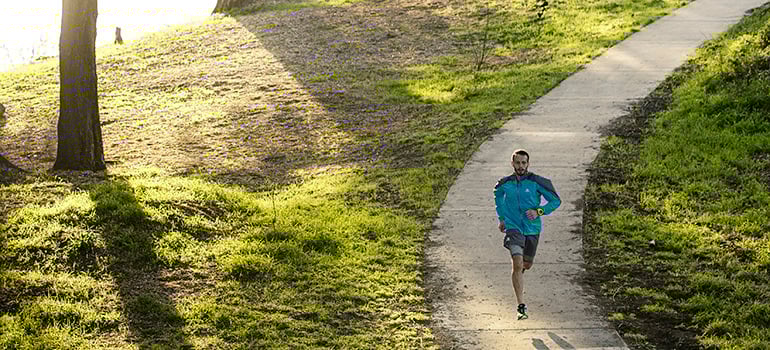

HOW TO USE AMBIT3’S RUNNING PERFORMANCE LEVEL
During a single run the running performance level has two benefits: Following the real-time difference indicator provides detailed, granular information on your daily performance and fatigue during the run. Endurance runners can use this information to learn how much fatigue seems manageable during long intensive runs. During races, this information helps you pace yourself properly.
After each run your Running performance level will be updated and you can track progress. If you are new to running or just haven't been out for a while, your running performance may be quite low at first. But as your physical fitness and running technique improve, you should see a corresponding increase in running performance.
DURING A RUN
Your Suunto Ambit3 compares your run with your current running performance level and provides real-time running performance feedback during your run. The real-time feedback is available as a graph display in Ambit3’s default Running sport mode. You can add this graph to any sport mode that uses the running activity type. The real-time difference (see below) can also be used as a data field in your custom running sport modes.
During your run, the graph display shows your four data points, as illustrated below.
1. Baseline: This is your current performance level that is calibrated to compensate for external variables such as terrain and to wait for your heart rate to stabilize. This calibration is done during the first minutes of your run.2. Real-time level: this is your real-time running performance level for the current run displayed per kilometer/mile. 3. Real-time difference: this shows you the real-time difference between the calibrated running performance baseline and your real-time running performance level for the current run. 4. Distance: total distance for the current recording. The graph shows the last six kilometers (~4 miles).
Illustrated below are three samples of Running performance levels during runs. In the first graph (1), performance is good. In the second (2), performance is bad and may indicate over training, illness, or just generally bad conditions. In the third graph (3), you see a typical long distance run where performance level drops steadily later in the run, indicate onset of fatigue.
AFTER A RUN
In the log summary at the end of your run, you get a new running performance level that is based on your last four to eight runs.
In addition, you can see your 30-day trend by pushing [Next]. The trend graph can also be viewed in Ambit3’s activity monitoring display after the first run is recorded.
Running performance around 20 is considered very low and above 60 to 70 very high. Average Running performance level for 40 to 50 year old males is around 35–40 and for females 30–35.
Over a 4–20 week period, you may see an increase in running performance level up to 20%. If your Running performance level is already good, it is difficult to improve further. In this situation, running performance level is better used as an endurance indicator.
RUNNING PERFORMANCE AND VO2MAX
Running performance level uses an estimation of your VO2max, a global standard for aerobic fitness and endurance performance. V02max indicates your body’s maximal capability to transport and utilize oxygen (ml/kg/min).
V02max is affected by the condition of your heart, lungs, circulatory system, and the ability of your muscles to utilize oxygen in energy production. VO2max is the most important single denominator of endurance performance of an athlete.
At optimum running efficiency, your Running performance level corresponds to your real VO2max (ml/kg/min).
Read more about the feature in Firstbeat’s scientific white paper:
Automated Fitness Level (VO2max) Estimation with Heart Rate and Speed Data
Read more Tutorial Tuesday articles at tutorialtuesday
Get support for your Suunto product and find user manuals at support


Mike Foote breaks the world record for most vertical skied in 24 hours
Let’s get things straight right away: there is virtually nothing pleasant about busting your legs and lungs up and down a single 1000-foot (about 300m) ski slope for 24 hours, non-stop. There might, however, be a little bit of pleasure in knowing you can do more laps on said slope than anyone in the world – a pleasure, we can assure you, that belongs wholly and solely to Mike Foote, aged 34, of nearby Missoula, Montana.
Well established in both the worlds of skimo racing and ultra-running, he was perhaps the perfect person for the challenge – he had the skill and technique on skis, and physical and mental endurance that it takes to run 100-mile races. Last summer he finished second at Hardrock 100 in Colorado.
Mike spent months training to dial in his optimum race speed – and masterminded the logistics of race day with a support crew, plenty of calories on hand to keep him going, and a little help from the mountain operations team who kept the ski slope in prime condition. To learn more, read the words below from the (probably still tired) man himself.
Mike's Suunto Spartan Ultra says it all.
So, what was your total vert for the day? What was the old record?
I did 61,200 feet (18,654m). It was 60 laps of a 1,020 ft (311m) slope. There are essentially two records of someone who completed 60,000 ft in the past. Ekkehard Dörschlag did 60,000 feet on the dot in 2009 in Austria at a 24-hour event at Bad Gastein. Then the famous ski mountaineer racer Florent Perrier did 59,893 feet in 2011 in Areche, France in the Alps. These were the two efforts that felt like the benchmark for me.
Skiing into the night. (©Matthew Irving)
When and where did you set the record?
I started at 9 am on Saturday, March 17th and went until Sunday morning at 9 am. I did it at Whitefish Mountain Resort, which is a ski area where I used to ski patrol and began uphill skiing and backcountry skiing. Conditions were variable. Quite warm and mashed-potato type snow during the day, and then frozen and slippery hard-pack at night. It made for challenging conditions for skinning, but we were able to manage it all OK.
Could you walk us through the day?
My plan for the day was quite simple. I really wanted to start conservative, but at the same time not slow down too much. I was able to get around 33,500 ft in the first 12 hours, which gave me a buffer for the latter half of the day. I worked really hard to limit any downtime. I didn’t sit down once in the 24 hours. For the most part, things went as planned. The snow froze hard at night, which made for really tricky skinning and teeth chattering descents. As a team, we worked through it and I had pacers working to keep the skin track in and not too iced up. I started the day off feeling pretty poor actually. Perhaps it was nerves, but it took me almost two hours to feel like I was getting into any sort of rhythm. Also in the middle of the night, I hit a wall and had to work really hard to keep from slowing down too much. Once the sun came up for the final 2 hours I got some energy back. For the final lap, about 15 friends joined me to celebrate and it gave me an insane boost of energy and I was able to complete one of my fastest laps of the day!
Friends’ support gave Mike an extra boost of energy. (©Matthew Irving)
When and how did you get this idea to go for the record?
I began thinking about it after racing the Hardrock 100 last summer. I enjoy long endurance events like 100 Mile running races, but ski-mountaineering races are often only in the one to two hours range. I wanted to see what I could do on skis in twenty-four hours, and this idea began to form.
How did you prepare for the record attempt?
By skiing a lot! And also by geeking out on training and metrics. I spent a lot of time going up and down steep slopes trying to get my technique and form as efficient as possible and to try and find the best ascent rates while staying in an easy aerobic effort. I knew I would need to be very comfortable going uphill for a very long time without blowing up, so I spent a lot of time finding that fine balance. My Suunto Spartan Ultra was the perfect tool for this.
After ski. (©Matthew Irving)
How would you compare a 100-mile ultra-running race, like the Hardrock, and this record ski tour?
Well, the mental grit it took to get to the end of the 24-hour attempt felt similar to a 100-mile race. There were highs and lows and everything in between as I have experience in ultras. However, this effort felt so different from something like Hardrock 100 as I was racing a clock and not another competitor. It wasn’t better or worse. Just a different kind of challenge. It was just me and a mountain and I had twenty-four hours to see how many times I could climb it. It was a very simple goal in many ways.
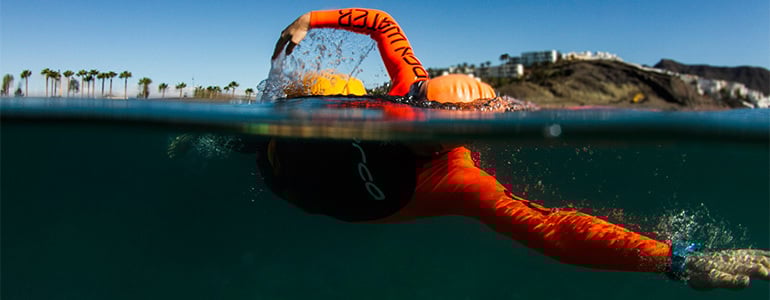

The road to Kona Ironman, Step One: Planning for Success
What does it take to train for the Ironman World Championship in Kona, Hawaii? Follow our four-part series about Suunto athlete Åsa Lundström as she prepares and find out!
For Swedish triathlete Åsa Lundström the next few weeks are everything.
Over the last month, the 30-year-old medical student and professional athlete has been preparing for the approaching Ironman World Championship in Kona, Hawaii on October 10th, 2015.
It’s the legendary Ironman that every triathlete dreams of competing in. That dream is about to become a reality for Åsa.
“Every sport has tales to tell of battles on the race course,” she says. “And with Ironman, we all hear stories of the legendary clashes of the triathlon titans at Kona.
“The best part is that we now have the opportunity to become one of those stories.”
Click here to read more about Åsa, the unlikely Swedish triathlete
Like all big projects, Åsa's road to Kona begins with the most important step: careful planning. She works closely with her professional triathlete coach, Cliff English, for this. When to intensify, where to train and when to go to Hawaii have all been planned well in advance.
Cliff updates Åsa’s training schedule week-by-week, always trying to find the right balance between the intensity and volume of her training and ensuring she gets enough recovery time.
“I’m constantly monitoring her sessions, looking at objective measurements, such as pace and power, as well as her subjective feedback on each session and on other factors including sleep quality, muscle soreness and freshness,” Cliff says.
During a normal training week, Åsa puts in between 20 and 25 hours. For Kona, that jumps to 35 hours every week. Her life becomes structured around training. In one week, she swims five or six times, cycles four or five times, runs five to six times and does strength and core training three times.
“Åsa typically trains two to three times per day,” Cliff says. “Some of the sessions are separate with a morning session then a midday session and typically a lighter active recovery session later in the day.
“I tend to prescribe one key session per day, however I also include combo sessions that include bike and run that are typically executed at race efforts.”
All this training might sound austere, like Åsa has no life, but she enjoys the process.
“When I have a big goal to work towards, it feels natural to focus on that, and to make choices adjusted to it,” Åsa says. “I don’t believe being disciplined means life cannot be fun at the same time.”
To keep things fun and to plan in a short term training goal, Åsa recently competed in the Tjörn Triathlon in Sweden and won the women’s division.
“It was a great boost,” she says, “and gave me proof that my training is going in the right direction.”
That’s important because she says it’s not always easy to tell if her build up is going well.
“When you are in a big training period, you feel tired and worn, and it’s hard to tell sometimes,” she explains. “However, when you feel tired, and you somehow manage to make the body do what you ask, then this is a good sign, especially if you were able to push yourself to a required pace or effort you didn’t think you could do.”
Åsa recently travelled to Fuerteventura in the Canary Islands to begin her final preparations. The warmer conditions are more similar to Hawaii than in Sweden, making it a good training ground.
Check out the second step, progress, of our four part series about Åsa as she continues on the road to the Ironman World Championship in Kona.


Ueli Steck in memoriam
Ueli Steck, our long-time friend and ambassador, died in a climbing accident in the Himalayas on April 30. Ueli was not just an exceptional athlete and explorer. His humble attitude and persistence to realize his dreams was an inspiration to many – us included.
Ueli Steck, 4.10.1976–30.4.2017
We were privileged to be by Ueli’s side since 2005. We saw him grow from a speed climber in the Alps to one of the best mountaineers of his time and an exceptional endurance athlete.
Ever since Ueli’s 2008 record-breaking solo speed ascent of the north face of the Eiger Ueli Steck was regarded as one of climbing’s most spectacular talents. In 2013 he was in the limelight after making an incredibly bold solo ascent of the south face of Annapurna (8,091 m) in 28 hours – a new record. The ascent won him the Piolet d’Or, one of climbing’s most prestigious awards.
“I was at the limits of my physical and mental ability. To go to such limits changes your consciousness,” Ueli said after the expedition. Climbers regard it as one of the most significant climbs in the Himalayas in a generation.
Ueli did not do things the traditional way. He wanted to climb light to be able to move fast. To him fast meant less time spent at altitude which increased safety. But Ueli was also a purist. “It’s out of the question for me to use bottled oxygen,” he said. “I either make the summit without it or I turn back, go home and train more.”
And train he did. He was preparing for his climbs like an Olympic endurance athlete. Climbing was just one part of getting faster, being better. In fact, Ueli really fell in love with trail running and believed endurance training could be the best way for him to become even better as a mountaineer: the gains he could get by training climbing were marginal compared to the gains he could get by being in the best possible shape.
When preparing for his Everest Lhotse Traverse Ueli travelled to Khumbu Valley for high-altitude training this February. He wanted to spend time and train in high altitude to be ready for his big Himalayan challenge this spring.
And he was ready. We have never seen Ueli as confident and relaxed as he was before his travel to Everest in April. He felt that he was in the shape of his life and was really looking forward to the climbs in the highest mountains of the world.
“Working with Ueli all these years has been an inspiration; his way to see the sport, his pure way to approach the mountains and his determination in his projects pushed also us to do things better. Our long talks were filled with energy and inspiration. We have not only lost an athlete, but a friend who will always be remembered,” says Joan Sola, sport and community manager at Suunto.
It was in the mountains that Ueli felt most at home. To him the north face of Eiger was as casual as a trail in the local park is for us. That is where he felt most at home.
But no matter what the route or the mountain, Steck’s inspiration remained the same. “It’s the challenge of moving on in life,” he says. “I always want to try something I have not done before.”
And that attitude of moving forward, of making progress, is what inspired us the most in Ueli. He showed us all that dreams can come true with determination and hard work.
Ueli, may your spirit forever guard others who live their dreams on the mountains. We will miss you – and your broad smile.
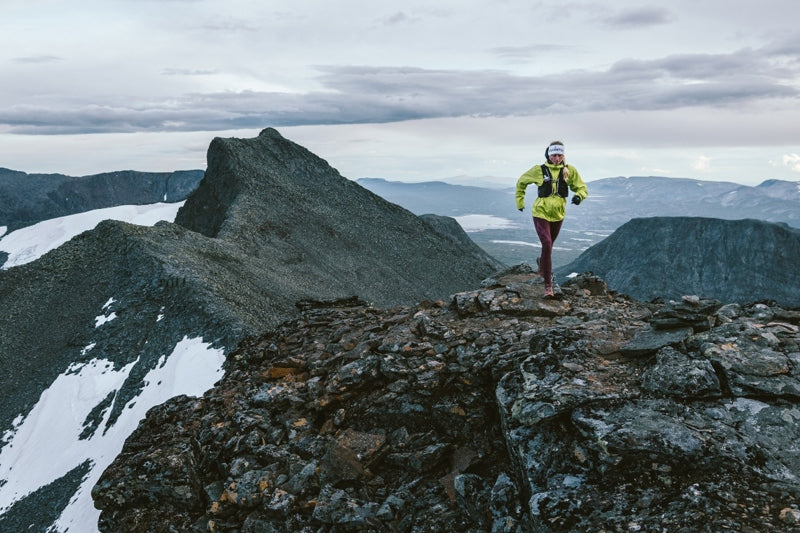

Turn it all off and come back to the present moment
Living just below the Arctic Circle in 2021 during the coronavirus pandemic Freya Orban, from southern Sweden, was missing sunshine and isolated due to social distancing restrictions.
Unable to do the things she loved — train with her cross-country skiing team, go trail running or to the gym to train — she became depressed. All the signs of stress and strain were showing, and then her dog died.
“That was the trigger for everything,” the 25 year Suunto athlete says. “Then I got shingles and couldn't get out of bed for a month.”
Piling on the pressure
At the worst low of her life, Freya started to question everything she was doing. Reflecting in this way allowed her to see what is important in her life, and what is superfluous. Like with so many competitive athletes, she used to pile too much pressure on herself. Going to races, managing her social media accounts, pleasing sponsors, pursuing academic excellence — she had become so busy and future-focused she had lost touch with the freedom and joy of running and being outdoors had always given her since she was a child. She had lost her presence. The simplicity of being in the here and now, senses open, taking in the beauty of the world.
Light at the end of the tunnel
Her journey into a dark place and into the light at the other end of the tunnel has led to massive change. She logged out of her social accounts, turned off her smartphone, stopped planning and instead focused on savoring simple presence in the outdoors and growing food in her garden. The sound of wolves howling in the distance (that’s Sweden!), the taste of wild blueberries, the feeling of wind on her face. Coming back to moment by moment experience, Freya healed herself and is now in the best place ever.
Leaving it all behind and running hut to hut
Watch the short film Presence below and follow Freya and her friend and photographer Lukas Dürnegger as they go on a fast packing hut to hut trip in the mountains of Jämtland in central Sweden. Over six days they ran 155 km with 5242 m of elevation gain. They left their smartphones at home and really tuned into the living world around them. Along the way they took time to stop a lot and ate handfuls of juicy blueberries and cloudberries.
Freya’s 3 tips to find presence
Rethink how you use social media
Freya’s approach to social media has changed. During some periods, she might sign in only once a month. And she posts only what she wants to look back on in a few years. It’s about keeping magical memories, not about sponsor-collaborations or gaining followers. Freya says being busy with screens and social media can make our senses dull and tuned out.
Pay attention to the little things
“A lot of people are caught in hamster wheels,” Freya says. “We go to work and tick off boxes on our to-do lists. But by the end of the day we can’t even remember what was happening. We rush through everything and miss things.”
To reverse this condition, Freya suggests going out into nature and opening up all the senses. “Try to use all your senses,” she says. “Not just your vision. Use your hearing, sense of smell, even taste, touch — the raindrops on your forehead. Everything you encounter out there, really try to feel it.”
Leave the tech at home
Once a week, leave all your technology at home and go out into nature for a run or a hike. Leave your earbuds, smartphone, GPS sports watch at home and be in the here and now. “Make it about being in nature and running for the joy of it,” Freya says.
All images by Lukas Dürnegger


Meet the orienteer who runs a 2h18m marathon
Thought orienteering was a strange fringe sport for runners who like map reading? Think again! The guys competing at the top are phenomenal athletes. Suunto ambassador Mårten Boström is one of them. We asked him how he does it – and why he loves a good map, especially if it’s upside down.
What’s your training involve? Whenever I'm healthy I am running around 140-170 km per week, but since my sport is not only about running, I do many other forms of training too. At the moment it adds up to 20 hours a week.
Time in the gym?I am just in the midst of a speed strength period where I go to the gym for short and fast series of squats, one leg squats and calf-lifts. Towards the end of the period I transfer the gained power to running through jumps and 7x7 second hill sprints.
How did you get into orienteering?My older siblings were practicing the sport so I followed their example at a young age and remember my first race at the age of five.
What is the appeal? The dual-task to manage finding the best route through unknown terrain while you put your body under hard physical stress.
Is it more important to be a great athlete or great navigator? The challenge is to stay focused in navigating while running as fast as you can, so both are important. Nowadays maps are so good at elite events that any small mistake in navigation will likely put you outside the podium.
And you need to be good at math right? It's continuous thinking until the finish line.
Your bio says you like making maps?
Mapmaking is both professional and fun. I'm pursuing a PhD in Geographical Information Science at the University of Helsinki, where I research methods of using LiDAR data (laser technology) for mapmaking, but I have also drawn various maps around the world. The best situation is when I can combine running and work, which I have recently done in Taita Hills, Kenya.
Why is navigating with a map and compass better than GPS? There is a place for both! Generally a GPS would show you the shortest way pointing you towards a POI, (point of interest) but with a map and compass I can find the fastest way. I do however also use GPX tracks guiding me on trail runs whenever out in unknown terrain, such as on remote islands in Thailand.
Have you always loved maps?Maps are works of art! As a kid I used to admire maps depicting far-flung places and draw fantasy maps of my own, so yes, I have always loved maps. When one learns how to read a map it's like learning a new language – and a new world of possibilities open up.
Do you have a favorite? I like maps which depict things other than purely geographical themes, like bulging countries to represent population, rather than land mass. My favorite map however would have to be "the Upside Down World Map" which challenges the cartographic rule of always having north up and Europe in the center.
Can you give x3 tips to be a better map reader? 1) Study maps of different parts of the world2) Imagine what the terrain looks like, by creating a 3D image in your mind3) Keep your thumb pointing to your location on the map always moving it along as you run further.
What are your goals for 2016?I’m aiming at reclaiming the gold at the World Champs at the sprint distance in orienteering.
MAIN IMAGE: © Matleena Boström

Lucy Bartholomew on how to almost quit... then not
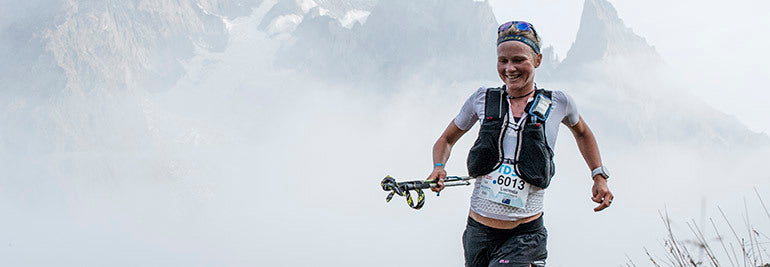
Ultra-runner Lucy Bartholomew is known for a few things: being an up-and-coming young gun on the distance scene, her constant grin, and of course, “bein’ ‘Strayan”. (That’s ‘being Australian’, in case you couldn’t figure it out.) After this year’s UTMB weekend, she’ll be known for another thing: comebacks. After contemplating a voluntary DNF just 30kms into the 120km TDS race at UTMB weekend, Lucy found a spark and picked up 25 female places, finishing the last 7km at a blazing 4:00/km pace, and taking 5th place overall for women.
“I was having some tummy issues early one in the race – and I just couldn’t get anything down. Water, food, gels – the second I brought it up to my lips I felt nauseous, and anything I forced down was just coming back up,” she says. Not long after the six A.M. start, Bartholomew was forced to walk a 15km downhill – which, as any runner can tell you, is a poor place to be losing time. “I think the extra jolting of the downhill just upset my stomach even more,” she said.
It was a shame – Bartholomew had been in Chamonix training and doing reccy for four weeks prior to the race, and she was coming off an impressive finish in the Mont Blanc 80, taking an unexpected 2nd place. The TDS route – more remote, with fewer aid stations, and more vertical per kilometer than UTMB – was to her liking. So coming off the downhill, she was going slowly and just waiting for her support – in fact, her dad who was also in the race – to catch her. “He probably would have told me to stop,” she says. What kept her going? Knowing what was coming – she’d done a proper three-day reccy before the race, giving her a solid overview of the entire course. “I think that helped – knowing what was ahead, no surprises.” And now? “Now I’m kind of glad he never drove by – it was something I needed to get through myself – and I learned a lot about myself out there.”
Nine hours into the race, she managed to get a shot block down her throat, and it stuck. “I’ve never been hit so hard by the sugar in my life,” says Bartholomew. “I think it was because I was just so empty. It really gave me a jolt and let me get back in the race.” She started passing racers, eventually roaring into town at the afore-mentioned speed, passing her last female competitor just 400 yards before the finish line.
While Bartholomew was still ‘disappointed’, the rest of us can agree: it was impressive display of resilience for the young runner. Now that it’s over, what’s in the plans? Lucy is happy to be home – and of course – more running. “It feels like I never left Australia – pretty happy to get back to my routine.” Potential upcoming races include the Ultra Trail Ning Hai in China – she’s not sure if she’ll do the 50 or the 100 – and the Capetown 100 in South Africa.
Next year, she might venture on to American soil. “I’d love to do the Hard Rock,” she says, “but I know people who have waited to get in [via lottery] for eight years!” Definitely not on the list? The Barkley Marathons or anything like it – navigation is not her game. “If it’s not on my Suunto watch, I’m not running – I’m not tough enough for that!”
Images by Damien Rosso / Droz Photo

William Trubridge reaches for another world record in freediving
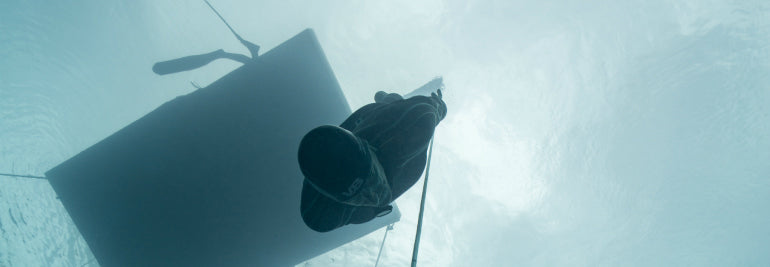
William takes the 126m depth tag on his world record attempt dive. © Johnathan Sunnex
COVID-19 kept Suunto ambassador William Trubridge isolated on Long Island in the Bahamas since March 2020 allowing him to focus exclusively on training with few distractions. After several months he started to see the benefits and his performances in many areas were the best of his career so far.
Although he is disappointed he didn't achieve a new world record, William is undeterred in his drive to continuing pushing and exploring the ultimate human limits for freediving.
Willam, what was the goal for this event?
My goal was to try and break the world record in Free Immersion, FIM (in which the athlete pulls on the rope to descend and ascend), currently at 125 m world record set in 2018 by Alexey Molchanov. I held the 124 m world record in FIM previously since 2011, but I thought it was about time I got it back!
Why now?
I came to the Bahamas in March and somewhat fortuitously have been trapped here safe in the remoteness of the island ever since, and happily, my family was able to join me in the summer from Japan.
COVID has been tough for everyone but it has meant that I have been able to focus on my training maybe more than I would have normally, having not had any courses or competitions scheduled. This has facilitated the best kind of training with no competitions looming, I've been able to maintain focus on the goal. I really felt like I was in the right place to attempt the record.
It's been four years since your last attempt, why the long pause?
Firstly, I think it is becoming more and more difficult to break world records. As with any sport, it’s not something that can continue indefinitely. There is always going to be a plateauing effect as we approach the human limits, wherever they are, and this is happening now in freediving as it has in other sports. In recent years there hasn't been much of an increase in FIM depths, and any of the disciplines of freediving as there were prior.
Also, in the last four years, I have been involved in a lot of other projects, and starting a family has been the biggest. That has involved not just a shift in day-to-day life and rhythms, but your whole perspective, and it is one of the most difficult things we go through but I have learned to take it in my stride. Now I am settled into family life, my training has been going well and my performances are the best they have ever been. I am ready to get back into it.
William ascending on the line. © Johnathan Sunnex
How are you feeling training wise?
I have done many of the deepest dives I have ever done in this discipline in recent months and also in other parameters of base training to do with breath-hold times, static apnea, and exhale static apnea (breath-hold with empty lungs) reaching the longest times I've ever done in these difficult exercises.
In terms of breath-hold and depth adaptation, I am in the best condition of my life. A world record attempt is a whole other monster so although all the signs are good, you have to deal with the mental game and the weather conditions, for which relaxing in the water with a thin wetsuit can sometimes be problematic.
What's changed in your training since your last world record?
Quite a lot has changed in my training since the last record. I am always in a constant state of development and evolution as I research and experiment with myself. I have focused on my weaker links, which are mainly breath-hold, but if any of the factors slip then you won't be able to dive deep.
Is technology or science helping with the evolution of the sport?
There is always a benefit from an increased understanding of the physiology and science of the sport.
Especially in my 17-year career, there have been huge changes. When I first started training I was feeling around in the dark a bit but now I have a more definitive, but not a complete idea. I'm sure that in the next ten years athletes will be far better equipped with an understanding of what's happening in their bodies and how to maximize that in their training. What happens in your body when freediving and what you require mentally and physically is unlike any other sport. From the dive reflex, the compression, the heart slowing, to the high acidic and lactic loads we are still discovering more efficient ways to train to maximize performance in those parameters.
Has your outlook or mindset changed in any way?
Yes, it has changed. Becoming a father has been the biggest shift. It changes your attitude toward risk, and your risk tolerance decreases. In freediving though, it has not changed so much, but in other areas like driving, and driving scooters in Indonesia in particular, it has definitely changed!
A lot of my training has been about identifying risks and accommodating them with enhanced safety mechanisms.
The turning point 126m down, with 126m more to reach the surface! Johnathan Sunnex ©
You turned 40 this year (congrats!); how does getting older affect you in this sport? And is there more risk?
It is hard to say what the effects of age on the sport are. We've seen athletes perform well into their 50s and 60s. Natalia Molcahov, before her untimely disappearance, was smashing women's world records in her 50s. It's definitely a sport where we benefit from the maturity of age and the slowing of the metabolism, but the risk lies in susceptibilities we are not aware of that increase with age, that I have been working on identifying. We need to be aware of this and prevent risks before they occur if possible.
How has the pandemic helped or hindered your preparation?
The pandemic has had a huge effect, mostly negative but some positive. I've been able to focus on training but mostly it has just been me and one other person here. However, now the record attempt team has increased and it is nice to connect and have more of a support group for training.
The biggest impact has been the uncertainty. As an athlete, with sports like freediving, you are aware of the fact that it is an expendable job, not as important socially as a Doctor and a teacher. More of a luxury in society as the arts, the sports, they are the first to go in a major fallout or crash.
Now having a family has been the main impact on me but luckily I have been able to train consistently through this period with the hope to capitalize on that.
What drives you to continue with this? Surely, you've found the human limits for apnea now?
No, we have not found the human limits, we never will. it is just a matter of stretching out the grey area of possibility and finding an approximation. We know we can go at least one or two more meters, maybe ten, twenty, who knows! It becomes more and more improbable and our job as athletes is to stretch into that zone and redefine human limits as much as we can.
How was the world record attempt dive?
Ah, 2020. Did anyone other than Jeff Bezos escape its infamy? I was hoping to end the year on a good note, by attempting a world record in Free Immersion. In training, I logged a dive to 126 m that was not just a personal best and one meter deeper than the current world record, but also one of the strongest and most enjoyable dives in this discipline of my career. Based on the strength of this dive, I announced a world record attempt for December 2020.
Then disaster hit.
The worst incident of my life. A deep underwater blackout in training was caused not by low oxygen but most likely by toxic levels of carbon dioxide. It was something that has to date been a hidden risk, lurking latent in the deepest depths of competitive freediving. I was under the water for almost 7 minutes and revived by the impeccable action of my safety team as well as a lot of luck.
William surrounded by safety divers, who in training revived him after disaster hit while deep underwater. © Johnathan Sunnex
What made you try again?
Afterward, I wasn’t even thinking about a world record. I took two weeks off and enjoyed being a father to my 20-month-old daughter. But when I tentatively returned to breath-hold and the water I found miraculously that my form had remained, or even improved. Mentally there didn’t seem to be any scars either. After consulting with my team and doctor I decided to press on with the attempts.
I built back through the depths again to the point where I was diving close to the record depth. Then 2020 threw me some more challenges: bad weather, a problem with my ear and jaw, a commercial shoot with dates that had to change and overlap with the record attempts… I was still diving strong, but not with the consistency I need in the build-up for an attempt.
When the window came for attempting the record I spent the first few days finding my feet again with dives to 118 m and 121 m. Then I decided to attempt the record on the 11th December 2020.
After such impressive results in training, what happened on your world record first attempt?
The day arrived, and so had a cold front, with low grey skies and temperatures plummeting. The wetsuit I’d been training in wasn’t enough, and after testing the waters I called the dive off, knowing that shivering would cause me to waste precious oxygen before the dive even began.
The next day was perfect. The sun makes all the difference when we’re lying stretched out on the surface of the water preparing in the final minutes before a dive. It was the right day for a record attempt, and I felt good, perhaps too good.
My time was slower, more relaxed on the way up, and this slight adjustment might have affected my efficiency negatively.
After retrieving the tag from 126 m and returning to the surface, I took two breaths then fell back momentarily in a brief surface blackout. It ended as quickly as it had begun, but the damage was done and the dive was disqualified.
How did this affect your mindset for the next attempt?
I needed to take a day off after the blackout, which meant I was left with one last day, the 14th. The cold had returned just a little, and this combined with some minor mistakes in the descent snowballed into an increasingly negative mental and physical state, until soon after the turn I felt like the dive was almost certain to end badly.
I tugged sharply three times on the rope to signal my surface crew, who released the counter ballast, pulling the rope up and giving me a free ride back to the surface.
Being pulled quickly upwards, as the weight of the water column slipped off my shoulders it was replaced by the weight of disappointment, and the knowledge that there would be no silver lining to end this year with.
What drives you to achieve deeper depths in this sport?
Regardless of the result, I have to credit my amazing support team who were faultless in running these attempts. Alex Llinas, Kevin James, and Richard McKenzie were my safety divers, Jani Valdivia was medic, Jonathan Sunnex and Michelle Lynn were taking video, Riccardo Paris was managing the platform equipment, and Chris McCay and Olga Sidorova were the AIDA judges for the attempt.
My 24/7 support team has been my incredible family, who have kept me fed, nourished, and motivated in every way. Thank you to my partner Sachiko, our beautiful daughter Mila, my mother-in-law Lily, who has put up with so many months here in the Bahamas, and to my parents and brother who have cheered me from New Zealand.
Of course, I couldn’t have even had the privilege of attempting this without the support of my sponsors, Suunto and Orca, who have been loyal to me through both the highs and lows.
What's next, William?
The hunger for training and plumbing new depths of the oceans and human aquatic potential has not weakened at all, and the day after the attempts finished I found myself drawn back to the Blue Hole for an easy training session.
Of those enticing depths, I will never tire.
All images were taken by Johnathan Sunnex ©

Emelie Forsberg’s principles for a sustainable lifestyle
Growing up in the wild forests of north-east Sweden, Suunto ambassador and mountain runner Emelie Forsberg formed a deep, enduring relationship with natural places and a desire to explore and protect them.
After recently giving birth to her second daughter, she has gradually returned to running and training, and aims to race again soon. Her other great passion in life is working with the earth and understanding natural systems.
The former sky running world champion, mother of two and avid gardener is passionate about sustainable living and minimizes her household’s environmental impacts.
“The most important thing in life is to live sustainably in all ways, in relation to myself and the goals I have, with nature, and my children,” Emelie says. “I think everything is connected. Of course the biggest concern is to take care of the planet we live on.”
With sustainability and climate change urgent topics, with grave implications for humanity, we caught up with Emelie to talk about her approach to it. Read below for her principles.
Learn about Suunto's approach to sustainability
Emelie collecting berries for the freezer to last over winter.
Follow the four ‘R’s
Emelie first learned about these 30 years ago when she was in kindergarten. Now, they are more important than ever.
The four ‘R’s are: reuse, reduce, refuse and recycle.
With 7.5 billion people on the planet and growing we need to be careful how we manage the planet’s resources. Every year Earth Overshoot Day - which marks the date when humanity’s demand for ecological resources and services in a given year exceeds what the planet can regenerate in that year - arrives earlier and earlier. In 2021, it arrived on July 29. Reusing, reducing, refusing and recycling are essential components if we are to preserve, even restore, our planet’s natural systems.
Reuse
There are so many possibilities here. For example, there are the obvious ones like taking a reusable coffee cup with you and using that on the go, or getting reusable cloth shopping bags, rather than using plastic bags. You can also reuse clothing, kitchenware and furniture by buying second hand. Glass jars, plastic containers, milk cartons and so many other household items can be repurposed and reused.
“I often think about my grandparents when it comes to reusing things because for them, and their generation in general, this was very natural,” Emelie says. “I grew up with this principle so it feels very natural to me, and I implement this with my daughters as well.”
Repair
Ok, so we know we didn’t mention this one at the outset and that’s because it’s really just another aspect of reusing - repairing items rather than tossing them out because of damage. The less we put into landfill and reuse the better. Items like shoes, clothes, furniture, sports equipment and more can, with a little skill, be repaired. In cities around the world “upcycling” - the creative reuse of discarded items in such a way as to create a new item often of higher quality or value than the original - has become a popular activity with courses showing people how to approach it. Repairing can be fun!
Reduce
“In general, I try to reduce my impact by reducing unnecessary gear, clothes and other material things,” Emelie says. Reducing can also mean choosing to drive and fly less, and cycling or walking more. It can also mean reducing how much meat and dairy we eat, given methane emitted by livestock is a more powerful greenhouse gas than C02. We can also reduce how much electricity we use by turning unnecessary lights off and shutting down our devices rather than leaving them running. Reducing can also mean buying your vegetables from a local market rather than plastic wrapped items from the supermarket.
Refuse
This one might seem touchy. But if you accept what the vast majority of climate and environmental scientists are saying and the impending disaster human civilization might face as a result of our impacts, then saying no to certain things is a logical and necessary next step. Many people, for example, have decided to stop flying. While others have decided to say no to taking short haul flights. We can also refuse to invest money in organisations that support the fossil fuel industry. In terms of everyday life, we can refuse to buy single use plastics, cheap plastic items, or vegetables packaged in plastic. There are many possibilities.
“Say no to meat, fruit and vegetables produced with a lot of pesticides, non-seasonal food and so on,” Emelie says. “The list can be huge if we want!”
Recycle
This one doesn’t need much explanation and is really the very least we should be doing. But we can get creative about what we recycle. Glass, metal containers, paper and plastic, obviously, plus clothing, batteries, electronic equipment and so much more.
Planting trees helps to capture carbon.
Run a low energy home
Emelie recommends choosing an electricity company based on renewable energy.
At night, turn off heating, lighting and your devices.
Use energy efficient light bulbs.
Take only short showers.
When you use the oven, take the opportunity to cook many things at once rather than heating it multiple times over the week.
Only use the dishwasher or washing machine for full loads.
Eat plant based, or as much as possible
The UN and multiple studies have found one of the best things we can do to stop climate change is adopt a plant based diet. Less livestock animals belching and farting methane the better. It also means less land use for grazing, and more space for forests to regrow. If going full plant based doesn’t work for you, then like our other ambassador Greg Hill and many people try being a weekday vegetarian - only eat meat on the weekend.
Eat seasonally
Eating seasonally and eating locally are two sides of the same coin. “Locavores”, like Emelie, choose to eat what is grown nearby, season to season, keeping to a minimum their “food miles” - how far their food has had to travel to arrive on their dinner plate. This means less resources are required to transport and store food. Ask yourself whether you really need to eat those strawberries in the middle of winter or whether you can wait until early summer and buy them from local producers?
Eat organic
Scientists have sounded the alarm about what they call the insect apocalypse - steep bug population declines because of stresses caused by humans. Sure, bugs can be annoying, but they play crucial roles in our ecosystems. Bees and other pollinators, for example, pollinate nearly 75% of the world’s plants that produce 90% of the world’s food.
Yet their numbers have been decreasing, and one of the reasons is the use of insecticides; nasty chemicals designed to eliminate insects that threaten crops. The problem is they kill much more than the targeted pest.
“So important to support farmers who don’t use pesticides,” Emelie says. “Pesticides destroy the living ecosystem.”
Grow your own food
“For me this is a way to connect to nature and realise how important it is that we take care of it,” Emelie says. “It also gives me so much respect for the products of organic small scale farms and farmers and their work. I would never ever let any veggies I grow in my own garden go to waste, and I bring this awareness into how I respect veggies I buy as well. I know the process of growing the food!”
If you do start your own garden, Emelie encourages growing flowers in and around it to help the bees!
Small caveat:It’s also important to point out that while all of these measures can help reduce our individual emissions and other environmental impacts, the challenge of climate change is too big to be solved by individuals alone. System change is required.

The art of cycling around the world
Nomads Pierre Bouchard and Janick Lemieux have cycled all over the world, covering an equivalent distance of four loops of the planet. In this second instalment of our three part series*, we asked them about daily life on the road. © nomadesxnomades.comCycling from Quebec to Miami in the summer of '89 was Canadian Pierre Bouchard’s first long distance tour. He calls the 4000 km journey his “L’initiation” into bicycle touring. “I came back hooked and convinced that the bicycle is the ultimate conveyance for overland journeys,” he says. “The reasons are many: the autonomy and freedom it provides, the fact it’s an environmentally sound means of transportation, it keeps one very fit, and provides a very intimate connection with our surroundings, whether landscapes, flora, fauna or humans!” Since his “L’initation”, Pierre and his partner Janick have cycled through more than 60 countries in the Americas, Europe, Asia and Oceania and Africa. They have mastered of the art of continental bicycle touring. We asked them about their daily life on the road.
Click for the first part of the series!
© nomadesxnomades.com
How has bicycle touring changed since ’89? There’s been many changes, especially the improvement of the equipment to travel on bikes. From outdoor and camping innovations to bikes specifically designed and crafted to haul all the necessities to roam continents. Lately, with the advent of fatbikes, a whole realm of wild and remote terrain has become accessible. © nomadesxnomades.comWhat does an average day on the road look like for you? Unless we're in hot deserts, we're slow risers. I usually get up first and ignite the stove to prepare hot drinks and porridge. We then start to pack up, a process that takes a couple of hours before we then hit the road. Depending on conditions and how scenic the landscape is, we cover anywhere between 40 to 120 km a day, averaging about 80 km. On expedition, taking the time to hike-trek-climb, write and immerse ourselves, we cruise about 1,000 km per month.
© nomadesxnomades.comHow much do your bikes and gear weigh? Janick carries about 25 to 30 kg and I carry between 40 and 45 kg. It fluctuates with the amount of water and goods we need to carry. We're no minimalists. As this is a form of nomadism, our way of life, we'd rather make ourselves comfortable and ready to face any eventuality.
© nomadesxnomades.comHow do you navigate and keep track of your daily efforts? On the road, our Suunto Ambit 3 Peaks play the role of dashboards and control panels. They record our daily pedal strokes and tons of useful data like altitude profiles, ambient temperature. For sketchy passages, like crossing into Ethiopia from Kenya via the Lower Omo River Valley and Turkana Lake over shifting desert tracks, we used our Ambits to navigate, having loaded them with the .gpx route a fellow bike traveller previously recorded and passed along over e-mail. With the impressive battery life, along with our Goal Zero solar power charger, we managed to keep them going for the last 600 days spent on the road, from the onset of our NOMADS² cycling odyssey.
© nomadesxnomades.comHave you ever had a problem with your bicycles in the middle nowhere? Of course! We always carry all the tools needed to open and adjust each of the components and carry crucial spare parts: tires, tubes, spokes, cables, drive train parts (chain, cassette and chain rings), brake pads. Breaking a rim is the only mechanical breakdown that can bring our caravan to a halt; we either have to walk or wait for assistance in order to move on!
© nomadesxnomades.comIs finding food and water sometimes difficult? Yes indeed! Thinking of our panniers as pantries, we always store and carry extra food. We spend a lot of time and effort getting info about the stretches of road ahead, especially with regards to availability of food and water. If we can collect water along the way we can usually last about seven to eight days without resupplying. If we need to carry our water, up to 30 litres between the two of us, we can last out there some three to four days – unless we’re in Sudan during July and both need to drink 10-12 litres a day!
© nomadesxnomades.comAny advice for someone doing his or her first bicycle tour? Make sure your bike is well adjusted to your body (seat, handlebars and seat post). Prioritize simplicity, sturdiness and durability. Don't hesitate to invest in high-quality carrier racks, generally made out of steel (chromoly). And most importantly, planning is great but set a departure date and ready or not, go – it'll all work out! Trust the road! *Stay tuned for our third instalment about the Nomads, and find out which countries in the world are the most cycling-friendly!
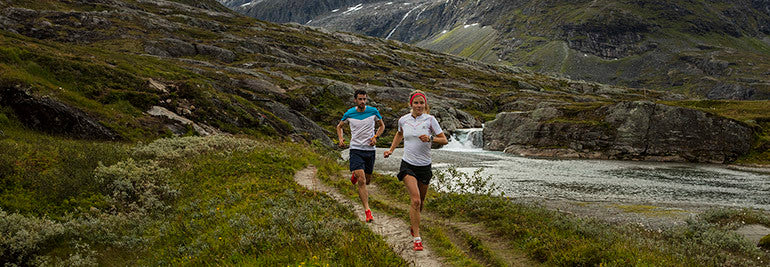

Five tips for multisport couples
According to USA Triathlon’s “The Mind of a Triathlete 2009 Study” nearly 62 percent of all triathletes are married and 11 percent consider themselves to be in a committed relationship. As you may know, training for an IRONMAN can be a very selfish task, especially if you are trying to punch that ticket to the IRONMAN World Championship. If you are married or married with kids—how do you manage your time with your spouse and your family? What if you both are IRONMAN triathletes craving to punch that ticket to the World Championship or Age Group Nationals?
This is a situation I am familiar with. My husband, Chris, and I each trained for and qualified for Kona at the 2017 IRONMAN Mont Tremblant. With these goals of ours came an important balancing act of how we worked together, trained separately, and supported one another through both our qualifying races and in Hawaii.
As we enter the new year and start setting our racing goals for next season, now would be a good time to talk with your partner to plan for next year and to really make sure that you head into the racing season on the same page. Whether you are both athletes or just one of you is, the point of this discussion should be to make sure both of you have a say in scheduling so no one ends up feeling shortchanged or underappreciated.
Here are five tips for how to optimize your training with your partner so you can each get the support, cameraderie—and sometimes space—that you need to fulfill your racing goals:
1. Organize your work schedule and triathlon training schedule.
The most important task to remember with each other is to understand your partner’s work schedule and training schedule. And if they aren’t in training, factor in the time they spend away from work that is important to them so it doesn’t get left out of the schedule.
A good tool is to use a paper calendar or a calendar app and start plugging in what is crucial for each of your lives. Work is work. Plug that in. Kids have events. Plug it in. Start plugging in each other’s workouts and learn to respect each other’s time for training.
Maybe one triathlete is better at working out in the morning than another, so factor that in to how you will both get those sessions in. Be honest with yourself and with each other so you aren’t signing up for a regular morning swim session that you probably won’t make it to half the time, especially if your partner could use that time for his or her own session.
Tip: Head to Google Calendar and plug in your week on a shared calendar, so you can figure out where you can get your workouts done. Maybe a date night is heading to the pool together and then going out to dinner. Make it fun!
2. Organize your workouts so you can do (some of) them together.
The joys of working out together can be fun, but it can also be a challenge. Maybe one athlete is faster than another or one can lift more than another. Make sure none of your training turns into an “ego fest” with your partner—unless you can do that in a constructive manner!
The biggest takeaway of this is to learn how to do your workouts together, so you can be together. You don’t have to always do the same workout together but at least you can start together or maybe end up at the same post-ride coffee shop.
Sometimes it can be enough to just take the time to drive together to the gym or the pool, even if once you’re there you focus on your own pace and workout goals.
Tip: Try this fun workout in the pool: “10 x 100 Rabbit Chase.” The faster swimmer takes off at the top of the clock. The partner gives them a five-second lead and tries to catch the faster swimmer. Or you can flip flop that. The slower swimmer takes off at the top of the clock. The partner gives them a 10-second lead and tries to catch the slower swimmer.
3. Find a race to do together and make a “race-cation” out of it.
When planning your triathlon racing calendar, you always want to talk with your spouse about what would be an ideal place for you to race both logistically and financially. IRONMAN Hawaii would be the top of the list for a lot of triathlon couples, but remember you have to head to another IRONMAN to get that spot in Hawaii.
Are you celebrating your 20th wedding anniversary? Maybe you head to IRONMAN Australia. Are you trying to save money and you want to drive to an IRONMAN? Maybe you drive to IRONMAN Lake Placid, IRONMAN Wisconsin or IRONMAN Florida (depending on where you live).
When you choose one or two “A” races for the year, consider there location beyond just race day. Are you able to make a “race-cation” out of it? Can you travel to Orlando with the kids after IRONMAN Florida? Can you head to Glacier National Park after IRONMAN Canada?
Tip: Head to the the Convention Visitors and Bureau to find out what you can do beyond your race, and if you have kids, include them in the conversation as well so they will be more supportive of your training and excited for your racing.
4. Find the balance: One races, one is a Sherpa.
When planning your next season, sometimes you both cannot race due to work, family or life.
As the triathlete not racing, it can be difficult to stand on the sidelines, but remember, you have been the one on the start line before and you know what it takes to prepare and get ready for this race.
Your race is to be the best Sherpa your partner needs you to be. Every once in a while head to a workout with them, ride the trainer next to them or meet them on the trails with the kids and hike while they do their long run.
Tip: Suffer in the Pain Cave together. Set the bike trainer up side by side. Watch an hour show, but don’t skip through the commercials. Once the commercial starts, do your interval work. Commercials can go from between three and five minutes, so pick an interval that you can hold within that hour, as you will probably end up doing four rounds of it. Your spouse will be suffering with you, which will make everything better!
5. Find time away of the swim, bike and run.
As endurance athletes, we can get consumed with our workouts, nutrition, the mind set, sleep, etc., but we also have to remember why we said “I do.” Maybe you were athletes when you met. Maybe one of you became a triathlete after you had children.
When you said “I do,” it was for “better or worse” and not “From Sprint triathlon to IRONMAN.” Your union goes beyond the swim, the bike and the run. You need to remember to hold on tight to each other through both of your athletic and non-athletic journeys, and continue to support each other through injuries, burnouts and amazing race results.
Your real race in life is continuing to be a part of the 63 percent in the USA Triathlon 2009 Study. Don’t forget that. And know that it will take work!
Tip: Find something that you love to do together outside the swim, bike and run. Get a regular sitter. Go to a concert. Go for a hike. Go for a cup of coffee and talk.
Living the life as an Endurance Athlete Couple definitely has its perks, but just like anything else, it is something that you have to work together on. Let me tell you this, it was pretty amazing seeing my husband out on the Queen K on his bike racing at the same time I was competing in my first IRONMAN World Championship. The journey to Kona was pretty amazing, but having my husband with me along the way was the cherry on top of that ice cream sundae!
This article by triathlon coach Jen Rulon was originally published on trainingpeaks.com.
TrainingPeaks provides you in-depth analysis, planning tools and coaching services to help you reach your goal. Track your workouts with your Suunto watch. Afterwards analyze your heart rate, power, pace and other data with TrainingPeaks on web or in mobile and progress towards your goals.


