


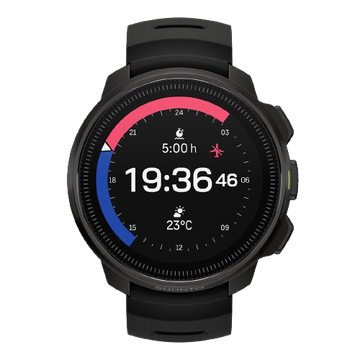


Suunto Run and Suunto Run 2 are both lightweight running watches, built for everyday training, structured sessions and race day. Run 2 keeps the same focused design and adds a 2,000-nit AMOLED display, around 10 days of battery life, offline maps, new-generation GPS and wrist heart rate tracking, and EnergySense for real-time guidance on how long your current effort will last.
Here is what changed from Suunto Run to Run 2, and what each difference means on the run.
Table of Contents
Suunto Run vs Run 2: Key differences at a glance
| Feature | Suunto Run | Suunto Run 2 |
|---|---|---|
| Display | 1.32" AMOLED, 600 nits | 1.32" AMOLED, up to 2,000 nits |
| Size | 46 × 46 × 11.5 mm | 46 × 46 × 11.7 mm |
| Case weight | 32 g | 35 g |
| Battery capacity | 295 mAh | 380 mAh |
| Daily use with 1 h outdoor exercise/day | Up to 8 days | Up to 10 days |
| High-performance GPS | Up to 20 hours | Up to 24 hours |
| Storage | 4 GB | 4 GB or 64 GB |
| Offline music | Yes | Yes |
| Offline maps | No | Yes |
| GPS & wrist heart rate | — | Updated |
| EnergySense | No | Yes |
On the wrist, Run 2 is almost identical to Run: the same 46 × 46 mm case, just 0.2 mm thicker, with a 35 g watch body. The real changes are in the display, battery, navigation, tracking and in-run guidance.
1. A brighter AMOLED display
Both watches use a 1.32-inch AMOLED display, and Run 2 raises brightness from 600 to 2,000 nits.
You will notice it most in bright sunlight, when a quick glance needs to show your pace, heart rate, distance or next interval clearly.
And because the screen size is unchanged, the watch stays just as compact on your wrist.
2. Longer battery life
Run 2 moves from 295 mAh to 380 mAh, which works out to 29 percent more battery capacity.
| Battery | Suunto Run | Suunto Run 2 |
|---|---|---|
| Daily use with 1 h outdoor exercise/day | Up to 8 days | Up to 10 days |
| High-performance GPS | Up to 20 h | Up to 24 h |
In daily use with an hour of outdoor training a day, that takes you from around 8 days to around 10 days, and high-performance GPS recording rises from 20 to 24 hours. That is enough to cover a full training week on one charge, with extra margin for long runs and race day.
3. More storage and offline maps
Suunto Run comes with 4 GB of storage for offline music.
Run 2 comes in 4 GB and 64 GB versions. If you want to carry a large music library alongside your downloaded maps, the 64 GB version gives you far more room.
The bigger upgrade is offline maps. Download maps of your area to Run 2 before you head out, and you can see the roads, trails and terrain around you right on your wrist, even on a route you have never run. Suunto offline maps are free and available worldwide.
That opens up running beyond the road. If you want to try trail running or explore new routes, Run 2 is ready for it, so one watch covers your everyday runs, your long runs and your weekend exploring.
Both watches also play offline music through Bluetooth headphones, so you can leave your phone at home.

4. Updated GPS and wrist heart rate tracking
Run 2 moves to new-generation dual-band GPS (L1 + L5) across five satellite systems: GPS, GLONASS, Galileo, BeiDou and QZSS. Your recorded track sits closer to your actual route, giving you pace and distance you can trust.
Heart rate comes from a 12-channel optical sensor behind 2.5D curved sensor glass, giving you a steadier read on training intensity and a more reliable foundation for your training load and recovery data.
You will feel the difference most in sessions where effort changes quickly, like intervals, progression runs and races.
5. EnergySense adds real-time endurance guidance
Both watches include marathon-focused tools such as Marathon Mode and Ghost Runner to help you train and race to your pace targets.
Run 2 adds EnergySense. Pace tells you how fast you are running and heart rate tells you how hard you are working. EnergySense tells you how long you can keep it up.
As you run, it estimates your remaining endurance in real time and shows how your current intensity is drawing it down.
It works with three key metrics:
- Endurance: A live estimate of how much endurance you have left.
- Sustain: With a distance target set, how much farther you could go at your current intensity.
- Remaining: How much distance is left to reach your target.
Together, they put your pace in context.

Say you are 30 km into a marathon and your pace feels good. If Sustain is comfortably ahead of Remaining, you have the margin to hold or even push. If the two start to close, it is time to ease off before the final kilometers cost you.
You can also run EnergySense with no distance target set. It tracks your intensity and remaining endurance throughout, which makes it just as useful on long runs and in training as it is on race day.
EnergySense launches on Run 2 as a beta feature and will keep improving through future updates.
Suunto Run or Run 2?
Both watches share the same lightweight, running-first foundation. Suunto Run covers the essentials of everyday training and race preparation. Run 2 is built for your next breakthrough, with a 2,000-nit display, around 10 days of battery life, offline maps, new-generation GPS and heart rate tracking, and EnergySense. If you want more navigation, more battery margin and real-time guidance when it counts, Run 2 is the one to choose.


